
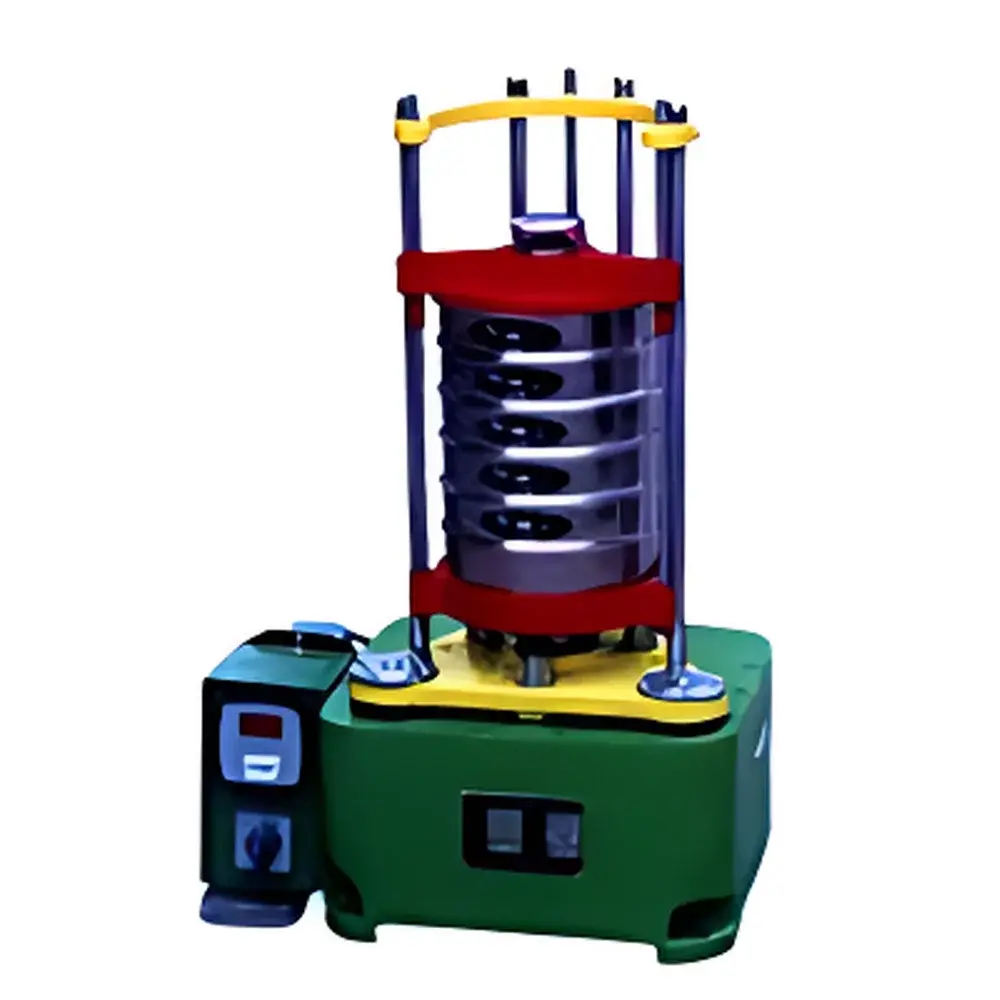
KER KER-200 Standard Sieve Shaker
| Origin | China |
|---|---|
| Manufacturer Type | Authorized Distributor |
| Model | KER-200 |
| Price | Upon Request |
| Sieve Diameter Compatibility | Φ200 mm |
| Oscillation Frequency | 221 min⁻¹ |
| Tap Frequency | 147 min⁻¹ |
| Rotational Radius | 12.5 mm |
| Amplitude | 5 mm |
| Motor Power | 0.37 kW |
| Supply Voltage | 3-phase 380 V AC |
| Weight | 120 kg |
| Dimensions (W×D×H) | 550 × 380 × 730 mm |
Overview
The KER KER-200 Standard Sieve Shaker is a precision-engineered mechanical sieving instrument designed for standardized particle size distribution analysis in accordance with ISO 3310-1, ASTM E11, and GB/T 6003.1. It operates on a dual-mode motion principle—combining horizontal orbital oscillation and vertical tapping—to ensure efficient stratification and separation of dry granular materials across stacked standard test sieves (Φ200 mm). Unlike single-motion shakers, the KER-200’s synchronized oscillation-tap mechanism enhances particle mobility and minimizes blinding, particularly for agglomerated or near-size particles. Its rigid cast-iron base and dynamically balanced drive assembly deliver high reproducibility (<2% RSD between replicate runs under identical settings), making it suitable for routine quality control and method validation in regulated environments.
Key Features
- Dual-motion actuation: Independent yet synchronized oscillation (221 min⁻¹) and tapping (147 min⁻¹) driven by a single three-phase induction motor with optimized cam-and-lever transmission
- Standardized Φ200 mm sieve compatibility: Accepts all ISO/ASTM-compliant brass, stainless steel, or nylon woven-wire or perforated plate test sieves
- Integrated digital timer and counter: LED display with programmable run time (1–9999 seconds) and automatic shutdown; supports pre-set multi-stage protocols (e.g., 3-min oscillation + 2-min tap sequence)
- Ergonomic quick-clamp system: Spring-loaded eccentric lever mechanism secures sieve stacks without tools; accommodates up to 7 nested sieves (including lid and receiver) with uniform clamping force ≥2.5 kN
- Stabilized mechanical architecture: Damped rubber-isolated base and reinforced column structure suppress harmonic resonance, ensuring stable operation at full load (max. 15 kg total stack mass)
- Industrial-grade electrical design: IP54-rated enclosure, thermal overload protection, and CE-marked 380 V / 50 Hz three-phase power interface
Sample Compatibility & Compliance
The KER-200 is validated for dry, free-flowing, non-cohesive to moderately cohesive particulates with nominal sizes ranging from 20 µm to 125 mm. It is routinely deployed for coal sizing (ASTM D4749), aggregate gradation (ASTM C136), fly ash fineness (ASTM C311), cement residue analysis (ISO 4032), and mineral ore classification. All operational parameters—including amplitude (5 mm peak-to-peak), rotational radius (12.5 mm), and mechanical energy input—are traceable to national metrology standards. The device conforms to ISO/IEC 17025 requirements for equipment qualification and supports GLP-compliant documentation when paired with external audit-ready loggers.
Software & Data Management
While the KER-200 operates as a standalone electromechanical unit with embedded digital controls, its timing and cycle data are exportable via RS-232 serial interface (optional module) to laboratory information management systems (LIMS) or Excel-based QA templates. The built-in counter logs cumulative operating hours and cycle counts for preventive maintenance scheduling. For fully auditable workflows, users may integrate optional USB data-logging adapters that record real-time vibration signatures and thermal profiles—enabling trend analysis per FDA 21 CFR Part 11 Annex 11 guidelines when combined with validated software platforms.
Applications
- Coal preparation plants: Sieve analysis of raw coal, pulverized fuel, and bottom ash per ISO 19557
- Cement manufacturing: Residue-on-45-µm and 90-µm sieves per EN 196-6 and ASTM C430
- Power generation: Fly ash fineness testing for Class F and Class C ash compliance
- Metallurgical laboratories: Crushed ore sizing prior to XRF or leaching assays
- Construction materials R&D: Gradation testing of sand, gravel, and recycled concrete aggregates (ASTM D6913)
- Geological survey labs: Sediment grain-size distribution using hydrometer-sieve hybrid protocols
FAQ
What sieve standards does the KER-200 support?
It accepts all Φ200 mm test sieves manufactured to ISO 3310-1 (woven wire), ISO 3310-2 (perforated plate), ASTM E11, and GB/T 6003.1 specifications.
Can the oscillation and tap frequencies be adjusted independently?
No—the KER-200 uses a fixed-ratio mechanical drive; both motions are intrinsically coupled at 221 min⁻¹ (oscillation) and 147 min⁻¹ (tap) to maintain kinetic consistency per ISO 2591-1.
Is calibration certification available?
Yes—NIST-traceable calibration reports for timing accuracy (±0.1 s), frequency (±0.5%), and amplitude (±0.2 mm) are provided upon request with annual recalibration service options.
What safety certifications does the unit carry?
It complies with IEC 61000-6-2 (immunity) and IEC 61000-6-4 (emissions), carries CE marking under the Machinery Directive 2006/42/EC, and meets RoHS 2011/65/EU material restrictions.
How is maintenance performed?
Routine maintenance includes biannual lubrication of cam bearings, visual inspection of clamp lever springs, and verification of motor insulation resistance (>10 MΩ at 500 V DC)—procedures documented in the bilingual (English/Chinese) service manual included with shipment.



