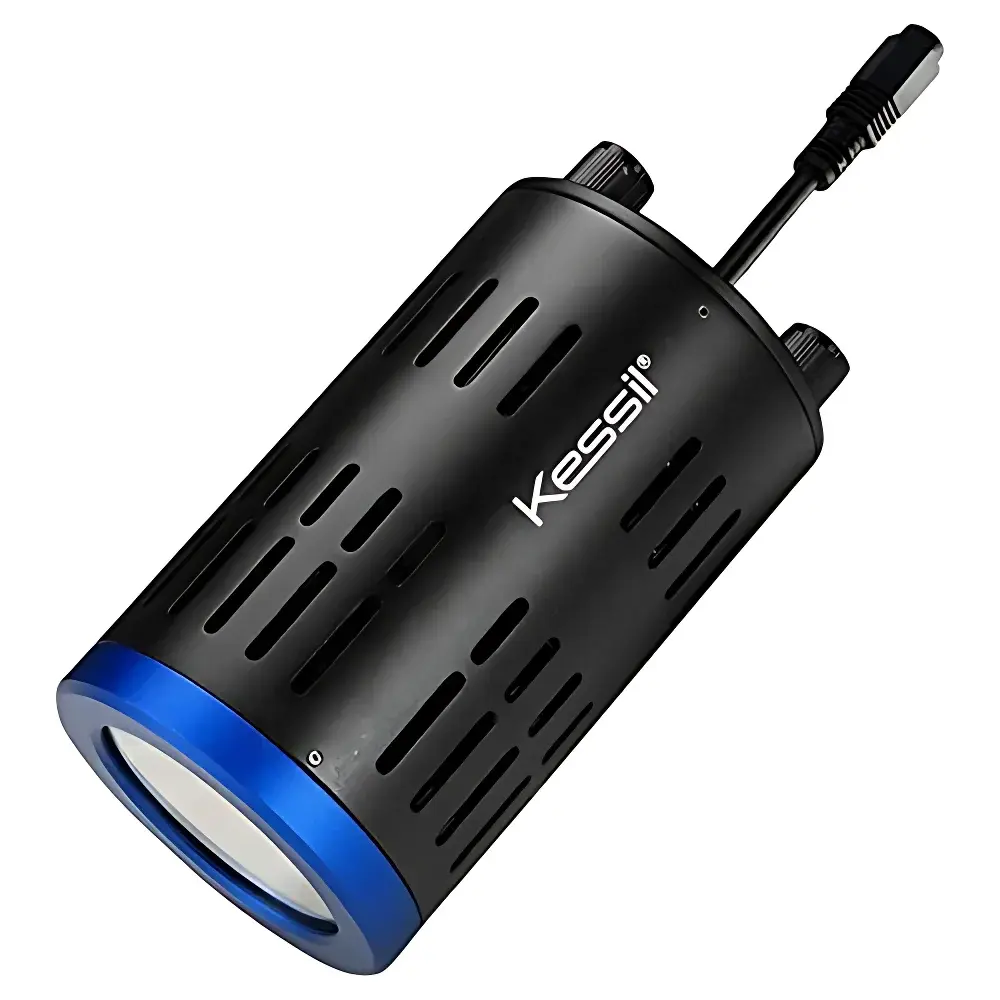
Kessil A160WE Advanced Photocatalytic LED Light Source
| Origin | USA |
|---|---|
| Manufacturer Type | Authorized Distributor |
| Origin Category | Imported |
| Model | A160WE |
| Price | Upon Request |
Overview
The Kessil A160WE is a high-precision, research-grade photocatalytic LED light source engineered for reproducible, wavelength-controlled photochemical synthesis in academic and industrial organic laboratories. Unlike conventional broad-spectrum lamps or filtered arc sources, the A160WE leverages Kessil’s proprietary Dense Matrix LED™ architecture—integrating multiple high-power LED chips into a single compact optical array—to deliver spatially uniform irradiance with exceptional depth penetration and minimal thermal load. Its core operating principle relies on solid-state monochromatic (or quasi-monochromatic) photon emission optimized for activation of common photoredox catalysts (e.g., Ir(ppy)₃, Ru(bpy)₃²⁺, 4CzIPN) and direct substrate excitation across the near-UV to blue spectral region (370–467 nm). Designed specifically for benchtop photochemistry workflows—including flow reactors, parallel vial arrays, and custom-built photoreactors—the A160WE enables rigorous control over photon flux density (irradiance), spectral profile, and temporal delivery—key parameters required for kinetic studies, quantum yield determination, and scalable reaction optimization under GLP-compliant conditions.
Key Features
- Dense Matrix LED™ optical engine delivering homogeneous irradiance across a 24 mm effective emission diameter—eliminating hot spots and enabling quantitative irradiation of multi-vial reaction setups
- Four-step intensity modulation (0–100%) with <±3% output stability at each setting, supporting dose-response studies and reaction scalability
- Fixed-wavelength configuration (model-specific; e.g., 390 nm, 427 nm, 440 nm, 456 nm, or 467 nm) with peak wavelength tolerance ≤ ±1 nm and spectral FWHM < 15 nm
- Compact form factor (114 mm H × 63 mm D) and low thermal signature (<40°C surface temperature at steady state), permitting integration into confined reactor enclosures and glovebox environments
- Universal AC input (100–240 V, 50/60 Hz) with regulated 19–24 V DC output and 40 W nominal power consumption—compatible with standard laboratory power distribution systems
- Robust aluminum housing with IP20-rated enclosure, designed for continuous operation in controlled ambient environments (0–40°C, non-condensing)
Sample Compatibility & Compliance
The A160WE is compatible with standard photochemical reaction vessels including 1–20 mL glass vials, quartz cuvettes, microreactors, and jacketed batch reactors. Its narrow angular emission profile (56° full width at half maximum) and collimated output facilitate precise coupling to fiber-optic adapters, liquid light guides, and custom optical manifolds. The device complies with IEC 61000-6-3 (EMC emissions) and IEC 61000-6-1 (immunity) standards. While not certified for medical or explosive atmospheres, its low-voltage DC operation and absence of ozone-generating UV-C emission render it suitable for routine use in ISO 17025-accredited analytical labs and FDA-regulated R&D facilities conducting early-phase process development per ICH Q5C and Q8(R2) guidelines.
Software & Data Management
The A160WE operates as a standalone analog-controlled instrument with no embedded firmware or digital interface. Intensity adjustment is performed via front-panel rotary encoder with tactile feedback and LED status indicators. For traceable experimental documentation, users are advised to log settings manually or integrate the unit into external control systems using 0–10 V analog input (optional accessory). All operational parameters—including wavelength, intensity level, exposure duration, and ambient temperature—are fully recordable within electronic lab notebooks (ELNs) compliant with 21 CFR Part 11 requirements when paired with audit-trail-enabled software platforms (e.g., LabArchives, Benchling, or IDBS E-WorkBook).
Applications
- Photoredox-catalyzed C–C and C–heteroatom bond formation (e.g., α-alkylation of aldehydes, aryl amination)
- Energy-transfer-mediated [2+2] cycloadditions and dihydroazulene photoisomerizations
- Photoinduced electron transfer (PET) reactions in natural product synthesis
- High-throughput catalyst screening under standardized irradiance conditions
- Quantitative actinometry using ferrioxalate or potassium iodide/iodate chemical actinometers
- Development of visible-light-driven asymmetric catalysis protocols requiring strict wavelength fidelity
FAQ
Is the A160WE compatible with standard laboratory power outlets worldwide?
Yes—it accepts universal 100–240 V AC input with auto-ranging capability and includes interchangeable IEC C14 inlet cables for North American, European, UK, and Australian sockets.
Can multiple A160WE units be synchronized for parallel irradiation experiments?
While the A160WE lacks built-in synchronization circuitry, identical units operated at the same intensity setting exhibit <±0.5% inter-unit irradiance variation when calibrated with a NIST-traceable photodiode sensor.
Does Kessil provide spectral irradiance calibration certificates?
Calibration reports (including spectral power distribution and irradiance at 1 cm distance) are available upon request and may be issued with NIST-traceable reference instrumentation per ISO/IEC 17025 requirements.
What safety precautions are recommended during operation?
Users must wear ANSI Z87.1-compliant UV/blue-light-blocking safety goggles when operating the lamp at close range; skin exposure to direct beam should be minimized per ACGIH TLV® guidelines for optical radiation.
Is the A160WE suitable for long-term continuous operation?
Yes—the thermal management system supports uninterrupted operation for >10,000 hours MTBF under ambient temperatures ≤35°C and adequate airflow.
Related Products