
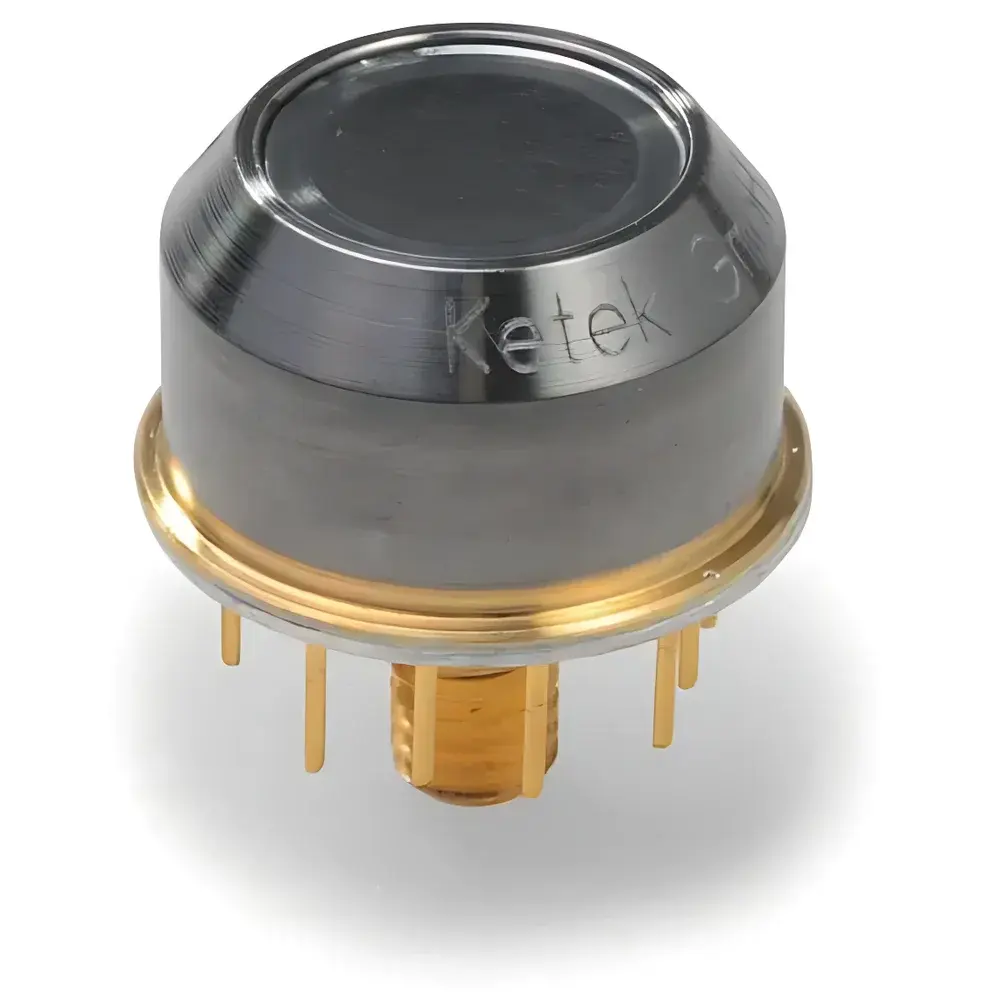
KETEK VITUS Series Silicon Drift Detector (SDD)
| Brand | KETEK |
|---|---|
| Origin | Germany |
| Model | VITUS Series |
| Energy Resolution (FWHM @ 1 µs peaking time, Cube Class) | 129 eV (H7–H50), 136 eV (H80/R100), 133–136 eV (LE variants) |
| Peak-to-Background Ratio (P/B) | >15,000 (Cube Class H7–H50), >10,000 (H80), >400 (R100), >10,000 (LE variants) |
| Peak-to-Tail Ratio (P/T) | >2,000 (Cube Class), >1,000 (Standard Class) |
| Active Si Thickness | 450 µm |
| Maximum Count Rate | 1,000 kcps |
| Beryllium Window | 8 µm (standard), 12.5 µm (H50), 25 µm (H80/R100), AP3.3 low-energy polymer (H7LE/H18LE) |
| Cooling Performance | ΔT > 75 K (Cube/Premium), ΔT > 55 K (LE variants) |
| Operating Heat Sink Temperature | ≤30 °C |
Overview
The KETEK VITUS Series Silicon Drift Detector (SDD) is a high-performance X-ray detection module engineered for demanding energy-dispersive X-ray spectroscopy (EDS) applications in scanning electron microscopy (SEM), transmission electron microscopy (TEM), micro-X-ray fluorescence (µ-XRF), and synchrotron beamline instrumentation. Built upon KETEK’s proprietary monolithic silicon drift architecture, the VITUS detector delivers exceptional spectral fidelity through optimized charge collection efficiency, ultra-low electronic noise, and precise temperature stabilization. Its core operating principle relies on lateral drift of photo-generated electrons under a controlled electric field toward a small, low-capacitance anode—enabling high count rate capability without significant resolution degradation. This architecture inherently supports fast pulse processing (<1 µs peaking time), making it suitable for quantitative elemental mapping at high beam currents and rapid stage scanning protocols required in industrial QA/QC and advanced materials research.
Key Features
- Two-tier performance classification: Cube Class (highest resolution & P/B) and Standard Class (optimized cost-performance balance), both fully compatible with industry-standard EDS electronics and vacuum interfaces.
- Active areas spanning 7–92 mm² (H7 to R100), enabling flexible trade-offs between solid angle coverage, spatial resolution, and count rate scalability.
- Multi-layer beryllium windows (8–25 µm) and optional AP3.3 polymer windows for enhanced low-energy sensitivity down to boron (B-Kα, 183 eV) and carbon (C-Kα, 277 eV).
- Integrated Peltier cooling with guaranteed ΔT > 75 K below ambient (Cube/Premium) or ΔT > 55 K (LE variants), ensuring stable operation at heat sink temperatures ≤30 °C without liquid nitrogen or external chillers.
- Guaranteed energy resolution: ≤129 eV FWHM at Mn-Kα (5.895 keV) with 1 µs peaking time (Cube Class); ≤136 eV for larger-area models; ≤133 eV for low-energy configurations.
- High peak-to-background (>15,000) and peak-to-tail (>2,000) ratios—critical for trace element detection and accurate deconvolution of overlapping peaks in complex matrices (e.g., geological samples, battery cathodes, catalysts).
- Robust mechanical design compliant with UHV (≤1×10⁻⁹ mbar) and high-vibration environments; all models feature standardized CF-35 or CF-63 flange mounting and integrated preamplifier housing.
Sample Compatibility & Compliance
VITUS detectors are routinely deployed in regulated analytical workflows requiring traceable performance validation. They comply with the physical interface and signal integrity requirements of ASTM E1508 (Standard Guide for Quantitative Analysis by Energy-Dispersive Spectrometry), ISO 22309 (Electron probe microanalysis — Quantitative analysis), and IEC 62230 (X-ray equipment — Safety requirements). When integrated into GLP/GMP-compliant SEM-EDS platforms, the detector’s stable calibration drift (<0.5 eV/week under controlled thermal conditions) and reproducible resolution metrics support audit-ready documentation. The absence of moving parts, sealed detector chamber, and radiation-hardened Si substrate ensure long-term reliability in continuous-operation facilities—including national labs, semiconductor metrology centers, and pharmaceutical excipient characterization suites.
Software & Data Management
KETEK provides full firmware and configuration support via the open KETEK Control Interface (KCI), a vendor-neutral API compatible with third-party acquisition software (e.g., Thermo Scientific™ Pathfinder, Bruker ESPRIT™, EDAX TEAM™). Raw pulse height data is delivered in standard IEEE 754 floating-point format with embedded timestamping and dead-time correction flags. All VITUS models support real-time spectrum streaming over GigE Vision or Camera Link HS, enabling synchronized acquisition with stage position metadata for hyperspectral mapping. For regulatory environments, optional firmware modules provide 21 CFR Part 11–compliant audit trails, user access control, and electronic signature logging—fully integrated with laboratory information management systems (LIMS) via OPC UA or RESTful webhooks.
Applications
- High-speed elemental mapping of battery electrode cross-sections (Ni, Co, Mn, O, F) with sub-100 nm spatial resolution in STEM mode.
- Quantitative phase analysis of multiphase metal alloys (Al-Si-Cu-Mg) under variable kV acceleration, leveraging high P/B for accurate Mg/Kα–Al/Kβ separation.
- In situ µ-XRF monitoring of catalyst sintering dynamics during thermal ramping, enabled by 1,000 kcps throughput and <50% dead time at 100 kcps.
- Low-Z analysis of polymer additives (Cl, S, Ca) in packaging films using H7LE/H18LE configurations with AP3.3 windows and optimized low-noise shaping.
- Space-qualified derivative variants used in planetary rovers (e.g., Mars 2020 Perseverance PIXL instrument heritage) due to radiation tolerance and passive thermal stability.
FAQ
What vacuum compatibility level do VITUS detectors support?
All standard VITUS models are rated for continuous operation in ultra-high vacuum environments down to 1×10⁻⁹ mbar, with CF-35/CF-63 metal-sealed flanges and bakeable components up to 150 °C.
Is energy calibration traceable to NIST standards?
Yes—each detector ships with a factory calibration certificate referencing Mn-Kα, Cu-Kα, and Co-Kα lines, with uncertainty budgets aligned to NIST SRM 1261 (X-ray line energies) and ISO/IEC 17025–accredited procedures.
Can VITUS detectors be retrofitted into legacy EDS systems?
KETEK offers mechanical and electrical adapter kits for major OEM platforms (JEOL, Zeiss, Hitachi, FEI/Thermo Fisher); compatibility requires verification of DAQ bandwidth (>200 MHz sampling) and digital trigger latency (<100 ns).
How is detector aging monitored in long-term deployments?
KETEK’s KCI firmware includes built-in diagnostics for leakage current trending, resolution drift tracking, and window transmission loss estimation—exportable as CSV for predictive maintenance scheduling.
Are LE (low-energy) variants suitable for air-path XRF?
No—AP3.3 windows require vacuum or He-purged paths; for atmospheric XRF, only Be-windowed models (H7–R100) are recommended, with minimum detectable limits for Na-Kα (~1.04 keV) achievable at optimal geometry.





