
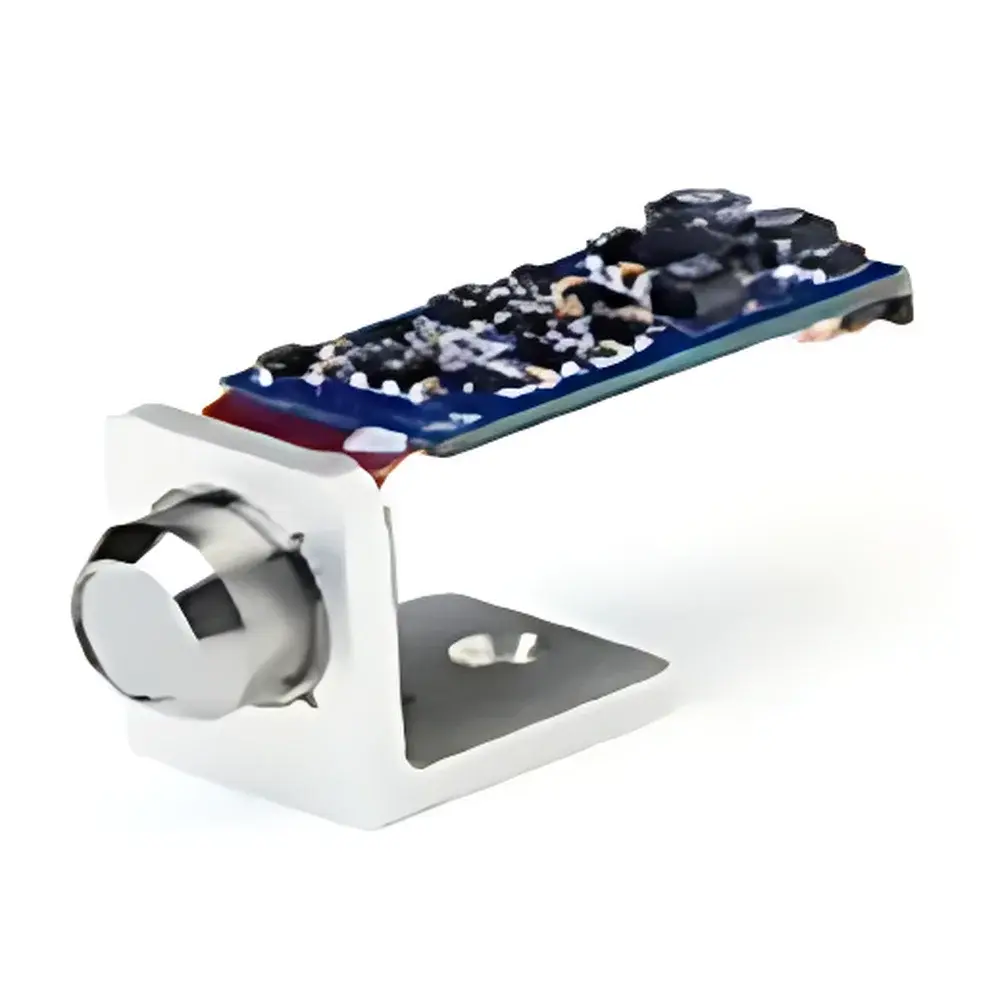
Si-PIN Detector XPIN-XT by Moxtek
| Brand | Moxtek |
|---|---|
| Origin | USA |
| Model | XPIN-XT |
| Active Area | 6 mm² or 13 mm² |
| Silicon Thickness | 450 µm or 625 µm |
| Beryllium Window Thickness | 8 µm or 25 µm |
| Collimator Materials | Tungsten / Cobalt / Titanium / Aluminum |
| Energy Resolution (FWHM @ Mn Kα) | < 170 eV (6 mm²), < 230 eV (13 mm²) |
| Peak-to-Background Ratio @ 1 keV | 3600:1 (6 mm², typical), 3000:1 (13 mm², typical) |
Overview
The XPIN-XT Si-PIN detector is a high-performance, low-noise X-ray detection module engineered by Moxtek (USA) for energy-dispersive X-ray fluorescence (EDXRF) spectroscopy. It operates on the principle of direct conversion of incident X-ray photons into electron-hole pairs within a reverse-biased silicon p-i-n diode structure. The detector’s intrinsic layer—fabricated from high-resistivity, low-defect silicon—provides excellent charge collection efficiency and minimal leakage current. Integrated with Moxtek’s proprietary ultra-low-noise JFET preamplifier and hermetically sealed beryllium entrance window, the XPIN-XT delivers stable spectral response across the 0.1–20 keV range. Its compact form factor and low power consumption make it ideal for integration into portable, benchtop, and OEM EDXRF systems where resolution, count-rate capability, and long-term stability are critical.
Key Features
- Two standard active area options: 6 mm² and 13 mm²—optimized for sensitivity vs. resolution trade-offs in different instrument configurations
- High-purity silicon depletion layers: 450 µm (standard) and 625 µm (high-efficiency) thicknesses to maximize quantum efficiency for mid-Z and higher-energy X-rays
- Ultra-thin, vacuum-compatible beryllium windows: 8 µm (for enhanced low-energy transmission down to ~0.1 keV) and 25 µm (for improved mechanical robustness and environmental sealing)
- Modular collimator interface supporting interchangeable apertures made from tungsten, cobalt, titanium, or aluminum—enabling application-specific beam shaping and scatter suppression
- Integrated JFET-based preamplifier with matched noise optimization, enabling sub-170 eV FWHM resolution at Mn Kα (5.9 keV) for the 6 mm² variant
- Hermetic ceramic package with gold-plated Kovar leads ensures long-term reliability under thermal cycling and humidity exposure
Sample Compatibility & Compliance
The XPIN-XT detector is compatible with solid, powdered, and thin-film samples commonly analyzed in regulated EDXRF workflows—including RoHS screening, mining geochemistry, catalyst analysis, and coating thickness verification. Its energy resolution and peak-to-background performance meet the analytical requirements of ASTM E1621 (Standard Guide for X-Ray Emission Spectrometry), ISO 21043 (XRF instrumentation performance evaluation), and USP / elemental impurities testing protocols. When integrated into systems compliant with FDA 21 CFR Part 11, the detector supports audit-trail-ready data acquisition when paired with validated firmware and host software. No internal radioactive sources or hazardous materials are employed; the device conforms to IEC 61000-6-3 (EMC emissions) and IEC 61010-1 (safety for electrical equipment).
Software & Data Management
The XPIN-XT interfaces via standard analog pulse output (shaped, negative polarity, ~10 µs decay time) or optional digital SPI/I²C variants for OEM integration. It is fully supported by Moxtek’s reference pulse processing chain—including shaping amplifiers, multi-channel analyzers (MCAs), and spectral acquisition libraries compatible with LabVIEW, Python (PyMCA, silx), and C/C++ environments. Raw spectrum data is output in standard .spe or .mca formats, enabling traceable calibration (energy/channel mapping), dead-time correction, and background subtraction using industry-standard algorithms. Firmware updates and configuration parameters (e.g., bias voltage, temperature compensation coefficients) are accessible through secure, password-protected registers—facilitating GLP/GMP-aligned instrument qualification documentation.
Applications
- Portable and handheld EDXRF analyzers for field-deployable alloy identification, soil screening, and scrap metal sorting
- Benchtop XRF spectrometers used in quality control laboratories for plating thickness measurement and contamination detection in electronics manufacturing
- OEM integration into micro-XRF mapping systems requiring high spatial resolution and elemental contrast at low excitation power
- Academic and industrial research platforms for synchrotron beamline diagnostics and soft X-ray absorption edge studies (with 8 µm Be window configuration)
- Calibration reference modules in metrology labs performing inter-laboratory comparison of detector response functions
FAQ
What cooling method does the XPIN-XT require?
The XPIN-XT operates at thermoelectrically stabilized temperatures (typically –10°C to +5°C) using an integrated Peltier cooler; no liquid nitrogen or external cryogenic infrastructure is needed.
Is the detector sensitive to humidity or vacuum conditions?
Yes—the 8 µm Be window version requires dry inert gas purging or vacuum operation below 10⁻² mbar to prevent oxidation; the 25 µm variant supports ambient air operation with appropriate desiccant housing.
Can the XPIN-XT be calibrated for absolute intensity quantification?
Yes—when used with certified reference materials (CRMs) and geometry-matched calibration standards, its linearity (<±0.5% over 10⁴ cps) and energy scale reproducibility (<0.02% channel drift/°C) support quantitative fundamental parameter (FP) modeling.
Does Moxtek provide radiation damage testing data?
Yes—accelerated lifetime testing reports (per ASTM F1892) are available upon NDA, documenting displacement damage thresholds up to 1×10¹⁰ protons/cm² and total ionizing dose tolerance exceeding 10 krad(Si).
How is detector selection (6 mm² vs. 13 mm²) determined for a given application?
The 6 mm² variant prioritizes energy resolution and low-noise performance for trace element detection; the 13 mm² option increases geometric efficiency and count rate capability for high-throughput or low-flux applications—trade-offs are evaluated during system-level Monte Carlo modeling.
Related Products



