
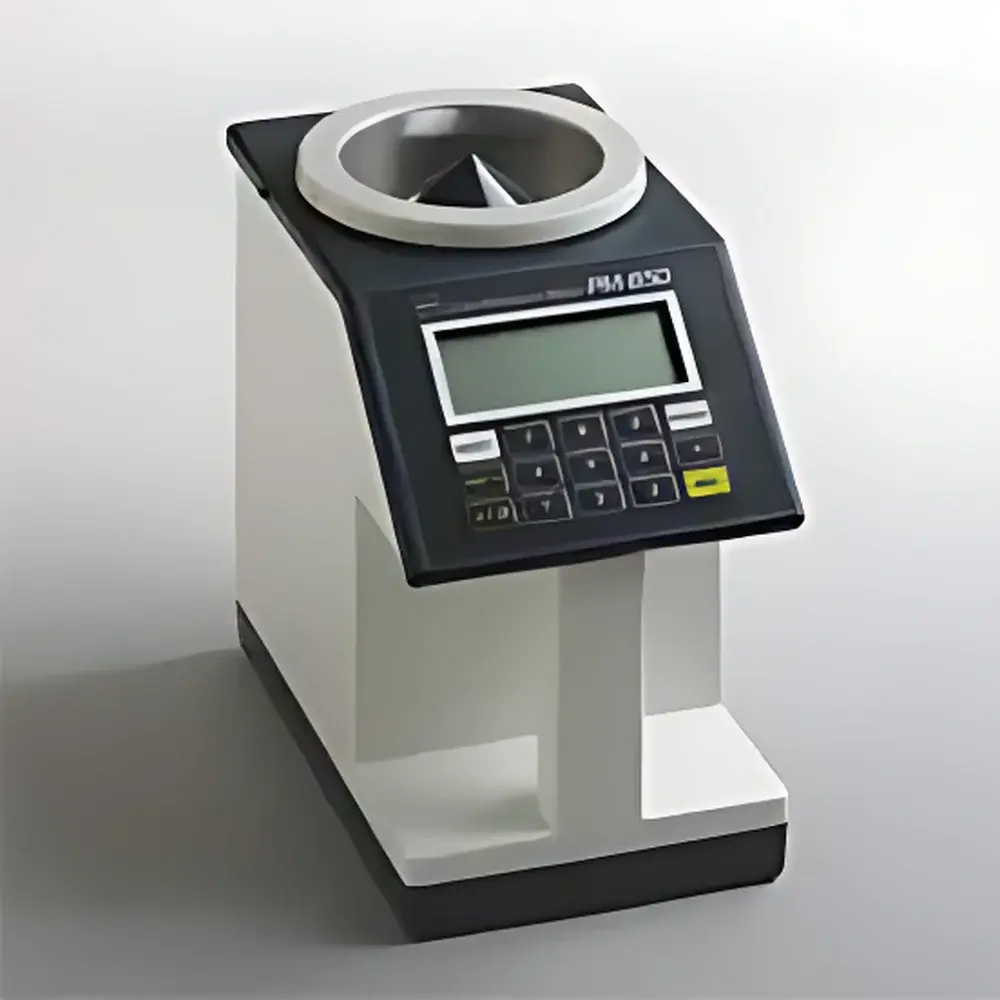
KETT PM650 Capacitance-Based Grain Moisture Analyzer
| Brand | KETT |
|---|---|
| Origin | Japan |
| Model | PM650 |
| Measurement Principle | High-Frequency Capacitance (50 MHz) |
| Sample Type | Cereals & Seeds |
| Moisture Range | 1–40% w/w (varies by grain species) |
| Sample Volume | 240 mL |
| Operating Temperature | 0–40 °C |
| Moisture Accuracy | ±0.5% (vs. ASTM D4940 or ISO 712 dry-weight reference method, for samples ≤20% moisture) |
| Built-in Compensation | Automatic mass correction via integrated precision balance (0.01 g resolution), temperature compensation via thermistor |
| Calibration Offset Range | −9.9 to +9.9 units (user-adjustable) |
| Additional Outputs | Bulk Density (g/L), arithmetic mean of up to 9 readings |
| Display | LCD numeric readout |
| Power | Four 1.5 V AA alkaline batteries |
| Dimensions (W×D×H) | 125 × 205 × 215 mm |
| Weight | 1.3 kg |
Overview
The KETT PM650 Capacitance-Based Grain Moisture Analyzer is a portable, field-deployable instrument engineered for rapid, non-destructive moisture quantification in bulk cereal grains and oilseeds. It operates on the principle of high-frequency capacitance measurement at 50 MHz, where dielectric permittivity—strongly correlated with water content—is detected through an electrode array immersed in a fixed-volume sample. Unlike near-infrared (NIR) or loss-on-drying (LOD) methods, the PM650 requires no sample grinding, heating, or consumables; measurement is completed in under 10 seconds per batch. Its design reflects decades of empirical calibration work across major commodity grains—including wheat, corn (maize), rice, barley, oats, soybeans, and sorghum—ensuring traceability to gravimetric reference standards per ISO 712 and ASTM D4940. The device is not intended for regulatory compliance reporting but serves as a primary screening tool aligned with Good Agricultural Practice (GAP) and pre-shipment quality control protocols.
Key Features
- High-frequency (50 MHz) capacitance sensing architecture optimized for heterogeneous granular matrices, minimizing interference from density variation and surface moisture.
- Integrated precision balance (0.01 g resolution) enables real-time mass normalization, correcting for minor volumetric inconsistencies during sample loading.
- Thermistor-based ambient temperature compensation ensures stable calibration across seasonal field conditions (0–40 °C operating range).
- Preset grain-specific calibration curves stored in non-volatile memory—each corresponding to validated reference datasets from international grain trading laboratories.
- User-configurable offset function (−9.9 to +9.9) allows fine-tuning against local reference methods without recalibration.
- Dual-output capability: simultaneous display of moisture content (% w/w) and bulk density (g/L), supporting storage and transport logistics planning.
- Low-power architecture powered by four standard AA alkaline cells, delivering >2,000 measurements per battery set under typical usage.
Sample Compatibility & Compliance
The PM650 is validated for intact, unground kernels and seeds within defined size and density ranges—excluding highly fibrous, oily, or fermented materials that fall outside its empirical calibration envelope. It complies with general electrical safety requirements IEC 61010-1 and electromagnetic compatibility (EMC) directive 2014/30/EU. While not certified for GLP or GMP environments, its measurement repeatability (RSD < 0.8% for homogeneous batches) supports internal QA/QC documentation per ISO/IEC 17025 clause 7.7. Traceability to national metrology institutes is maintained through factory calibration certificates issued with each unit, referencing NIST-traceable gravimetric standards.
Software & Data Management
The PM650 operates as a standalone hardware platform with no embedded data logging or PC connectivity. All measurement results are displayed in real time on a monochrome LCD screen with 4-digit resolution. No firmware updates or software installation is required; calibration parameters are immutable unless modified via authorized service procedure. For audit readiness, users are advised to record readings manually into laboratory notebooks or LIMS-compatible spreadsheets. The absence of digital data export aligns with low-infrastructure deployment scenarios—such as farm gates, rural elevators, and border inspection posts—where network connectivity and cybersecurity governance are limited.
Applications
- Pre-harvest moisture assessment to determine optimal combine harvest timing.
- On-site verification of grain moisture prior to binning, ensuring safe long-term storage below critical thresholds (e.g., ≤14% for wheat, ≤13.5% for corn).
- Quality sorting at receiving points: segregation of loads exceeding contractual moisture limits (e.g., USDA Grade Standards, GAFTA contracts).
- Research-grade comparative analysis in agronomy trials evaluating drought tolerance or drying efficacy.
- Feed mill intake inspection to prevent mold risk associated with elevated moisture in compound feed ingredients.
FAQ
Does the PM650 require daily calibration?
No—factory calibration remains stable for 12 months under normal use. A single-point verification using a certified reference sample is recommended before each shift.
Can it measure ground or milled grain?
No. The instrument is calibrated exclusively for whole, free-flowing kernels. Ground material alters dielectric packing density and invalidates preset curves.
Is temperature compensation automatic?
Yes. An integrated thermistor continuously monitors ambient temperature and applies algorithmic correction to the base capacitance reading.
What is the typical measurement repeatability?
For homogeneous samples measured consecutively under identical conditions, standard deviation is ≤0.4% moisture (n = 10), consistent with ISO 5725-2 precision criteria.
How is bulk density calculated?
Bulk density (g/L) = [measured sample mass (g) ÷ 240 mL] × 1000; derived directly from the built-in balance and fixed sample cup volume.




