KEYENCE LR-Z Series Amplifier-Integrated CMOS Laser Sensor
| Brand | KEYENCE |
|---|---|
| Origin | Japan |
| Manufacturer Type | Manufacturer |
| Origin Category | Imported |
| Model | LR-Z |
| Pricing | Upon Request |
Overview
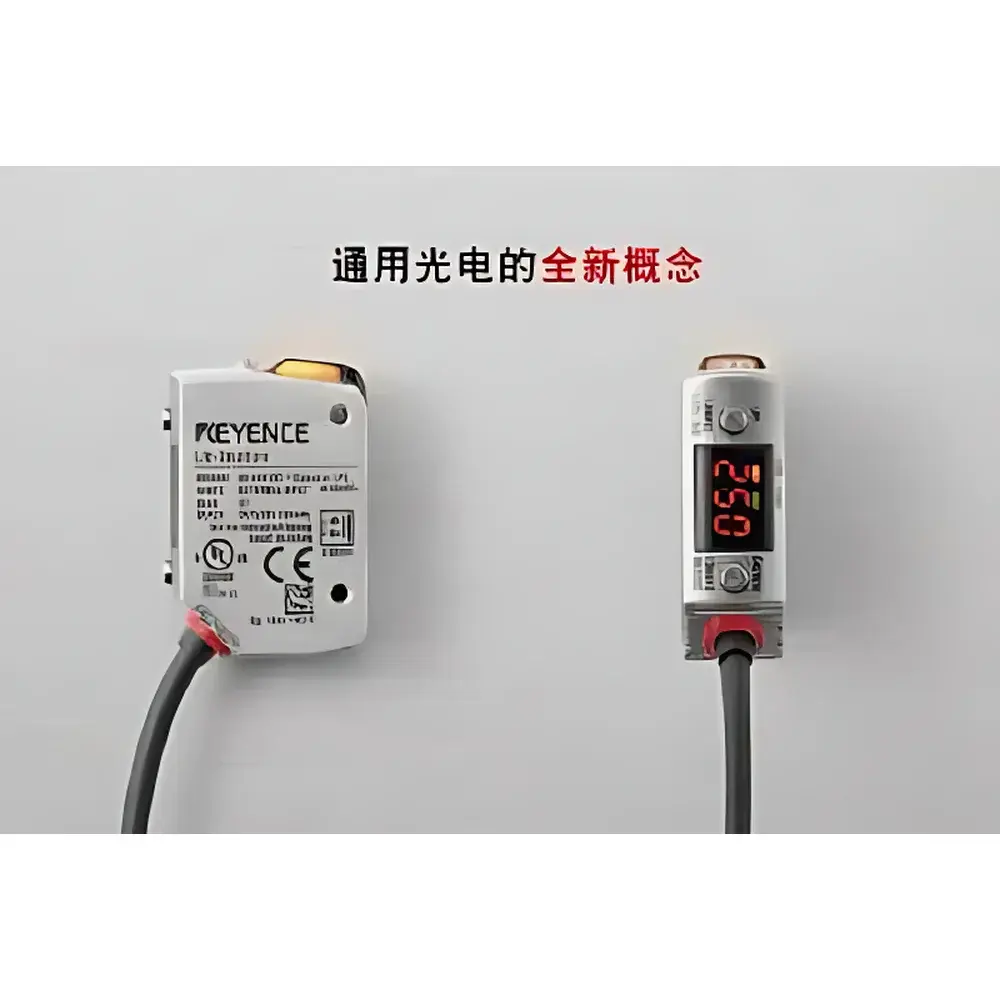
The KEYENCE LR-Z Series is an amplifier-integrated CMOS laser sensor engineered for high-reliability presence, position, and contrast-based detection in demanding industrial environments. Unlike conventional photoelectric sensors that rely on analog photodiode receivers, the LR-Z employs a precision-aligned combination of a visible red laser emitter (650 nm) and a high-resolution CMOS image sensor — enabling true pixel-level light intensity analysis across the entire sensing field. This architecture supports dynamic photometric control with up to 350,000:1 adjustable gain range, allowing real-time compensation for ambient light fluctuations, surface reflectivity variations, and angular incidence changes. The sensor operates on the principle of triangulation-assisted light intensity profiling, where the CMOS array captures not only peak intensity but also spatial distribution of reflected laser light — forming the basis for both Background Suppression (BGS) and Datum-based Foreground Suppression (FGS) detection modes. Designed from inception for machine builders and automation integrators, the LR-Z eliminates the need for external amplifiers or separate mounting enclosures while maintaining metrological integrity under continuous operation.
Key Features
- Metal housing constructed from corrosion-resistant SUS316L stainless steel — rated IP69K and IP68 for high-pressure washdown and submersion applications
- Integrated amplifier with dual-mode detection logic: BGS (background suppression) and FGS/DATUM (foreground reference-based thresholding)
- 7-segment LED display with large-digit visibility (≥10 m viewing distance) and intuitive one-touch teach-in functionality
- Programmable key lock to prevent inadvertent parameter changes during operation
- No external amplifier or protective housing required — full signal conditioning, timing control, and I/O interfacing housed within the sensor body
- Resistance to oils, alkaline cleaners, and acidic solutions — validated per ISO 16750-4 and JIS C 0920 for chemical exposure endurance
Sample Compatibility & Compliance
The LR-Z series detects a broad range of materials including metallic, painted, anodized, plastic, paper, and laminated surfaces — regardless of color, gloss level, or orientation angle. Its CMOS-based optical engine mitigates false triggers caused by oil mist, condensation, or partial occlusion — making it suitable for packaging, bookbinding, automotive assembly, and food processing lines. The device complies with IEC 60947-5-2 (industrial proximity sensors), EN 61496-1 (safety-related presence detection), and meets EMC immunity requirements per EN 61000-6-2 and emission limits per EN 61000-6-4. For regulated manufacturing environments, configuration data logging supports audit trails aligned with GLP/GMP documentation practices.
Software & Data Management
Configuration is performed locally via front-panel controls; no PC software is required for basic setup. Advanced parameters — including response time (1 ms to 500 ms), output hysteresis, and multi-threshold switching — are accessible through the built-in menu system. All settings are retained in non-volatile memory during power loss. While the LR-Z does not feature Ethernet or USB connectivity, its discrete NPN/PNP outputs support integration into PLC-controlled systems compliant with IEC 61131-3 programming standards. Event logging capability includes operational hour counters and fault history storage (e.g., overtemperature, voltage anomaly), retrievable via LED blink-code diagnostics.
Applications
- Oil-contaminated conveyor monitoring: Replaces through-beam sensors prone to intermittent failure due to oil splatter — achieves stable detection without relocation or shielding
- Multi-height stack verification in bookbinding: Enables top-mounted installation with external sensitivity adjustment, eliminating re-teaching when product height changes
- High-speed label presence detection on wet or glossy substrates in pharmaceutical blister packaging
- Position verification of stamped metal parts under coolant mist in CNC machining cells
- Contrast-based edge detection on printed circuit board carriers during automated optical inspection (AOI) staging
FAQ
What detection principles does the LR-Z use?
It combines laser triangulation geometry with CMOS image sensor-based light intensity profiling — enabling simultaneous evaluation of positional offset and reflectance magnitude.
Is the LR-Z compatible with standard industrial control voltages?
Yes — it supports 12–24 VDC power input and provides configurable NPN or PNP digital outputs with short-circuit and reverse-polarity protection.
Can the LR-Z be used in outdoor applications?
While IP69K-rated for high-pressure cleaning, it is not UV-stabilized for prolonged direct sunlight exposure; indoor or sheltered outdoor use is recommended.
Does the LR-Z support analog output or IO-Link?
No — it is a discrete-output-only sensor; analog or fieldbus variants are not available in the LR-Z series.
How is calibration performed?
Teach-in is executed via single-button press with live 7-segment feedback; no external reference tools or software are required.