
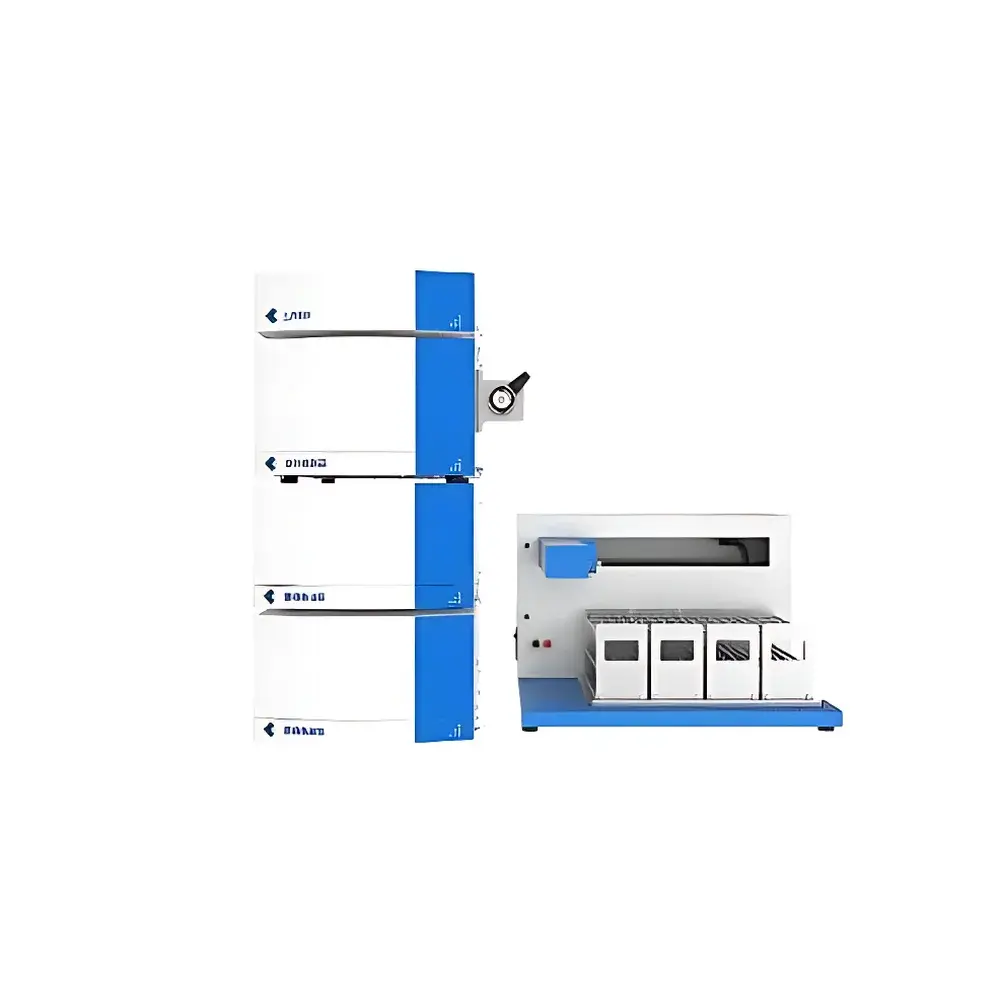
KEZHE PuriMaster-2000 Binary Automated Fraction Collection Preparative HPLC System
| Brand | KEZHE / KEZHE SHANGHAI |
|---|---|
| Origin | Shanghai, China |
| Manufacturer Type | Original Equipment Manufacturer (OEM) |
| Regional Classification | Domestic (China) |
| Model | PuriMaster-2000 |
| Application Level | Laboratory-Scale R&D |
| Instrument Type | High-Pressure Preparative Liquid Chromatography System |
| Flow Rate Range | 0–100 mL/min |
| Flow Accuracy | RSD ≤ 0.5% |
| Flow Precision | RSD ≤ 1.0% |
| Maximum Pressure | 4000 PSI (27.6 MPa) |
| Wavelength Range | 190–850 nm (dual-wavelength simultaneous detection) |
| Wavelength Accuracy | ±1 nm |
| Wavelength Repeatability | 0.2 nm |
| Baseline Noise | ±3×10⁻⁵ AU (254 nm) |
| Data Acquisition Rate | 5 Hz |
Overview
The KEZHE PuriMaster-2000 is a modular, high-pressure preparative liquid chromatography system engineered for laboratory-scale isolation and purification of natural products—particularly botanical extracts, traditional Chinese medicine (TCM) constituents, and synthetic intermediates. It operates on the principle of reversed-phase high-performance liquid chromatography (RP-HPLC), utilizing binary gradient elution with active mixing to deliver precise, low-lag solvent composition control. Designed for reproducible fractionation under pressures up to 4000 PSI (27.6 MPa), the system integrates a dual-pump gradient architecture, a dual-wavelength UV-Vis detector with spectral scanning capability, and an X-Y robotic fraction collector capable of unattended operation across 160 tube positions. Its architecture meets core functional requirements for GLP-compliant method development, including traceable instrument status logging, audit-trail-enabled software, and user-role-based access control.
Key Features
- Binary high-pressure gradient delivery with integrated mixer—eliminates need for offline degassing and minimizes gradient delay (<1.2 mL dwell volume)
- Dual-wavelength UV-Vis detector featuring deuterium/tungsten lamp source, 1200-line holographic grating, and real-time wavelength self-calibration for ±1 nm accuracy
- X-Y matrix fraction collector supporting 15 × 150 mm test tubes (160-position standard); compatible with custom tube formats upon request
- Intelligent fraction triggering modes: time-based, threshold-based, peak apex, peak width, and manual override—all programmable within a single acquisition sequence
- Real-time chromatogram–fraction map synchronization: visual overlay of collected fractions onto the corresponding chromatographic peaks
- Onboard UV-VIS spectral scanning (190–850 nm) at user-defined retention windows; exportable spectral libraries for compound identification support
- Modular workstation software with full 21 CFR Part 11 compliance features: electronic signatures, immutable audit trails, role-based permissions, and data integrity validation
- High-stability preparative pump with flow accuracy ≤0.5% RSD and long-term precision ≤1.0% RSD across 0.01–100 mL/min range
- Integrated lamp life monitoring and automatic diagnostic alerts for source degradation or optical alignment drift
Sample Compatibility & Compliance
The PuriMaster-2000 accommodates a broad range of sample matrices—including crude plant extracts, fermentation broths, peptide mixtures, and small-molecule synthetic libraries—when paired with appropriate preparative columns (e.g., C18, C8, phenyl-hexyl, or silica). Standard configuration includes a 10 µm, 10 × 250 mm C18 column suitable for analytical-to-preparative scale-up. The system supports method transfer per ICH Q5A and USP , and its software enforces ALCOA+ data integrity principles. All hardware components comply with CE electromagnetic compatibility (EMC) directives and IEC 61010-1 safety standards. Optional detectors—including ELSD, DAD, and RID—extend compatibility with non-UV-absorbing analytes and enable orthogonal detection strategies aligned with ASTM E2912 and ISO 17025 quality frameworks.
Software & Data Management
The modular liquid chromatography workstation provides a unified interface for instrument control, real-time visualization, and post-run analysis. It supports concurrent display of gradient profile, chromatogram, fraction collection map, and system pressure/temperature status—all synchronized on a shared time axis. Multi-detector data (e.g., UV + ELSD) are co-plotted in identical retention time coordinates for direct comparative analysis. Built-in peak integration algorithms conform to USP tailing factor and asymmetry criteria. Raw data files adhere to ANDI/NetCDF format for third-party processing. Audit trail records capture operator identity, timestamp, parameter changes, and file modifications—retained for ≥30 days by default and exportable as encrypted PDF or CSV. User management supports three-tier roles (Administrator, Analyst, Viewer) with configurable password policies and session timeout enforcement.
Applications
- Isolation of bioactive compounds from herbal extracts (e.g., flavonoids, alkaloids, terpenoids) for pharmacological screening
- Purification of synthetic peptides and oligonucleotides prior to structural characterization (NMR, MS)
- Method development for downstream process scale-up—from lab-scale (mg) to pilot-scale (g) purification workflows
- Stability-indicating assays for degradation product isolation in pharmaceutical formulation studies
- Preparative separation of chiral intermediates using polysaccharide-based chiral columns (compatible with optional backpressure regulation)
- Quality control of TCM monographs per Chinese Pharmacopoeia (ChP) section 0512 and WHO guidelines on herbal medicine standardization
FAQ
What regulatory standards does the PuriMaster-2000 software support?
It implements 21 CFR Part 11-compliant electronic signatures, audit trail generation, and data integrity controls—including immutable record retention, user authentication, and change history tracking.
Can the system perform gradient elution without a degasser?
Yes—the high-pressure binary mixing design eliminates reliance on offline or inline degassers; solvent saturation is maintained via pressurized reservoirs and low-dwell-volume mixing.
Is spectral library matching supported?
The UV-VIS detector enables on-the-fly spectral acquisition; exported spectra (.spc or .csv) can be imported into third-party chemometric tools for library search and similarity scoring.
What column dimensions and chemistries are validated for use?
Standard validation covers 10–30 mm ID × 150–500 mm length columns with particle sizes 5–20 µm, including C18, C8, phenyl, amino, and cyano phases; custom packing configurations require method qualification.
How is baseline stability ensured during extended runs?
Thermal stabilization of optical components, active lamp intensity feedback control, and real-time baseline correction algorithms maintain noise ≤3×10⁻⁵ AU over >8-hour acquisitions at 254 nm.





