
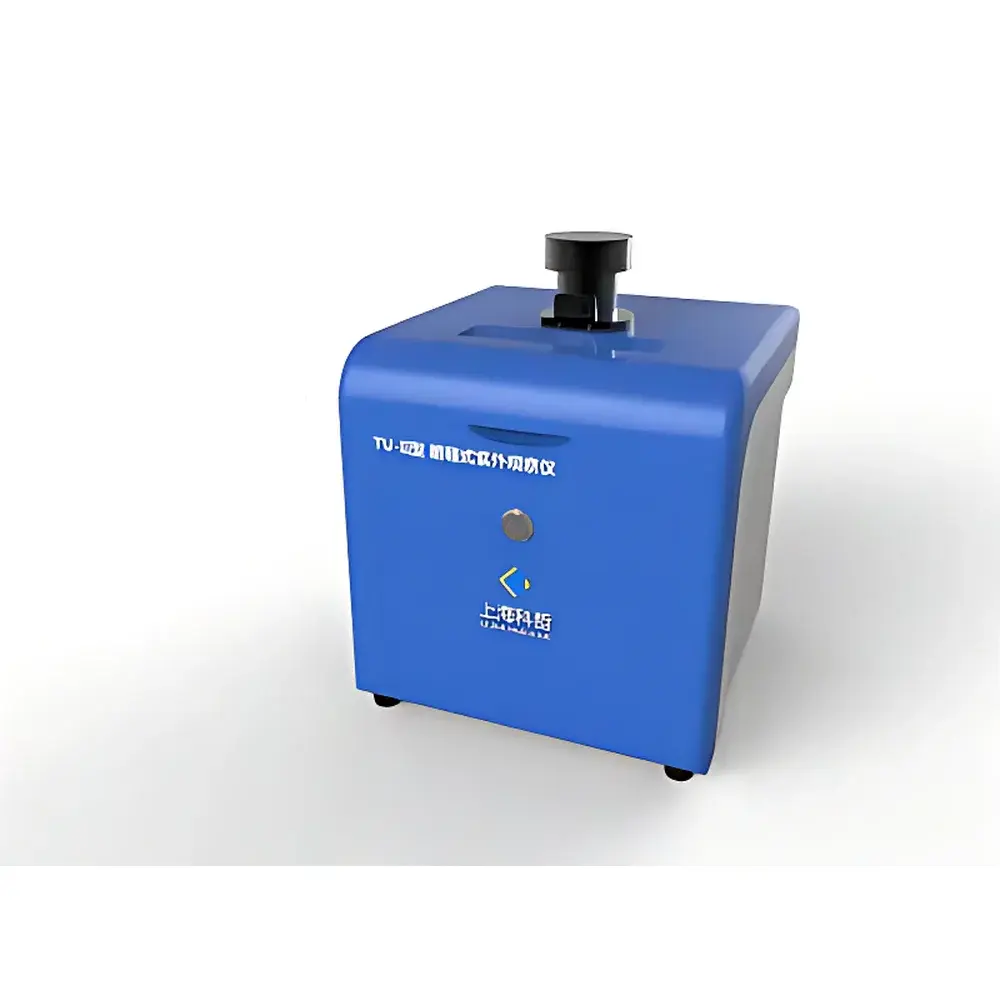
KEZHE TU-II Portable UV Transilluminator Cabinet
| Brand | KEZHE SHANGHAI |
|---|---|
| Origin | Shanghai, China |
| Manufacturer Type | Direct Manufacturer |
| Product Category | Domestic |
| Model | TU-II |
| Price Range | USD 140 – 700 (FOB) |
| Instrument Type | TLC Auxiliary Equipment |
| UV Wavelengths | 254 nm & 365 nm |
| Max Sample Size | 200 × 200 mm TLC Plate |
| Design | Portable, Light-Tight Enclosure |
| UV Lamp Configuration | Dual-Wavelength Integrated Fluorescent Lamps |
Overview
The KEZHE TU-II Portable UV Transilluminator Cabinet is an engineered solution for safe, high-contrast visualization of ultraviolet-fluorescent compounds on thin-layer chromatography (TLC) plates. Designed in accordance with standard laboratory practices for planar chromatography analysis, the unit operates on the principle of controlled UV excitation—using two discrete, narrow-band fluorescent lamp sources emitting at 254 nm and 365 nm—to induce fluorescence in analytes such as aromatic hydrocarbons, conjugated dyes, alkaloids, and derivatized carbohydrates. Its light-tight enclosure eliminates ambient stray light interference while incorporating UV-absorbing acrylic shielding to protect users from direct exposure to harmful short-wave UV radiation. The cabinet’s compact footprint and integrated handle support benchtop deployment in QC labs, academic teaching environments, and field-deployable analytical workflows where mobility and operational simplicity are critical.
Key Features
- Optimized dual-wavelength UV illumination system: independently switchable 254 nm (for quenching visualization of UV-absorbing compounds) and 365 nm (for fluorescence enhancement of native or derivatized analytes)
- Light-tight aluminum-and-acrylic cabinet structure with hinged front door and viewing window fitted with UV-blocking polycarbonate filter (OD ≥ 4 at 254 nm)
- Uniform UV irradiance distribution across full 200 × 200 mm active area, verified per ASTM E2912-13 guidelines for transilluminator uniformity assessment
- Integrated mounting rails and adjustable camera platform compatible with DSLR, mirrorless, and scientific CMOS cameras (C-mount or M42 adapters optional)
- Robust, chemical-resistant powder-coated steel chassis; non-slip rubber feet; ergonomic carry handle for intra-laboratory transport
- Thermal management via passive convection cooling—no fans or moving parts—ensuring silent operation and long-term lamp stability
Sample Compatibility & Compliance
The TU-II accommodates standard commercial and custom-cut silica gel, alumina, cellulose, and reversed-phase (RP-18) TLC plates up to 200 × 200 mm in dimension, including pre-coated plates with fluorescent indicator (F254 or F365). It supports both solvent-evaporated and air-dried plates without thermal distortion. All electrical components comply with IEC 61010-1:2010 safety standards for laboratory equipment. UV lamp assemblies meet ISO 15223-1:2021 labeling requirements for optical radiation hazard classification (Class 3R per IEC 60825-1). The design facilitates adherence to GLP documentation protocols when paired with validated imaging software and audit-trail-enabled acquisition systems.
Software & Data Management
While the TU-II operates as a standalone visualization tool, it serves as the optical core of a complete TLC imaging station when interfaced with third-party or OEM image acquisition software (e.g., ImageJ-compatible drivers, GelAnalyzer, or proprietary KEZHE TLCView Suite). Optional USB-triggered shutter control enables synchronized exposure capture. All acquired TIFF or PNG images retain embedded EXIF metadata—including wavelength used, exposure time, and plate orientation—for traceability in regulated environments. When deployed under FDA 21 CFR Part 11-compliant software platforms, the system supports electronic signatures, user access controls, and immutable audit trails required for pharmaceutical QC laboratories.
Applications
- Routine Rf value determination and comparative spot identification in organic synthesis monitoring
- Qualitative purity assessment of natural product extracts and synthetic intermediates
- Method development and optimization for preparative TLC and HPTLC workflows
- Educational demonstration of separation principles in undergraduate chemistry laboratories
- Forensic ink analysis and document authenticity verification using UV-responsive dye profiles
- Environmental screening of PAHs and pesticide residues on silica-based plates
FAQ
Is the TU-II suitable for use with ethidium bromide-stained gels?
No—the TU-II is optimized for TLC plate visualization and lacks the large-area uniformity and intensity required for nucleic acid gel documentation. It is not intended for agarose or polyacrylamide gel applications.
Can the UV lamps be replaced by the user?
Yes—lamps are standardized G13 T8 fluorescent tubes (254 nm: low-pressure mercury; 365 nm: Wood’s glass filtered), commercially available with ANSI codes F15T8/BLB and F15T8/BL. Replacement requires basic screwdriver access and adherence to lamp disposal regulations.
Does the unit include a timer or exposure control?
No—exposure duration is manually controlled during imaging. For quantitative densitometry, integration with external software-controlled shutters or programmable camera triggers is recommended.
What safety certifications does the TU-II hold?
It conforms to IEC 61010-1:2010 (Electrical Safety) and carries CE marking for EMC Directive 2014/30/EU. UV shielding performance is validated per EN 62471:2006 (Photobiological Safety of Lamps).
Is calibration documentation provided with shipment?
A factory-issued Certificate of Conformance is included, listing lamp spectral output verification and mechanical dimensional inspection. NIST-traceable radiometric calibration is available as an optional service.




