
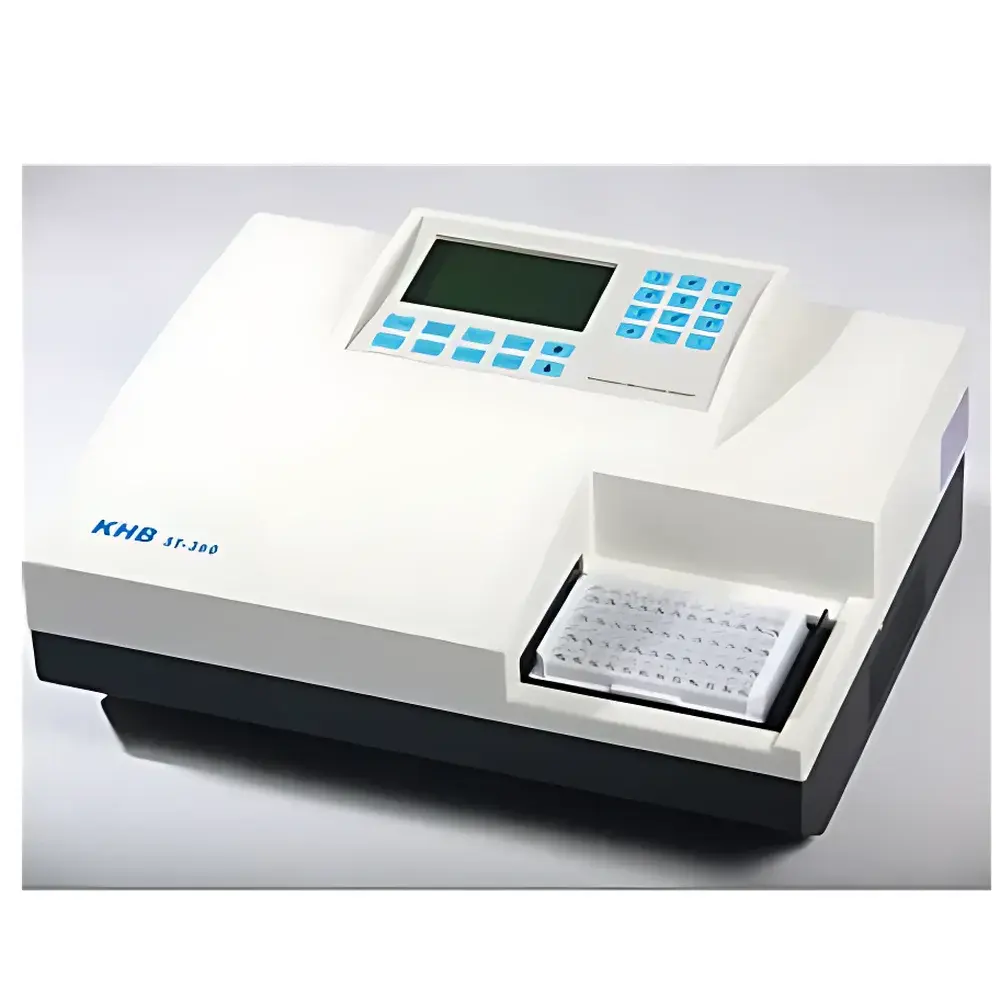
KHB ST-360 Microplate Reader
| Brand | KHB |
|---|---|
| Origin | Shanghai, China |
| Model | ST-360 |
| Detection Method | Absorbance (Photometric) |
| Function Type | Multifunctional |
| Automation Level | Fully Automatic |
| Assay Modes | Absorbance, Factor Calculation, Standard Concentration, Standard Curve, Single-Threshold, Dual-Threshold, Categorical Classification, Column Subtraction, Point-to-Point |
| Measurement Configurations | Single-Wavelength, Dual-Wavelength, Dual-Time, Kinetic, Multi-Wavelength, PC-Controlled |
| Light Source | Halogen Lamp |
| Wavelength Range | 400–750 nm |
| Absorbance Range | 0.000–4.000 A |
| Linearity (0–3 A) | ≥0.99 |
| Wavelength Measurement Speed | 3 s per wavelength |
| Resolution | 0.001 A |
| Repeatability | ≤±0.005 A |
| Optical Channels | 8-channel fiber-optic detection (optional reference channel) |
| Filter Positions | 8 positions (standard: 405, 450, 492, 630 nm |
| optional | 414, 546, 578, 690 nm) |
| Plate Handling | 96-well microplates only |
| Vibration Function | Adjustable amplitude and duration |
| Display | Large LCD with full-dot-matrix Chinese interface |
| Data Storage | 500 assay protocols + 1,100 full 96-well runs (expandable) |
| Software | Integrated qualitative/quantitative analysis suite with customizable equations, curve-fitting models (linear, quadratic, log-log, 4PL, 5PL), QC tools (Levey-Jennings, Westgard rules), and user-defined plate layout templates |
Overview
The KHB ST-360 Microplate Reader is a fully automated, absorbance-based photometric instrument engineered for routine and high-throughput quantitative and qualitative assays in clinical diagnostics, pharmaceutical quality control, and academic life science laboratories. Operating on the principle of Beer-Lambert law-based photometry, it measures light attenuation across a broad visible spectrum (400–750 nm) to determine analyte concentration in microplate wells. Its halogen lamp illumination system, coupled with an eight-position filter wheel and precision 8-channel fiber-optic detection path, ensures stable light delivery and high inter-channel reproducibility. Designed for regulatory-compliant environments, the ST-360 supports audit-ready workflows through built-in calibration verification, self-diagnostic routines at startup, and traceable absorbance measurement down to 0.001 A resolution. The system meets foundational performance criteria aligned with CLSI EP10-A3 and ISO 15197:2013 for photometric accuracy and repeatability in diagnostic instrumentation.
Key Features
- Fully automated operation with integrated self-test and optical calibration prior to each run
- Eight-position programmable filter wheel — standard filters at 405, 450, 492, and 630 nm; optional wavelengths include 414, 546, 578, and 690 nm for expanded assay compatibility
- 8-channel fiber-optic detection architecture with configurable reference channel option to minimize well-to-well variability and background drift
- High-speed photometric acquisition: completes single-wavelength reading of a full 96-well plate in ≤3 seconds
- Wide dynamic absorbance range (0.000–4.000 A) with linearity ≥0.99 over 0–3 A and repeatability ≤±0.005 A (CV < 0.5% at 1.0 A)
- Adjustable orbital shaking function with programmable amplitude and duration to ensure homogeneous sample suspension prior to reading
- Large full-dot-matrix LCD display with native Chinese UI — enables intuitive navigation, real-time result visualization, and on-device protocol editing without external software
Sample Compatibility & Compliance
The ST-360 is optimized exclusively for standard 96-well microplates (flat-bottom, U-bottom, or V-bottom formats) conforming to ANSI/SBS standards. It supports common ELISA, enzyme activity, cell viability (e.g., MTT, CCK-8), protein quantification (e.g., Bradford, BCA), and endotoxin detection assays requiring visible-range absorbance readouts. All firmware and measurement algorithms comply with fundamental requirements of ISO/IEC 17025 for testing laboratories and support documentation necessary for GLP and GMP-aligned workflows. While not FDA 510(k)-cleared as an IVD device, its performance specifications satisfy internal validation protocols required under CLIA, CAP, and ISO 15189 for clinical laboratory instrumentation. The system provides raw absorbance data export in CSV format compatible with LIMS integration and supports manual entry of calibration standards for traceable concentration reporting.
Software & Data Management
The embedded software delivers comprehensive qualitative and quantitative analysis without dependency on external PCs. It includes preconfigured calculation methods — absorbance ratio, factor-based conversion, standard curve fitting (linear, semi-log, 4-parameter logistic), single/dual-threshold classification, column-wise subtraction, and point-to-point kinetics. Users may define custom plate layouts with up to 12 independent assay zones per plate, each assigned distinct wavelength, blanking strategy, and analysis algorithm. Internal memory stores 500 assay protocols and 1,100 full 96-well datasets; storage capacity can be extended via optional SD card module. Quality control functionality includes Levey-Jennings charting, Westgard multirule evaluation, and batch-level statistical summaries (mean, SD, CV%). All data entries, parameter changes, and calibration events are timestamped and logged — supporting basic audit trail requirements for regulated environments.
Applications
- Clinical immunoassays: Quantitative ELISA for infectious disease serology (e.g., HBsAg, anti-HIV, syphilis), hormone profiling, and autoimmune markers
- Pharmaceutical QC: Verification of enzyme activity in biologics, residual host cell protein quantification, and excipient interference screening
- Academic research: Cell proliferation and cytotoxicity assessment (MTT, XTT, resazurin), bacterial growth kinetics, and reporter gene expression (e.g., β-galactosidase, alkaline phosphatase)
- Biochemistry labs: Protein concentration determination via Bradford or Lowry assays, kinetic monitoring of NAD(P)H-dependent dehydrogenase reactions
- Food and environmental testing: Rapid screening for mycotoxins, pesticide residues, and microbial contaminants using colorimetric lateral flow or microplate-based immunoassays
FAQ
What wavelength filters are included by default?
The ST-360 ships with four fixed-wavelength interference filters: 405 nm, 450 nm, 492 nm, and 630 nm. Additional filters (414, 546, 578, 690 nm) are available as factory-installed options.
Can the instrument perform kinetic measurements over time?
Yes — the ST-360 supports dual-time point and continuous kinetic modes, enabling real-time monitoring of enzymatic reactions or cell metabolic activity at user-defined intervals.
Is the software compliant with FDA 21 CFR Part 11?
The onboard software does not provide electronic signatures, role-based access control, or full Part 11 audit trail functionality. However, raw data export and timestamped logs support manual compliance documentation in non-critical or research-only settings.
How is calibration verified during operation?
The system executes automatic lamp intensity and optical path stability checks at power-on and before each measurement cycle. Optional neutral density filters enable periodic user-performed absorbance calibration verification.
Does the ST-360 support 384-well plates?
No — the optical design and mechanical stage are validated exclusively for 96-well microplates meeting ANSI/SBS dimensional specifications.





