
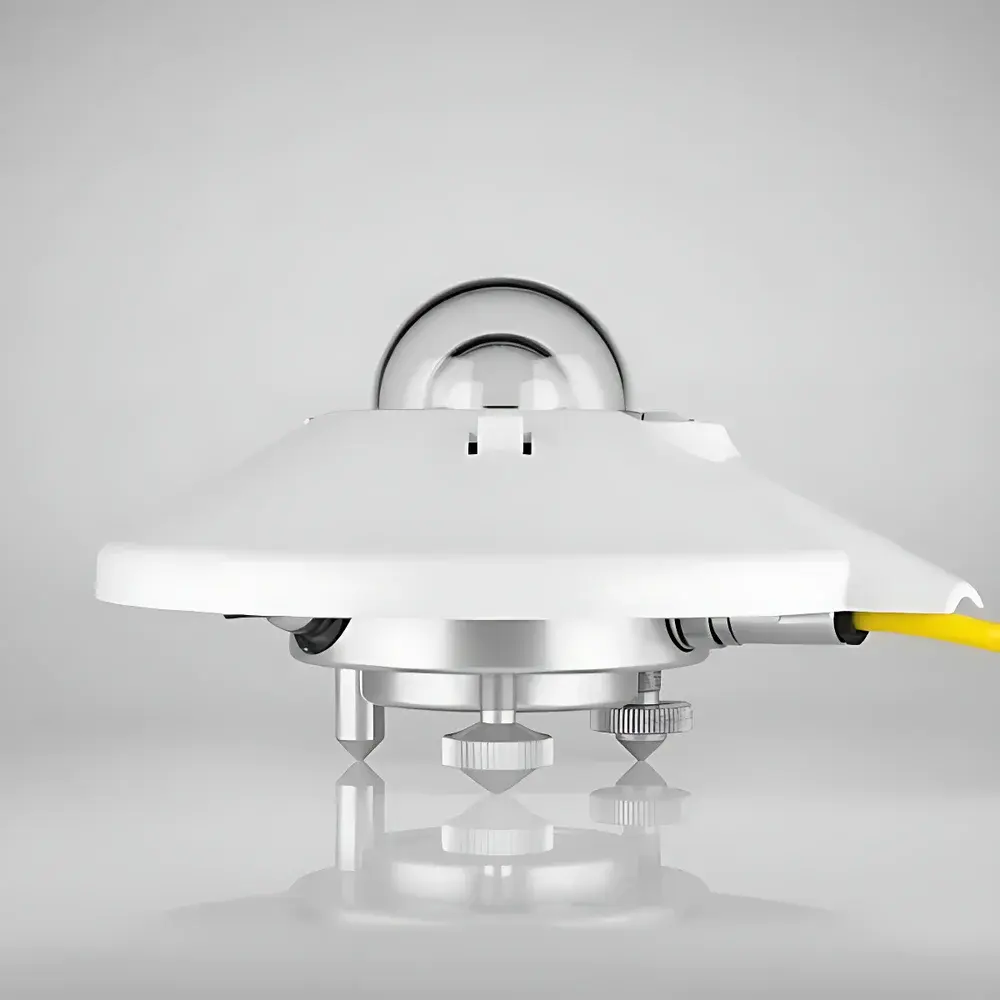
KIPP & ZONEN CMP22 Pyranometer
| Brand | KIPP & ZONEN |
|---|---|
| Origin | Netherlands |
| Model | CMP22 Pyranometer |
| Spectral Range | 200–3600 nm |
| Sensitivity | 7–14 µV/W/m² |
| Response Time (95%) | 5 s |
| Zero-Offset A (thermal, 5 K/h) | < 3 W/m² |
| Zero-Offset B (nighttime, 200 W/m² net IR) | < 1 W/m² |
| Directional Error (up to 80° zenith, 1000 W/m² beam) | < 5 W/m² |
| Temperature Dependence of Sensitivity (−20 °C to +50 °C) | < 0.5 % |
| Operating Temperature Range | −40 °C to +80 °C |
| Maximum Irradiance | 4000 W/m² |
| Field of View | 180° (2π steradian) |
| Dome Material | High-Purity Fused Quartz |
| Integrated Level | Top-Mounted Bubble Vial |
| Desiccant System | Threaded Desiccant Cartridge with Refill Kit Included |
| Cable | Yellow UV-Stable PVC Cable with IP68 Waterproof Connector (pre-wired lengths optional) |
Overview
The KIPP & ZONEN CMP22 Pyranometer is a secondary-standard thermopile-based solar radiation sensor engineered for high-accuracy broadband hemispherical irradiance measurement under ISO 9060:2018 classification as a “Secondary Standard” instrument. It operates on the principle of thermal detection: incident solar radiation—spanning the full biologically and climatologically relevant spectrum from 200 nm (UV-C) to 3600 nm (near-infrared)—is absorbed by a blackened thermopile junction mounted beneath a precision-ground, high-transmittance fused quartz dome. The resulting temperature differential across the thermopile generates a proportional millivolt-level output signal (7–14 µV per W/m²), linearly traceable to SI units via NIST-traceable calibration. Unlike silicon photodiode sensors, the CMP22 delivers spectrally flat response and minimal angular dependence, making it suitable for long-term climate monitoring, PV system performance validation, and atmospheric science applications where spectral fidelity and thermal stability are critical.
Key Features
- Fused Quartz Dome Optics: Replaces the standard glass dome of the CMP21 with optically homogenous synthetic fused quartz, extending spectral transmission down to 200 nm and improving transmittance uniformity across the full 200–3600 nm range—critical for UV-A/UV-B monitoring and spectral mismatch correction in PV yield modeling.
- Reduced Thermal Offset Performance: Achieves Zero-Offset A < 3 W/m² (under rapid thermal gradient conditions of 5 K/h) and Zero-Offset B < 1 W/m² (under nighttime net infrared exchange), minimizing diurnal drift in unventilated installations.
- Enhanced Angular Response: Directional error remains below 5 W/m² up to 80° solar zenith angle at 1000 W/m² beam intensity—meeting IEC 61724-1 Class A requirements for PV monitoring stations.
- Top-Mounted Integrated Level: Precision bubble vial relocated to the upper housing surface, enabling real-time leveling verification without removal of the redesigned snap-fit shading ring—preserving alignment integrity during routine maintenance.
- Serviceable Desiccant System: Threaded desiccant cartridge allows rapid replacement without disassembly; supplied with refill-grade silica gel and sealed O-ring housing to maintain internal dew point < −40 °C over extended deployment cycles.
- Robust Environmental Interface: IP68-rated waterproof connector (M12 or LEMO-compatible variants available), UV-stabilized yellow cable with customizable pre-wired lengths (1 m, 5 m, 10 m, 20 m), and corrosion-resistant anodized aluminum housing rated for continuous operation from −40 °C to +80 °C.
Sample Compatibility & Compliance
The CMP22 is designed for outdoor deployment on meteorological masts, solar resource assessment towers, and fixed-tilt or single-axis tracking platforms. Its 180° field of view (2π steradian) ensures full-hemispheric integration of global horizontal irradiance (GHI). The sensor complies with ISO 9060:2018 (Secondary Standard classification), IEC 61724-1:2021 (Photovoltaic system performance monitoring), and WMO Guide to Meteorological Instruments and Methods of Observation (CIMO Guide, Chapter 7). Calibration certificates are provided with traceability to the World Radiometric Reference (WRR) maintained at PMOD/WRC, Davos, Switzerland. For regulatory reporting, the CMP22 supports GLP-compliant data acquisition when paired with compliant dataloggers featuring audit-trail functionality and time-synchronized sampling.
Software & Data Management
The CMP22 outputs a passive analog signal (mV) compatible with all industry-standard data loggers (e.g., Campbell Scientific CR series, Onset HOBO RX3000, Delta-T DL6). No embedded firmware or digital interface is present—ensuring long-term signal stability and eliminating firmware obsolescence risk. When integrated into automated networks, raw mV readings are converted to W/m² using the individual calibration factor (provided on certificate) and corrected for temperature-dependent sensitivity deviation (< 0.5 % over −20 °C to +50 °C) if high-precision post-processing is required. Data streams may be ingested into cloud platforms (e.g., PVOutput, Solcast, or proprietary SCADA systems) via Modbus TCP or SDI-12 gateways. All calibration documentation conforms to ISO/IEC 17025 requirements for accredited laboratories.
Applications
- Baseline solar resource assessment for utility-scale photovoltaic and concentrated solar power (CSP) plant feasibility studies
- Long-term climate monitoring networks (e.g., BSRN, GAW, SURFRAD)
- Performance ratio (PR) and yield analysis in operational PV parks per IEC 61724-1
- Albedo and net radiation measurements when deployed in upward/downward pairs
- Atmospheric transmissivity and aerosol optical depth (AOD) derivation in conjunction with spectral radiometers
- Validation of satellite-derived irradiance products (e.g., CAMS, NSRDB)
FAQ
Is the CMP22 suitable for use in extreme cold environments, such as Arctic research stations?
Yes—the operating temperature range extends to −40 °C, and the fused quartz dome exhibits negligible thermal stress cracking risk at low temperatures. Desiccant performance remains effective down to −50 °C when properly maintained.
Does the CMP22 require ventilation or heating for optimal accuracy?
No. Ventilation is not required for standard Secondary Standard operation. However, for applications demanding sub-1 W/m² zero-offset stability under high-humidity or rapidly changing conditions, optional ventilated housings (e.g., CVF 4) are available.
How often should the desiccant be replaced?
Under typical temperate conditions, replacement is recommended every 12–18 months. In high-humidity or coastal deployments, inspection every 6 months is advised. Visual discoloration of the indicator gel (blue → pink) signals saturation.
Can the CMP22 be calibrated in-house?
No. Calibration must be performed by an ISO/IEC 17025-accredited laboratory using outdoor shaded comparison methods traceable to WRR. KIPP & ZONEN recommends recalibration every two years for critical applications.
What mounting hardware is included with the CMP22?
The instrument ships with a universal leveling base (stainless steel), M6 mounting thread adapter, and compatibility with standard solar tracker interfaces (e.g., Solys 2, N-Sun). Optional tilt adapters and heated mounting plates are available separately.
Related Products







