
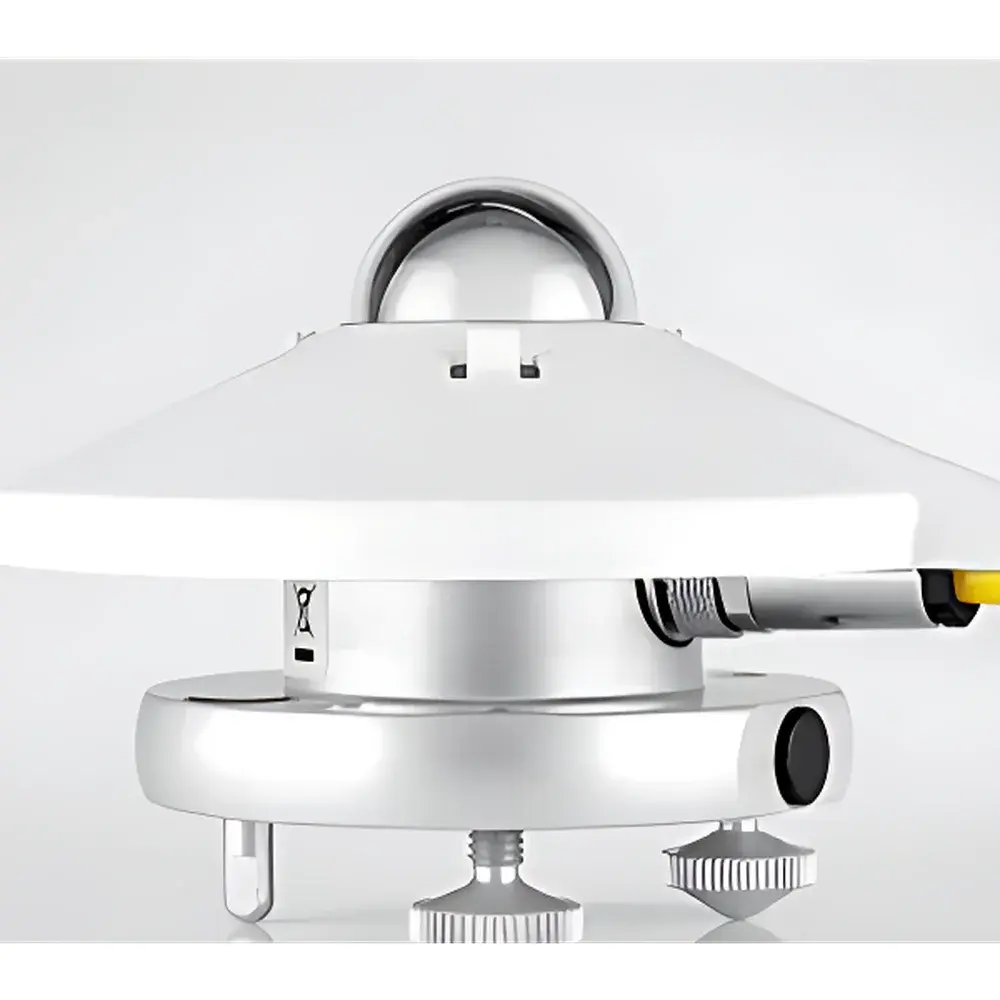
Kipp & Zonen SMP3 Smart Pyranometer
| Brand | Kipp & Zonen |
|---|---|
| Origin | Netherlands |
| Model | SMP3 |
| Spectral Range | 300–2800 nm |
| Response Time (63%) | < 1.5 s |
| Response Time (95%) | < 12 s |
| Zero Offset A | < 15 W/m² |
| Zero Offset B | < 5 W/m² |
| Directional Error (up to 80°, 1000 W/m² beam) | 20 W/m² |
| Temperature Dependence of Sensitivity (-20 °C to +50 °C) | < 2 % |
| Analog Output (-V version) | 0–1 V |
| Analog Output (-A version) | 4–20 mA |
| Digital Output | 2-wire RS-485 Modbus® RTU |
Overview
The Kipp & Zonen SMP3 Smart Pyranometer is a high-accuracy, thermopile-based radiometric sensor engineered for continuous measurement of global solar irradiance on a horizontal plane—or, when tilted, on inclined surfaces such as photovoltaic (PV) arrays. It operates on the fundamental principle of thermal detection: incident solar radiation heats a blackened thermopile junction, generating a voltage proportional to the irradiance (W/m²) across the spectral range of 300–2800 nm—encompassing the full solar spectrum relevant to terrestrial PV energy conversion and meteorological monitoring. Building upon the field-proven optical and thermal design of the CMP3 series, the SMP3 integrates digital intelligence without compromising metrological integrity. Its core innovation lies in embedded temperature compensation algorithms and factory-calibrated Modbus® RTU communication, enabling real-time correction of thermal drift and direct integration into SCADA, PLC, and automated weather station (AWS) architectures.
Key Features
- Thermopile detector with precision-ground quartz dome and secondary glass dome for optimal cosine response and thermal stability
- Dual-output capability: simultaneous analog (0–1 V or 4–20 mA) and digital (2-wire RS-485 Modbus® RTU) interfaces, eliminating need for external signal converters
- Low-power operation (5–30 VDC), supporting flexible deployment across battery-powered, solar-charged, or mains-supplied systems
- Integrated protection circuitry: reverse polarity, overvoltage (>35 VDC), and short-circuit immunity—critical for unattended outdoor installations
- Uniform sensitivity across all SMP-series instruments (< ±1 % inter-unit variation), enabling seamless sensor replacement without recalibration of data logging systems
- Temperature-compensated output with <2 % sensitivity drift over -20 °C to +50 °C ambient range—validated per ISO 9060:2018 Class C (formerly Secondary Standard)
Sample Compatibility & Compliance
The SMP3 is designed for long-term outdoor exposure under IEC 61215 and IEC 61724-1 compliant PV monitoring environments. Its robust anodized aluminum housing and IP67-rated enclosure ensure resistance to UV degradation, condensation, dust ingress, and thermal cycling. The instrument conforms to the performance criteria defined in ISO 9060:2018 for pyranometers (Class C), including directional response error ≤20 W/m² at 80° zenith angle under 1000 W/m² beam irradiance. While not classified as a Class A or B instrument per ISO 9060:2018, its documented zero-offset characteristics (A < 15 W/m², B < 5 W/m²) and fast thermal response (<12 s to 95%) make it suitable for high-temporal-resolution applications such as PV performance ratio analysis, albedo estimation, and cloud transmittance studies where cost-effective scalability is required.
Software & Data Management
Kipp & Zonen provides the free SMP Manager PC software for configuration, diagnostics, and local data visualization. This Windows-based utility enables users to set Modbus® register addresses, adjust scaling factors, perform firmware updates, and validate sensor health via live diagnostic registers (e.g., internal temperature, supply voltage, signal saturation status). All Modbus® registers comply with standard SunSpec Model 103 mapping for interoperability with third-party energy management platforms. Data logs exported from SMP Manager are CSV-formatted and compatible with MATLAB, Python (Pandas), and commercial SCADA historians. For regulated environments requiring audit trails, the SMP3’s deterministic digital output supports time-stamped, non-volatile register reads—facilitating alignment with GLP-aligned QA/QC workflows when paired with compliant data acquisition hardware.
Applications
- Grid-connected and off-grid photovoltaic plant performance monitoring (IEC 61724-1 Tier B/C)
- Solar resource assessment for site feasibility studies and yield modeling
- Albedo and surface reflectance quantification in climatological and ecological research
- Real-time irradiance input for solar forecasting models and demand-side management systems
- Calibration reference transfer within multi-sensor networks where unit interchangeability is critical
- Educational laboratories requiring traceable, low-maintenance solar radiation instrumentation
FAQ
What is the calibration traceability of the SMP3?
The SMP3 is calibrated against Kipp & Zonen’s primary standard reference pyranometer, itself traceable to the World Radiometric Reference (WRR) maintained by PMOD/WRC in Davos, Switzerland.
Can the SMP3 be used for diffuse irradiance measurements?
No—the SMP3 measures global horizontal irradiance (GHI) only. For diffuse component measurements, a shading device (e.g., shadow band or tracker-mounted shade) must be used in conjunction with a second SMP3, following ISO 9060:2018 Annex E protocols.
Is the SMP3 compatible with Campbell Scientific dataloggers?
Yes—via its 4–20 mA or 0–1 V analog outputs, or directly via Modbus® RTU over RS-485 using the CR1000X or CR6 with appropriate interface modules.
Does the SMP3 require periodic recalibration?
Kipp & Zonen recommends recalibration every two years for critical applications; however, its stable thermopile design and uniform sensitivity across units allow field verification using intercomparison methods without immediate lab return.
How is temperature compensation implemented?
Internal NTC thermistor readings feed a microcontroller-executed polynomial correction algorithm applied to raw thermopile output prior to analog/digital conversion—ensuring compensated output is delivered in real time.







