
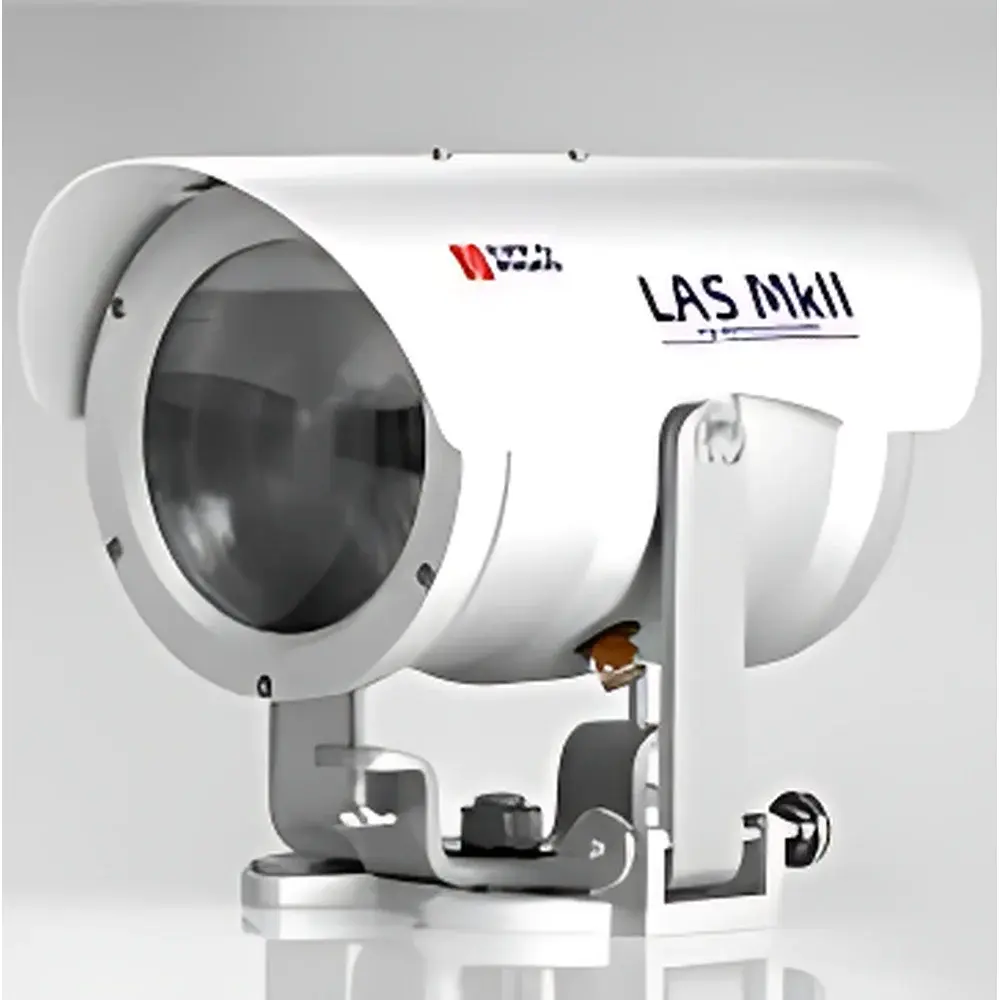
KIPP&ZONEN LAS MkII Large-Aperture Scintillometer
| Brand | KIPP&ZONEN |
|---|---|
| Origin | Netherlands |
| Model | LAS MkII Large-Aperture Scintillometer |
| Aperture Options | 10 cm (path range: 100 m – 1 km) / 15 cm (path range: 250 m – 4.5 km) |
| Operating Wavelength | 850 nm |
| Scintillation Bandwidth | 10⁻¹⁷ – 10⁻¹² m⁻²/³ |
| Power Supply | 12 VDC, 6 W (max 54 W with heater enabled) |
| Dimensions | 400 × 300 × 240 mm (L×H×D) |
| Weight | 8.5 kg |
| Internal Processing | Cn², sensible heat flux (H), and derived turbulence parameters |
| Data Logging | Onboard non-volatile memory for multi-month storage |
| Interface | RS-232/422 digital, 0–2 V analog output |
| Software | EVATION® (real-time monitoring, post-processing, compliance-ready export) |
Overview
The KIPP&ZONEN LAS MkII Large-Aperture Scintillometer is an optoelectronic instrument engineered for continuous, path-integrated measurement of atmospheric refractive index structure parameter (Cn²) and sensible heat flux (H) over horizontal paths ranging from 100 meters to 4.5 kilometers. It operates on the physical principle of optical scintillation—intensity fluctuations in a collimated near-infrared beam (850 nm) induced by turbulent eddies that modulate the local refractive index of air. These fluctuations are directly related to the strength of atmospheric turbulence and, when combined with concurrent micrometeorological data, enable derivation of surface-layer sensible heat flux via the Monin–Obukhov similarity theory. Designed for unattended field deployment in ecological, hydrological, and boundary-layer meteorological research, the LAS MkII delivers high temporal resolution (up to 1 Hz sampling) and long-term stability without requiring co-located eddy covariance towers or complex calibration protocols.
Key Features
- Two aperture configurations: 10 cm optics for short-path applications (100 m – 1 km) and 15 cm optics optimized for extended-path measurements (250 m – 4.5 km), ensuring flexibility across diverse site geometries.
- Integrated digital signal processor within the receiver unit performs real-time computation of Cn², H, and auxiliary turbulence metrics—including integral length scale and dissipation rate—using standardized scintillometric transfer functions.
- Self-contained operation: built-in monochrome LCD display and membrane keyboard allow full local configuration, diagnostics, and real-time data visualization without external computers or software dependencies.
- Low-power architecture: nominal 6 W consumption enables solar-battery autonomy in remote locations; optional integrated heater (max 54 W) prevents dew/frost accumulation on optical surfaces under humid or sub-zero conditions.
- Ruggedized aluminum housing (IP65-rated) with thermal stabilization design ensures consistent optical alignment and measurement repeatability across diurnal temperature cycles and wind loading.
Sample Compatibility & Compliance
The LAS MkII is compatible with standard micrometeorological sensor suites, including optional integrated wind speed, air temperature, and barometric pressure sensors mounted directly inside the receiver enclosure. This modular configuration satisfies requirements for direct H calculation per ISO 18738-2 (2019) and aligns with best practices outlined in the FLUXNET and ICOS observational protocols. All internal computations adhere to the theoretical framework defined in Hill (1992) and Thiermann & Grassl (1992), and raw Cn² time series are traceable to NIST-traceable radiometric standards via factory calibration certificates. The device supports GLP-compliant data integrity through timestamped, write-protected onboard logging and audit-trail-capable firmware (EVATION® v4.2+).
Software & Data Management
EVATION® software—supplied as standard—is a platform-independent application for Windows, macOS, and Linux that provides dual-mode operation: live telemetry monitoring via RS-232/422 and post-acquisition analysis of binary-logged datasets. It supports batch processing of Cn²-to-H conversions using user-defined stability corrections, spectral filtering, and gap-filling algorithms compliant with AmeriFlux Level 2 guidelines. Export modules generate CSV, NetCDF, and CF-1.6-compliant files suitable for ingestion into CRNS, FluxNet-CH4, or EddyPro pipelines. Remote control functionality includes dynamic adjustment of integration time, heater activation thresholds, and alarm triggers—fully scriptable via ASCII command set for integration into SCADA or IoT-based environmental monitoring networks.
Applications
- Surface energy balance closure studies in agricultural, forest, and urban canopy environments.
- Validation of land-surface model parameterizations (e.g., Noah-MP, CLM5) and satellite-derived evapotranspiration products (MOD16, SSEBop).
- Long-term eddy covariance intercomparison campaigns where tower access is restricted or topographically constrained.
- Operational drought monitoring networks requiring path-averaged flux estimates over heterogeneous terrain.
- Boundary-layer height estimation via Cn² gradient profiling in conjunction with RASS or lidar systems.
FAQ
What atmospheric parameters does the LAS MkII measure directly?
The LAS MkII directly measures the refractive index structure parameter Cn² along the optical path. Sensible heat flux (H) is derived indirectly when paired with ancillary meteorological data (temperature, wind speed, pressure) via Monin–Obukhov similarity theory.
Is the LAS MkII suitable for operation in freezing conditions?
Yes—optional integrated heating maintains optical window clarity down to −25 °C; power management logic dynamically engages the heater only when ambient humidity and temperature thresholds indicate condensation risk.
How is data synchronization handled when integrating with other sensors?
The LAS MkII outputs synchronized timestamps (UTC, GPS-referenced if external PPS signal is provided) and supports configurable sample alignment windows (±500 ms) to match external DAQ systems operating at variable scan rates.
Does the instrument require periodic recalibration in the field?
No—factory calibration is stable over the instrument’s operational lifetime. Annual verification against reference Cn² sources (e.g., calibrated turbulence generators) is recommended for metrological traceability in regulatory-grade deployments.
Can the LAS MkII be deployed across water bodies or uneven terrain?
Yes—its large-aperture design minimizes beam wander and scintillation saturation effects, making it robust for cross-valley, coastal, or lake transect measurements where small-aperture scintillometers exhibit reduced dynamic range.







