Kissei SleepSign Recorder for Animal Sleep Deprivation Studies
| Brand | Kissei |
|---|---|
| Origin | Japan |
| Model | SleepSign |
| Device Type | Electrophysiological Sleep Stage Monitoring and Closed-Loop Deprivation System |
| Regulatory Classification | Research-Use-Only (RUO) Instrument for Preclinical Neuroscience |
Overview
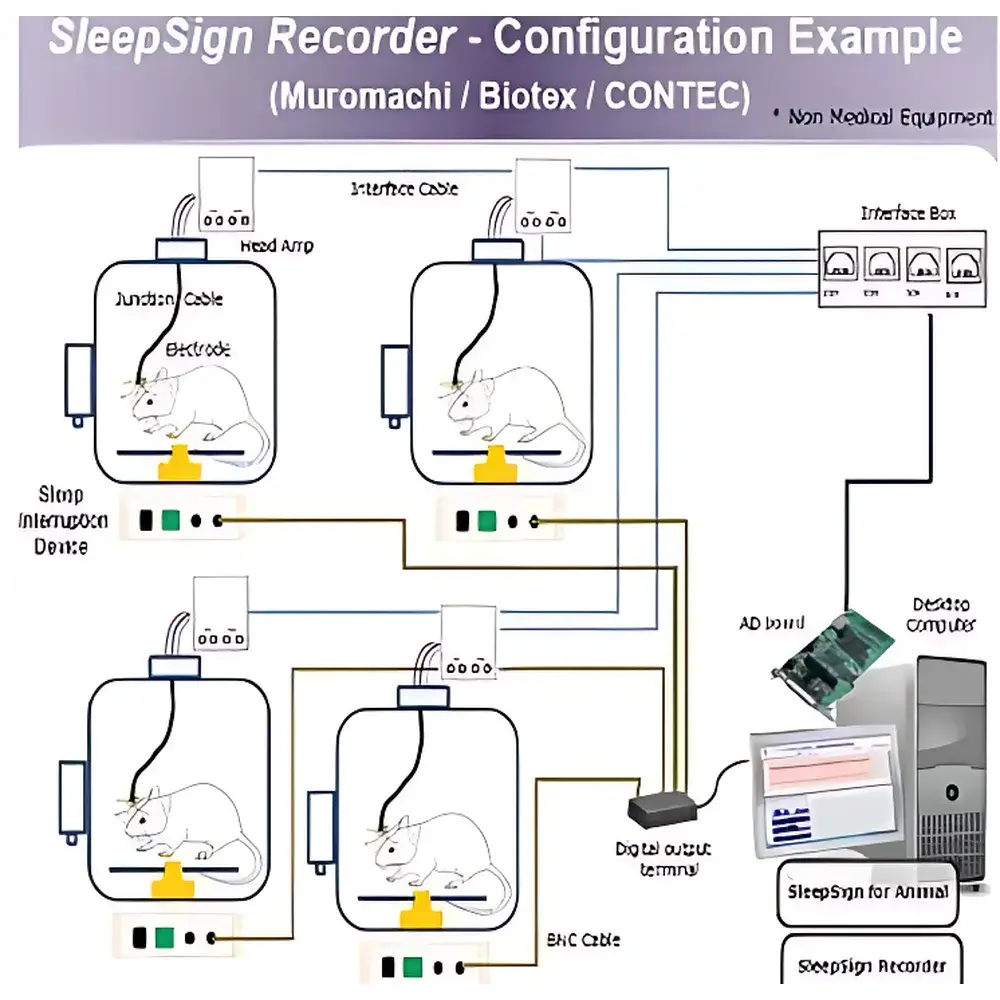
The Kissei SleepSign Recorder is a research-grade electrophysiological monitoring and closed-loop intervention system designed specifically for preclinical sleep neuroscience studies in rodent models. It acquires and digitizes analog electroencephalographic (EEG) and electromyographic (EMG) signals in real time, enabling automated, algorithm-driven classification of vigilance states—including wakefulness, non-rapid eye movement (NREM) sleep, and rapid eye movement (REM) sleep—based on established spectral and amplitude criteria. Unlike open-loop recording systems, SleepSign integrates real-time signal processing with programmable output triggering: upon detection of a predefined sleep stage (e.g., REM onset or sustained NREM), the system generates a precisely timed TTL or analog trigger signal to activate external stimulation hardware—such as gentle tactile stimulators, rotating cages, or auditory cue generators—thereby enforcing controlled, stage-specific sleep deprivation without manual intervention. The system is engineered for high temporal fidelity, low-latency signal analysis (<100 ms end-to-end processing delay), and long-term unattended operation, supporting longitudinal experiments over days or weeks.
Key Features
- Simultaneous dual-channel analog EEG/EMG acquisition with 16-bit resolution and configurable sampling rates (up to 1 kHz per channel)
- Real-time, on-device sleep staging using adaptive spectral power ratio algorithms (delta/theta/beta band ratios, EMG RMS amplitude thresholds)
- Programmable trigger logic: user-defined conditions (e.g., “trigger if REM detected for ≥30 s”) with adjustable latency compensation and pulse width/duration
- Hardware-synchronized I/O interface supporting TTL, ±5 V analog, and opto-isolated outputs for compatibility with third-party stimulators and environmental control units
- Embedded data buffering and SD-card logging (up to 32 GB) ensuring uninterrupted recording during network interruptions or PC downtime
- Modular architecture: base unit supports up to 8 independent animal channels via optional expansion modules (sold separately)
- Calibration-traceable analog inputs with factory-certified gain linearity (±0.5% FS) and input impedance >1 GΩ
Sample Compatibility & Compliance
SleepSign is validated for use with adult Sprague-Dawley and C57BL/6 mice and rats (20–40 g). Electrode configurations follow standardized stereotaxic placements (e.g., frontal-parietal EEG leads, nuchal EMG wires) compatible with common surgical implantation kits. All signal conditioning circuits comply with IEC 61000-4-5 surge immunity and IEC 61000-4-3 radiated immunity standards. As a Research-Use-Only (RUO) instrument, SleepSign does not carry CE IVD, FDA 510(k), or ISO 13485 certification; however, its data output format (binary .ssd + metadata-rich XML) is structured to support ALCOA+ principles (Attributable, Legible, Contemporaneous, Original, Accurate, Complete, Consistent, Enduring, Available) for GLP-compliant study documentation. Raw signal archives are fully compatible with MATLAB, Python (via scipy.io and neo libraries), and commercial neuroinformatics platforms including Spike2 and NeuroExplorer.
Software & Data Management
The SleepSign Control Suite (v4.2+, Windows 10/11 64-bit) provides unified configuration, real-time visualization, offline staging review, and report generation. Staging algorithms are fully parameterizable—users may adjust spectral band boundaries, power threshold sensitivities, and inter-stage refractory periods to match strain- or protocol-specific neurophysiology. All acquisition sessions are automatically timestamped using GPS-synchronized NTP and include embedded audit trails: every parameter change, trigger event, and software restart is logged with user ID, system time, and hash-verified integrity tags. Export options include CSV (epoch-wise staging), EDF+ (for interoperability with SleepSign-compatible viewers), and HDF5 (for large-scale machine learning pipelines). The software supports 21 CFR Part 11-compliant user role management (Admin, Operator, Reviewer) and electronic signature workflows when deployed on validated IT infrastructure.
Applications
- Investigation of sleep homeostasis and circadian regulation in genetic knockout models
- Evaluation of pharmacological agents targeting orexin, GABAA, or adenosine receptors on sleep architecture
- Chronic partial sleep restriction paradigms modeling shift-work disorder or insomnia
- REM-sleep-specific deprivation to assess synaptic plasticity, memory consolidation, and emotional regulation
- Integration with optogenetic or chemogenetic stimulation to probe causal neural circuit mechanisms of sleep-wake transitions
- Validation of non-invasive sleep scoring algorithms against gold-standard polygraphic recordings
FAQ
Is SleepSign compatible with existing EEG/EMG amplifier systems?
Yes—SleepSign accepts standard ±5 V analog inputs and includes configurable gain settings to interface directly with most commercially available bioamplifiers (e.g., Grass, TDT, Intan, OpenEPhys).
Can staging parameters be modified for species other than mice/rats?
While default algorithms are optimized for murine electrophysiology, users may retrain or manually tune spectral thresholds using annotated ground-truth datasets from other species (e.g., hamsters, zebrafish larvae) via the offline calibration module.
Does the system support wireless telemetry?
No—SleepSign is designed for tethered, high-fidelity wired recordings to ensure signal integrity and precise trigger timing. Wireless integration requires external telemetry receivers with analog output capability.
What is the maximum continuous recording duration?
Limited only by storage capacity: with 32 GB SD card and 1-kHz dual-channel acquisition, >72 hours of raw data can be stored locally before transfer; continuous multi-day experiments require periodic offloading or network-attached storage configuration.