
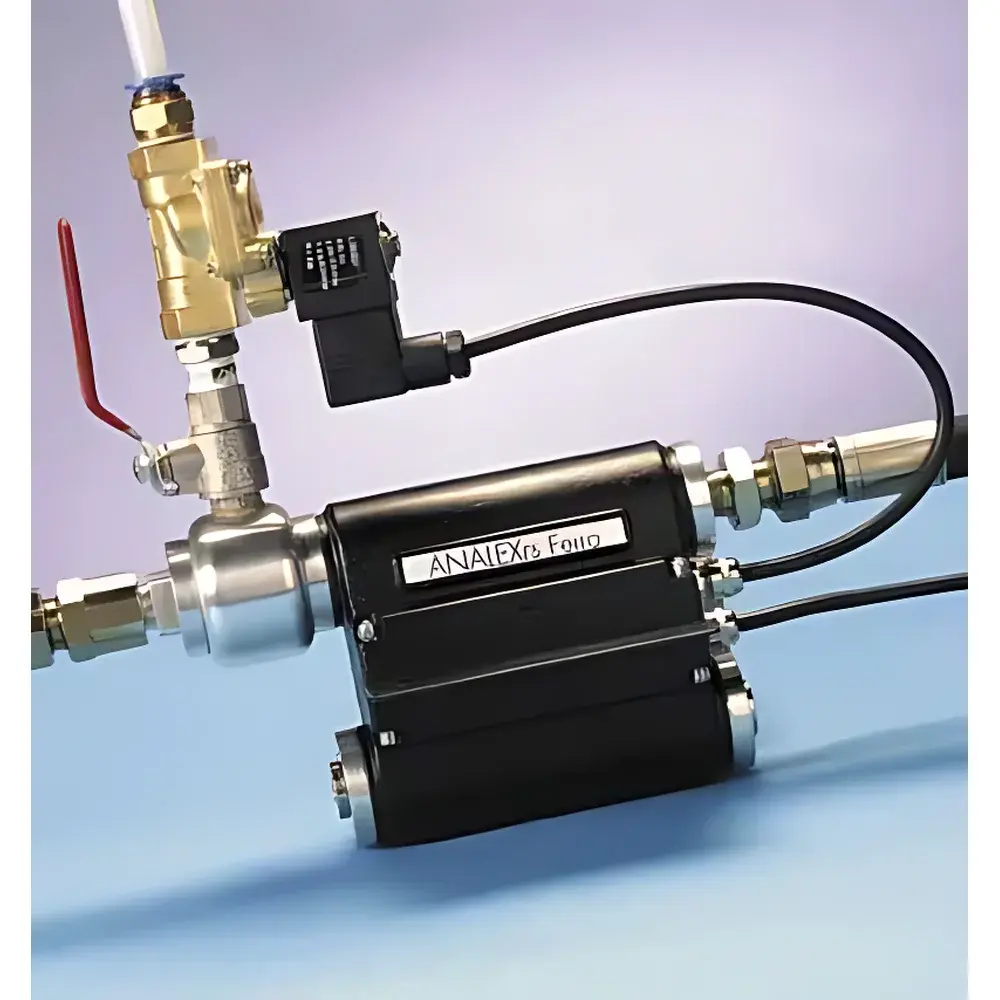
Kittiwake FG-K16120-KW Online Ferrous Debris Sensor
| Brand | Kittiwake |
|---|---|
| Origin | United Kingdom |
| Manufacturer Type | Authorized Distributor |
| Origin Category | Imported |
| Model | FG-K16120-KW |
| Pricing | Upon Request |
| Communication Interfaces | CAN Bus, RS232, RS485, Wireless Network |
| Sensor Port | BSP 3/8″ |
| Compatible Fluids | Mineral Oils, Synthetic Lubricants, Hydraulic Fluids |
| Fluid Temperature Range | −20 to +65 °C |
| Maximum Operating Pressure | 10 bar |
| Power Supply | 18–30 VDC |
| Ingress Protection Rating | IP65 |
| Ferrous Debris Detection Range | 0–2000 ppm (by mass) |
| Weight | 2.2 kg |
Overview
The Kittiwake FG-K16120-KW Online Ferrous Debris Sensor is an industrial-grade condition monitoring instrument engineered for continuous, real-time detection and quantification of ferromagnetic wear particles suspended in circulating lubricating or hydraulic oils. Utilizing inductive magnetic field perturbation measurement—principally based on Faraday’s law of electromagnetic induction—the sensor detects changes in magnetic flux density caused by ferrous debris passing through its calibrated sensing zone. Unlike optical or gravimetric methods, this technique provides direct, non-intrusive correlation between particle mass concentration (ppm) and induced signal amplitude, enabling early-stage wear trend identification before catastrophic failure occurs. Designed for integration into machinery health monitoring systems—including gas turbines, marine diesel engines, wind turbine gearboxes, and large industrial compressors—the FG-K16120-KW operates inline without flow interruption and delivers repeatable, temperature-compensated output under dynamic operating conditions.
Key Features
- Robust stainless-steel housing with integrated magnetic shielding to suppress external electromagnetic interference (EMI), ensuring signal integrity in electrically noisy environments such as engine rooms or power generation facilities.
- BSP 3/8″ threaded port for standardized, leak-tight installation directly into pressurized oil circulation lines—no bypass loop or auxiliary plumbing required.
- Wide operational fluid temperature range (−20 to +65 °C) supported by internal thermal compensation algorithms, maintaining measurement stability across seasonal or load-dependent thermal transients.
- Multi-protocol digital connectivity: native support for CAN bus (J1939-compliant), RS232, RS485 (Modbus RTU), and optional wireless telemetry modules (Wi-Fi or cellular) for SCADA and IIoT platform integration.
- Integrated backlit LCD display showing real-time debris concentration (ppm), fluid temperature, system status, and diagnostic flags—enabling local verification without external instrumentation.
- IP65-rated enclosure certified for outdoor or semi-outdoor deployment, resistant to dust ingress and low-pressure water jets per IEC 60529.
Sample Compatibility & Compliance
The FG-K16120-KW is validated for use with mineral-based, PAO, and ester-type synthetic lubricants, as well as phosphate-ester and polyalkylene glycol (PAG) hydraulic fluids. It is not intended for use with non-conductive or highly viscous fluids (>ISO VG 220 at 40 °C) where particle suspension kinetics may compromise detection sensitivity. The sensor conforms to EN 61000-6-2 (immunity) and EN 61000-6-4 (emissions) for industrial electromagnetic compatibility. Its mechanical design complies with ISO 4406:2017 Annex B guidelines for particle counting instrumentation interfaces, and electrical safety meets IEC 61000-1-2 requirements. For regulated industries, raw data logs and configuration parameters can be exported in CSV format compatible with FDA 21 CFR Part 11–compliant audit trail frameworks when paired with Kittiwake’s K-Monitor software.
Software & Data Management
The sensor interfaces seamlessly with Kittiwake’s K-Monitor Suite—a Windows-based asset health analytics platform supporting time-series trending, alarm thresholding (predefined or adaptive), and automated report generation (PDF/Excel). All communication channels support timestamped, CRC-verified data packets. When deployed in networked configurations, the device supports MQTT over TLS for secure cloud ingestion into AWS IoT Core or Microsoft Azure IoT Hub. Firmware updates are delivered via signed binary packages with SHA-256 validation. Internal non-volatile memory retains up to 30 days of 1-minute interval data (concentration, temperature, pressure status) in case of upstream communication loss—ensuring no critical event gap during transient network outages.
Applications
- Early detection of abnormal wear in main propulsion engines and auxiliary generators aboard commercial vessels—supporting Class Society recommendations (e.g., DNV GL SEEMP, LR Machinery Condition Monitoring Guidelines).
- Continuous monitoring of gearbox oil in offshore wind turbines, where unplanned downtime incurs high logistical costs and safety risks.
- Trend-based maintenance scheduling for critical rotating equipment in petrochemical refineries and power plants, aligned with ISO 17359 and ISO 20816-3 vibration and oil analysis best practices.
- Verification of filter efficiency and oil reclamation system performance in hydraulic systems used in mobile construction equipment.
- Baseline wear characterization during commissioning and post-overhaul validation testing of turbomachinery.
FAQ
What particle size range does the FG-K16120-KW detect?
It responds primarily to ferrous particles ≥10 µm in equivalent spherical diameter, with greatest sensitivity between 25–200 µm—covering the most mechanically significant wear debris generated by gear pitting, bearing spalling, and journal surface fatigue.
Can the sensor distinguish between different ferrous alloys?
No—it measures total ferromagnetic mass concentration only. Alloy-specific identification requires complementary techniques such as SEM-EDS or ferrography.
Is calibration traceable to national standards?
Yes—factory calibration uses NIST-traceable ferrous particle suspensions prepared per ASTM D7690 practice, with certificate of calibration provided per unit.
Does it require periodic zeroing or field recalibration?
No—its solid-state magnetic architecture eliminates drift; however, baseline verification using clean reference oil is recommended annually or after major system maintenance.
How is pressure compensation handled?
The sensor incorporates a piezoresistive pressure transducer co-located with the magnetic sensing element, enabling real-time correction of permeability effects induced by pressure-dependent oil density changes.



