
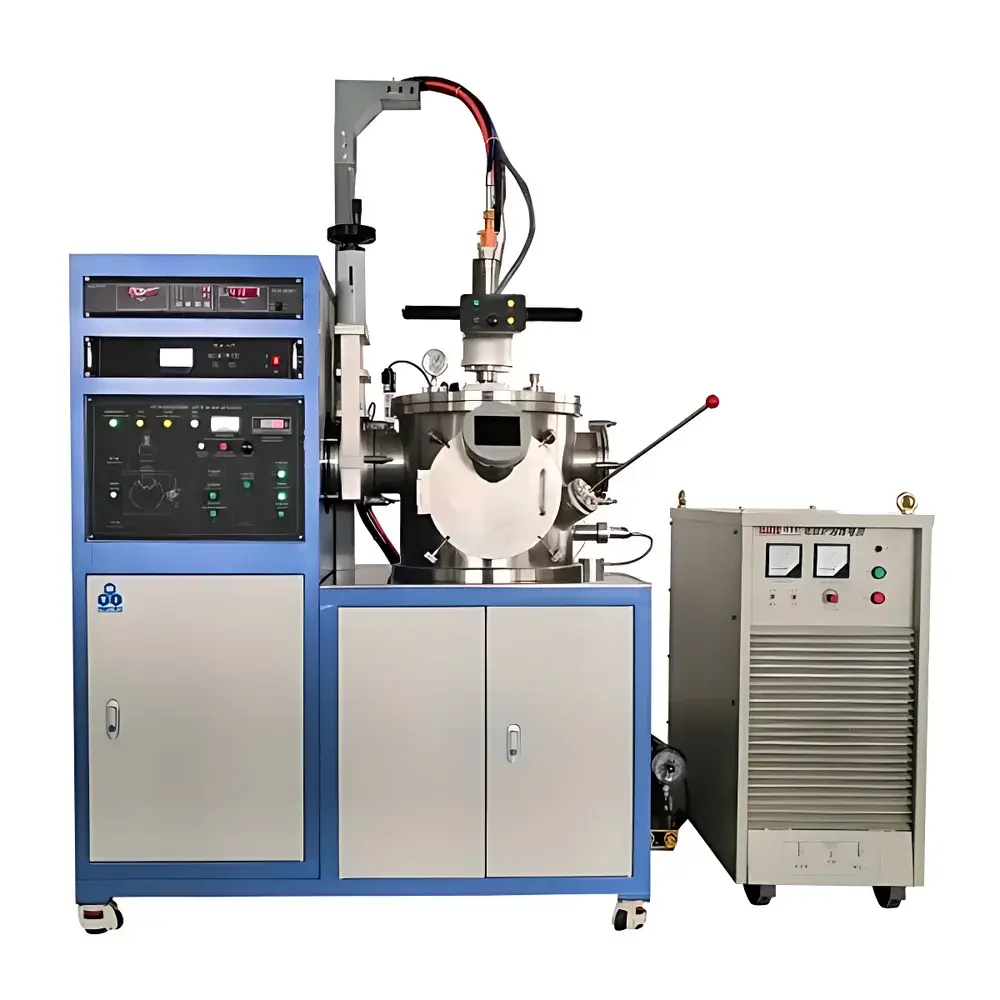
KJ GROUP AM-800-3 Triple-Station High-Vacuum Arc Melting Furnace
| Brand | KJ GROUP |
|---|---|
| Origin | Liaoning, China |
| Manufacturer Type | Authorized Distributor |
| Origin Category | Domestic (China) |
| Model | AM-800-3 |
| Price | Upon Request |
| Power Supply | 15 kW, 380 V AC, 3-phase, 50/60 Hz |
| Max Arc Current | 800 A |
| Chamber Vacuum | ≤1×10⁻⁶ Torr (with turbomolecular pump, cold state) |
| Chamber Dimensions | Φ400 mm × 350 mm |
| Construction | Double-Walled Water-Cooled SS304 Stainless Steel |
| Observation Window | Fused Quartz |
| Crucible | Water-Cooled Copper, Triple-Station Configuration |
| Station 1 | 80 g capacity with magnetic stirring |
| Station 2 | 150 g capacity with vacuum suction casting |
| Station 3 | 200 g capacity (max) |
| Working Atmosphere | High-Purity Argon (≥5.0 N) or Ar–H₂ (5% H₂ / 95% Ar) |
| Electrode Drive | Motorized Vertical Adjustment |
| Sample Manipulation | Manual Mechanical Rod (vacuum-compatible) |
| Optional Accessories | Recirculating Chiller, Dust Filter, Gas Purification Module, Quartz Shield |
Overview
The KJ GROUP AM-800-3 Triple-Station High-Vacuum Arc Melting Furnace is an engineered solution for reproducible, atmosphere-controlled metallurgical synthesis of advanced alloys, intermetallics, and refractory metal systems. It operates on the principle of direct-current (DC) arc melting under high-purity inert or reducing atmospheres—typically ≥5.0 N argon or controlled Ar–H₂ mixtures—enabling precise thermal processing without oxide contamination. Unlike induction or resistance furnaces, arc melting delivers localized, ultra-high-temperature energy (>3,500 °C at the arc spot) directly to the charge, ensuring rapid and uniform melting of high-melting-point metals such as Ti, Nb, Zr, Mo, and Ta-based compositions. The triple-station copper crucible design permits parallel or sequential experimentation across three distinct operational configurations—magnetic stirring, vacuum suction casting, and high-capacity static melting—making it ideal for combinatorial alloy development, phase diagram validation, and small-batch ingot production in R&D laboratories and materials science departments.
Key Features
- Triple-station water-cooled copper crucible system enabling concurrent or comparative melt experiments: Station 1 (80 g, integrated magnetic stirrer for homogenization); Station 2 (150 g, vacuum-assisted suction casting for directional solidification studies); Station 3 (200 g, maximum capacity for bulk ingot preparation)
- Double-walled, water-jacketed SS304 stainless steel chamber with fused quartz viewport for real-time visual monitoring under vacuum or inert gas conditions
- Motor-driven tungsten or thoriated tungsten electrode with programmable vertical positioning—ensuring consistent arc initiation, stable arc length control, and repeatable power delivery
- Integrated manual mechanical manipulator rod rated for operation at pressures down to 10⁻⁶ Torr, allowing safe sample reorientation or post-melt handling without venting
- High-vacuum architecture featuring a turbomolecular pumping system capable of achieving ≤1×10⁻⁶ Torr base pressure (cold state), verified per ASTM E575–21 standards for vacuum integrity testing
- Compliance-ready electrical and cooling interfaces: 15 kW DC arc power supply (380 V, 3-phase, 50/60 Hz), rated for peak currents up to 800 A; optional recirculating chiller supports continuous thermal management of crucible, chamber walls, and electrode
Sample Compatibility & Compliance
The AM-800-3 accommodates metallic feedstock in elemental, master-alloy, or pre-alloyed pellet form—compatible with Ti-, Ni-, Co-, Fe-, Al-, Cu-, and refractory-based systems. It supports GMP-aligned process documentation when paired with external data loggers (e.g., temperature, pressure, current, arc voltage). While not certified to ISO 13485 or FDA 21 CFR Part 11 out-of-the-box, its modular architecture allows integration with third-party audit-trail software and calibrated sensor inputs required for GLP/GMP environments. All vacuum and gas-handling components meet ASME B31.3 process piping guidelines for high-purity gas service. Users must implement appropriate dust filtration (optional accessory) upstream of the turbomolecular pump to maintain long-term pump performance and comply with ISO 8573-1 Class 2 particulate limits.
Software & Data Management
The furnace operates via a dedicated industrial PLC-based control panel with analog and digital I/O for real-time monitoring of arc current, chamber pressure, cooling water flow rate, and electrode position. While the base system does not include embedded PC software, it provides RS485/Modbus RTU and analog 4–20 mA outputs for seamless integration into LabVIEW, MATLAB, or SCADA platforms. Optional data acquisition modules support time-stamped logging of up to 16 parameters at 1 Hz resolution—enabling traceability per ISO/IEC 17025:2017 Clause 7.7 (measurement uncertainty and record retention). All operational setpoints and event logs can be exported in CSV format for internal quality review or regulatory submission.
Applications
- Rapid prototyping of multi-component alloy libraries for high-entropy alloy (HEA) discovery
- Preparation of homogeneous master alloys for subsequent casting, powder metallurgy, or additive manufacturing feedstock
- Thermodynamic validation of metastable phase formation under controlled cooling rates (via suction-casting station)
- Microstructure refinement studies using in-situ magnetic stirring to suppress macrosegregation
- Reactive metal purification (e.g., Ti, Zr) via repeated melting under ultra-high-purity argon
- Hydrogen-assisted melting of Nb–Ti–Ta systems for hydride-phase exploration
FAQ
What is the minimum recommended argon purity for stable arc operation?
High-purity argon ≥5.0 N (99.999%) is mandatory; impurities >10 ppm O₂ or H₂O destabilize the arc column and promote oxide inclusion. A gas purification module (optional) reduces residual H₂O to <0.1 ppm and O₂ to <1 ppm.
Can the furnace operate under hydrogen-containing atmospheres safely?
Yes—when configured with 5% H₂ / 95% Ar mixture and equipped with explosion-proof venting, leak-tested gas lines, and H₂-compatible seals per CGA G-13 guidelines. Hydrogen partial pressure must remain below 0.05 MPa during operation.
Is the magnetic stirring function compatible with all crucible stations?
No—only Station 1 (80 g capacity) integrates a sealed, water-cooled magnetic drive system. Stirring speed is manually adjustable from 0–300 rpm via external rheostat.
Why is chamber pressure restricted to 0.01–0.11 MPa during melting?
Arc stability and electrode lifetime are optimized within this micro-positive pressure range. Operating under high vacuum (0.12 MPa) risks seal failure and compromises observation window integrity.
What safety certifications apply to the mechanical manipulator rod?
The rod assembly conforms to ISO 14120:2015 (guards—general requirements) and is rated for vacuum use per ASTM F2622–20 (leak testing of vacuum components). Operators must wear ANSI Z87.1-compliant face shields during arc ignition and melting phases.



