
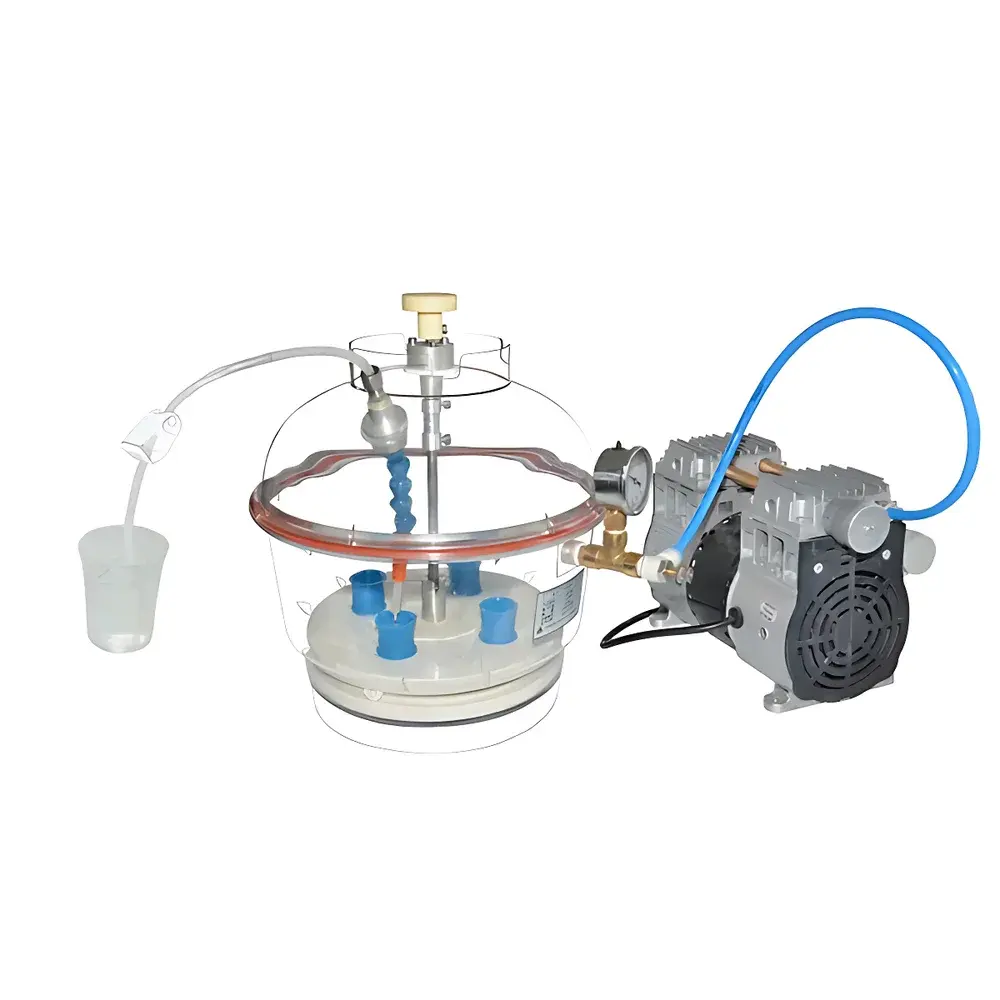
KJ GROUP CXQ-2500 Vacuum Cold Mounting Press
| Brand | KJ GROUP |
|---|---|
| Origin | Liaoning, China |
| Model | CXQ-2500 |
| Instrument Type | Cold Mounting Press |
| Vacuum Level | –0.08 MPa |
| Rotating Plate Diameter | Ø205 mm |
| Overall Dimensions | Ø280 mm × 330 mm |
| Required Vacuum Pump Range | 0 to –0.1 MPa |
| Operating Environment | Altitude <1000 m, Temperature 25°C ±15°C, Relative Humidity 55% RH ±10% RH |
| Accessories Included | (1) Rotating Plate, (10) Inlet Tubes, (1) Oil-Free Vacuum Pump, (6) Mounting Molds, (5) Resin Cups, (5) Stirring Rods |
Overview
The KJ GROUP CXQ-2500 Vacuum Cold Mounting Press is an engineered solution for precision cold embedding of temperature-sensitive, porous, or structurally fragile specimens—commonly encountered in metallurgy, electronics failure analysis, geology, and composite materials research. Unlike hot compression mounting—which subjects samples to elevated temperatures and mechanical pressure—the CXQ-2500 employs vacuum-assisted impregnation at ambient temperature. Its core operating principle relies on controlled evacuation of air from specimen interstices (e.g., microvoids in PCBs, capillary networks in sedimentary rock, or open porosity in sintered ceramics), followed by atmospheric-pressure-driven infiltration of low-viscosity epoxy, acrylic, or dye-based embedding media. This process preserves thermal integrity, prevents distortion of heat-labile phases, and ensures complete resin penetration into sub-50 µm features. The unit’s compact footprint (Ø280 mm × 330 mm) and integrated rotating plate (Ø205 mm) support simultaneous multi-sample processing without cross-contamination, making it suitable for high-throughput QA/QC labs and academic core facilities.
Key Features
- Vacuum chamber with stable –0.08 MPa operational vacuum level, compatible with standard oil-free vacuum pumps delivering up to –0.1 MPa
- Motor-driven rotating plate (Ø205 mm) enabling uniform resin distribution and bubble disengagement during infiltration
- Modular mold system: six interchangeable mounting molds accommodate diverse specimen geometries—from irregular geological fragments to standardized metallographic discs (up to 30 mm diameter)
- Five calibrated resin cups and five PTFE-coated stirring rods facilitate precise resin-to-hardener ratio preparation and contamination-free mixing
- No electrical heating elements or hydraulic systems: eliminates thermal drift, fire hazard, and maintenance associated with hot presses
- Integrated ventilation interface compliant with ISO 14644-1 Class 8 cleanroom-compatible exhaust ducting requirements
Sample Compatibility & Compliance
The CXQ-2500 accommodates specimens incompatible with thermal stress—including printed circuit boards (PCBs) with solder mask integrity concerns, fiber-reinforced polymers, biological tissue sections pre-stained with histochemical dyes, and friable sedimentary or volcanic rock samples. Its vacuum infiltration method aligns with ASTM E3–22 (Standard Guide for Preparation of Metallographic Specimens) and ISO 15510:2021 (Metallic materials — Metallographic specimen preparation). When used with dye-infused resins for defect visualization, the system supports non-destructive evaluation workflows referenced in IPC-A-600 and MIL-STD-883H (Method 2010). All wetted components are chemically resistant to common embedding media (e.g., Epofix®, Technovit® 5071, and methyl methacrylate formulations), ensuring long-term repeatability under GLP-compliant documentation protocols.
Software & Data Management
The CXQ-2500 operates as a standalone electromechanical platform with no embedded firmware or digital interface. Process parameters—including vacuum dwell time, rotation speed (mechanically fixed), and ambient temperature/humidity—are recorded manually in laboratory notebooks or LIMS-integrated electronic logbooks. For audit readiness, users may configure external environmental monitoring (e.g., Vaisala HMP7 humidity/temperature probes) linked to 21 CFR Part 11–compliant data acquisition systems. Maintenance logs for vacuum pump calibration, mold sterilization cycles, and resin batch traceability are recommended per ISO/IEC 17025:2017 Clause 7.6 (Traceability of Measurements).
Applications
- Failure analysis of microelectronic packages: void detection in underfill regions using fluorescent dye infiltration
- Petrographic thin-section preparation: consolidation of unconsolidated sandstone or clay-rich cores prior to sawing
- Quality control of additive-manufactured metal parts: revealing internal porosity and lack-of-fusion defects
- Archaeometallurgical sample stabilization: embedding corroded artifacts without accelerating oxidative degradation
- Forensic material comparison: embedding fractured polymer evidence for stereoscopic fracture surface analysis
FAQ
Does the CXQ-2500 require electrical power for operation?
No—the press itself is purely mechanical and vacuum-driven; only the externally connected oil-free vacuum pump requires AC power.
Can the CXQ-2500 be used with conductive resins for SEM sample preparation?
Yes—its ambient-temperature process preserves the conductivity of carbon- or metal-filled resins, provided compatibility with the selected hardener is verified per manufacturer SDS.
What is the maximum specimen height accommodated by the standard molds?
Standard molds support specimens up to 25 mm in height; custom-depth molds can be fabricated upon request with dimensional validation against ISO 1442:2020 mounting geometry tolerances.
Is vacuum pump calibration traceable to national standards?
Vacuum pump calibration must be performed annually using a NIST-traceable digital manometer (e.g., Druck DPI 141) per ISO 5725-2:2022 accuracy verification guidelines.
How frequently should the rotating plate bearing be lubricated?
The sealed stainless-steel bearing requires no routine lubrication; periodic inspection for particulate ingress is recommended every 200 operational cycles.



