
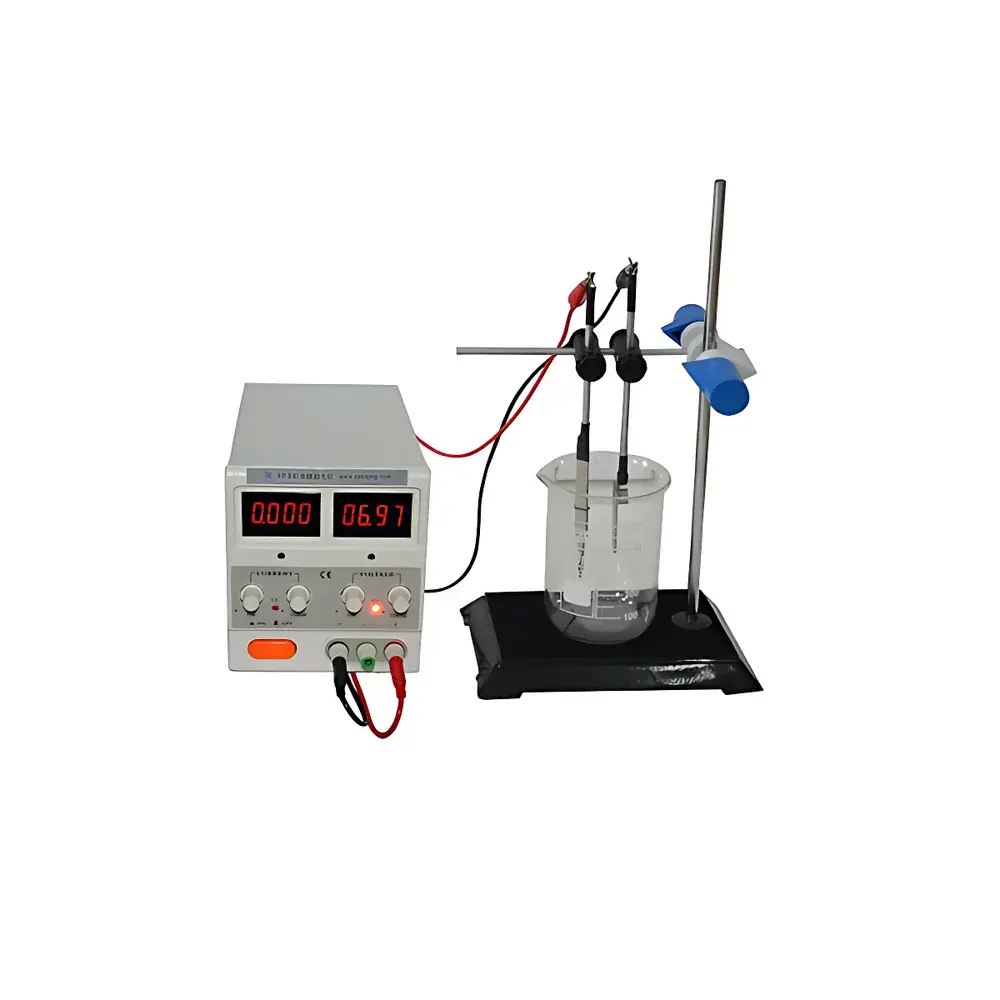
KJ GROUP EP-530 Electrolytic Polishing and Etching Unit
| Brand | KJ GROUP |
|---|---|
| Model | EP-530 |
| Input Voltage | 104–127 VAC (60 Hz) or 207–253 VAC (50 Hz) |
| Output Voltage Range | 0–30 V DC |
| Output Current Range | 0–5 A DC |
| Voltage Resolution | 10 mV |
| Current Resolution | 1 mA |
| Operating Temperature | 0–40 °C |
| Relative Humidity | <90% RH |
| Dimensions | 255 × 130 × 155 mm |
| Weight | 2.0 kg |
| Protection Features | Current limiting, short-circuit protection, thermal overload protection |
| Sample Holder | Stainless steel sample clamp (1 pc), stainless steel cathode plate (50 × 20 × 5 mm, 1 pc), 150 mL glass beaker (1 pc), sample stage (1 pc), petri dish pair (1 set) |
Overview
The KJ GROUP EP-530 Electrolytic Polishing and Etching Unit is a compact, benchtop DC power supply system engineered specifically for controlled electrochemical surface preparation of metallic specimens in metallurgical and materials science laboratories. It operates on the principle of anodic dissolution—applying a regulated direct current between a conductive specimen (anode) and a counter electrode (cathode) immersed in a suitable electrolyte to selectively remove surface material at the microstructural level. Unlike mechanical polishing, this process eliminates plastic deformation, smearing, and subsurface damage, yielding artifact-free surfaces ideal for high-resolution optical microscopy, scanning electron microscopy (SEM), and electron backscatter diffraction (EBSD) analysis. The EP-530 supports both electropolishing (for surface smoothing and grain boundary delineation) and electrochemical etching (for phase contrast enhancement), making it a dual-function instrument compliant with standard metallographic preparation workflows defined in ASTM E3, ISO 3887, and ASTM E407.
Key Features
- True dual-mode operation: independent selection and precise control of voltage (0–30 V) and current (0–5 A) for both electropolishing and electrochemical etching protocols.
- Automatic constant-voltage/constant-current mode switching: real-time regulation ensures stable electrochemical conditions even under variable electrolyte resistance or evolving surface morphology.
- Dual high-resolution digital displays: simultaneous readout of actual output voltage (10 mV resolution) and current (1 mA resolution), enabling immediate feedback during parameter optimization.
- Compact footprint (255 × 130 × 155 mm) and lightweight design (2.0 kg): facilitates deployment in space-constrained labs, mobile field units, or teaching environments without requiring dedicated power conditioning.
- Comprehensive safety architecture: integrated current limiting, short-circuit detection, and thermal overload protection prevent equipment damage and ensure operator safety during extended or unattended runs.
- Wide-input universal AC compatibility: accepts 104–127 VAC (60 Hz) or 207–253 VAC (50 Hz), eliminating need for external transformers in global laboratory settings.
Sample Compatibility & Compliance
The EP-530 is compatible with common non-ferrous and ferrous alloys—including aluminum, copper, stainless steels (e.g., 304, 316), titanium, nickel-based superalloys, and magnesium—when paired with appropriate electrolytes such as perchloric acid–ethanol mixtures, phosphoric–chromic acid solutions, or oxalic acid baths. Its output stability (<0.5% ripple) and resolution support reproducible preparation across batched samples, meeting repeatability requirements outlined in ISO/IEC 17025-accredited metallography labs. All electrical components conform to IEC 61010-1 safety standards for laboratory equipment. While the unit itself does not carry CE or UL certification, its design adheres to fundamental risk mitigation principles required for GLP-compliant sample preparation workflows.
Software & Data Management
The EP-530 is a manually operated analog-digital hybrid instrument with no embedded firmware or data logging capability. Parameter values are displayed in real time but are not stored or exportable. For traceability in regulated environments (e.g., aerospace QA or medical device R&D), users are advised to document settings via lab notebooks or LIMS-integrated electronic records. When used alongside optional accessories such as the SFM-200T thermostatically controlled magnetic stirrer, temperature-stabilized electrolyte conditions can be maintained—critical for achieving consistent etch rates per ASTM E112 and ISO 643. No proprietary software or drivers are required; operation is fully hardware-based and maintenance-free.
Applications
- Routine metallographic specimen preparation for quality control in foundries, heat treatment facilities, and additive manufacturing post-processing labs.
- Grain boundary revelation and phase contrast enhancement in research-grade microstructure characterization (e.g., precipitate distribution in Al-Mg-Si alloys or carbide networks in tool steels).
- Surface finishing of TEM foil edges prior to ion milling to reduce edge damage and improve electron transparency.
- Field-deployable microstructural assessment in geotechnical or forensic metallurgy applications where portability and battery-inverter compatibility are essential.
- Undergraduate and graduate teaching labs: enables hands-on instruction in electrochemical kinetics, passivation behavior, and microstructural response to anodic polarization.
FAQ
Does the EP-530 support programmable ramping or timed endpoint control?
No. The EP-530 provides manual, continuous adjustment of voltage and current only. Timing and endpoint determination must be performed externally using stopwatch protocols or visual/microscopic observation.
Can the EP-530 be used with acidic or hazardous electrolytes?
Yes—provided proper fume hood ventilation, chemical-resistant gloves, and PPE are employed. The unit’s housing is sealed against incidental splashes, but electrolyte containment remains the responsibility of the user’s vessel selection (e.g., glass beaker or PTFE cell).
Is calibration required or supported by the manufacturer?
The EP-530 does not include user-accessible calibration routines. Voltage and current outputs are factory-trimmed for linearity across full range; periodic verification with a NIST-traceable multimeter is recommended for critical applications.
What is the recommended maintenance interval?
No scheduled maintenance is required. Wipe exterior surfaces with isopropyl alcohol; inspect terminals for corrosion after use with aggressive electrolytes. Avoid exposing internal electronics to condensation or solvent vapors.
Is the EP-530 compatible with automated sample changers or robotic workstations?
Not natively. It lacks digital I/O, RS-232/USB interfaces, or TTL triggers. Integration into automated workflows would require external relay control modules and custom scripting.



