
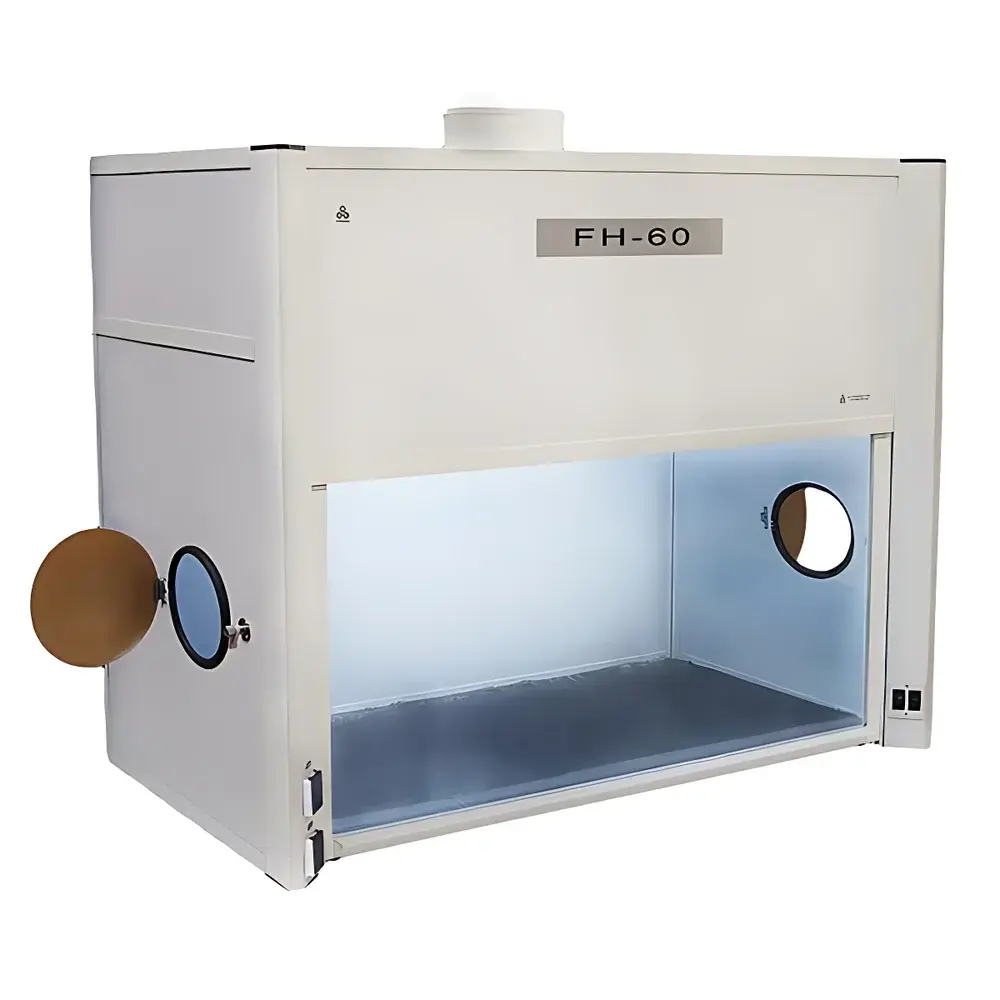
KJ GROUP FH-60 Desktop Fume Hood
| Brand | KJ GROUP |
|---|---|
| Origin | Liaoning, China |
| Manufacturer Type | Authorized Distributor |
| Country of Origin | China |
| Model | FH-60 Desktop Fume Hood |
| Power Supply | 220 V AC, 50 Hz, Single-phase |
| Blower | Centrifugal, 300 W, 1.5 A, 1440 rpm |
| Dimensions (W×D×H) | 68" × 32" × 57" |
| Construction | Stainless steel frame, tempered glass sash with explosion-resistant film, corrosion-resistant composite work surface, flame-retardant compact composite rear/side panels |
| Filtration | Integrated activated carbon filter cartridge |
| Lighting | Low-voltage, spark-free LED explosion-proof lamp |
| Accessory Ports | (1) 10" ductless exhaust port (flex hose not included) |
| Optional | Digital blower speed controller |
Overview
The KJ GROUP FH-60 Desktop Fume Hood is an engineered solution for localized containment and chemical vapor mitigation in low-to-moderate hazard laboratory environments. Designed on the principle of ductless (recirculating) fume extraction, it employs a dual-stage filtration system—primarily relying on high-capacity activated carbon media—to adsorb organic vapors, acids, and other volatile contaminants before returning conditioned air to the lab space. Unlike traditional ducted hoods requiring building infrastructure, the FH-60 operates as a self-contained unit, making it suitable for temporary setups, teaching labs, satellite workstations, or facilities where structural ducting is impractical. Its compact footprint and vertical sash configuration support ergonomic access while maintaining face velocity integrity across the working aperture. The hood conforms to general laboratory safety principles outlined in ANSI/ASHRAE Standard 110–2016 (Method of Testing Performance of Laboratory Fume Hoods) for qualitative airflow visualization and containment verification, though quantitative certification requires third-party testing under controlled conditions.
Key Features
- Structural integrity ensured by a welded stainless steel support frame, providing long-term resistance to mechanical stress and chemical exposure.
- Tempered glass sash with integrated explosion-resistant film—meets EN 12600 Class P2 safety rating for impact resistance and fragmentation control.
- Corrosion-resistant composite work surface engineered for compatibility with common solvents, dilute acids, and bases; non-porous and easy to decontaminate.
- Rear and side panels fabricated from compact-grade flame-retardant composite material (UL 94 V-0 rated), minimizing fire propagation risk in electrical or thermal fault scenarios.
- Dual-access side doors facilitate secure mounting of external duct adapters or integration with auxiliary gas lines and vacuum manifolds.
- Integrated low-voltage, intrinsically safe LED lighting system compliant with IEC 60079-0 for use in potentially hazardous atmospheres.
- Standard 10-inch (254 mm) exhaust port located at the rear—compatible with industry-standard flexible ducting systems for optional ducted operation.
Sample Compatibility & Compliance
The FH-60 is intended for use with low-to-medium volatility chemicals including alcohols, ketones, esters, halogenated hydrocarbons, and diluted mineral acids (e.g., HCl, HNO₃ ≤10% v/v). It is not rated for perchloric acid, hydrogen fluoride, radioactive aerosols, or high-boiling-point compounds (>200 °C) that may saturate or thermally degrade the carbon bed. While not certified to ISO 15797 or EN 14175 series for type-testing, its design aligns with fundamental engineering controls described in OSHA 1910.1450 (Laboratory Standard) and EU Directive 2004/40/EC regarding worker exposure limits. Routine maintenance—including scheduled carbon filter replacement per manufacturer guidelines and annual airflow verification—is required to sustain performance consistency and regulatory defensibility during GLP or ISO/IEC 17025 audits.
Software & Data Management
The FH-60 operates as a hardware-only platform without embedded firmware or network connectivity. When equipped with the optional digital blower speed controller, users gain manual RPM adjustment via rotary encoder with visual feedback (LED indicators), enabling fine-tuned face velocity optimization between 0.3–0.5 m/s depending on application demands. No data logging, remote monitoring, or audit trail functionality is provided. For laboratories operating under FDA 21 CFR Part 11 or EU Annex 11 requirements, procedural documentation—including filter change logs, airflow verification records, and maintenance history—must be maintained manually in accordance with institutional SOPs.
Applications
- Undergraduate and graduate chemistry teaching labs performing solvent-based extractions, recrystallizations, or small-scale synthesis.
- Quality control stations in pharmaceutical or polymer manufacturing for reagent handling and formulation checks.
- Maintenance benches in electronics or materials R&D labs requiring soldering flux or cleaning agent containment.
- Field-deployable analytical prep areas where permanent ventilation infrastructure is unavailable.
- Archival or restoration labs managing off-gassing artifacts or solvent-treated specimens.
FAQ
What types of chemicals can be safely used in the FH-60?
It is validated for organic solvents (e.g., acetone, ethanol, toluene), weak acids (≤10% HCl/HNO₃), and basic aqueous solutions. Avoid use with perchloric acid, HF, ammonia gas, or particulates.
How often must the activated carbon filter be replaced?
Replacement frequency depends on usage intensity and chemical load; typical service life ranges from 3–6 months under moderate use. Visual inspection for saturation (odor breakthrough, discoloration) and documented airflow verification are mandatory prior to each new experiment.
Can the FH-60 be converted to ducted operation?
Yes—the rear-mounted 10-inch port supports connection to rigid or flexible ducting. Static pressure losses must remain within the blower’s operational envelope (≤150 Pa at 300 W); professional HVAC assessment is recommended before permanent installation.
Is the FH-60 compliant with local building codes?
As a ductless device, it does not require mechanical permit approval in most jurisdictions—but institutional EHS policies may impose additional validation requirements prior to deployment.
Does the unit include airflow monitoring or alarm functions?
No. Continuous airflow verification requires external anemometry; KJ GROUP recommends quarterly calibration using a traceable hot-wire anemometer per ISO 17025-accredited procedures.



