
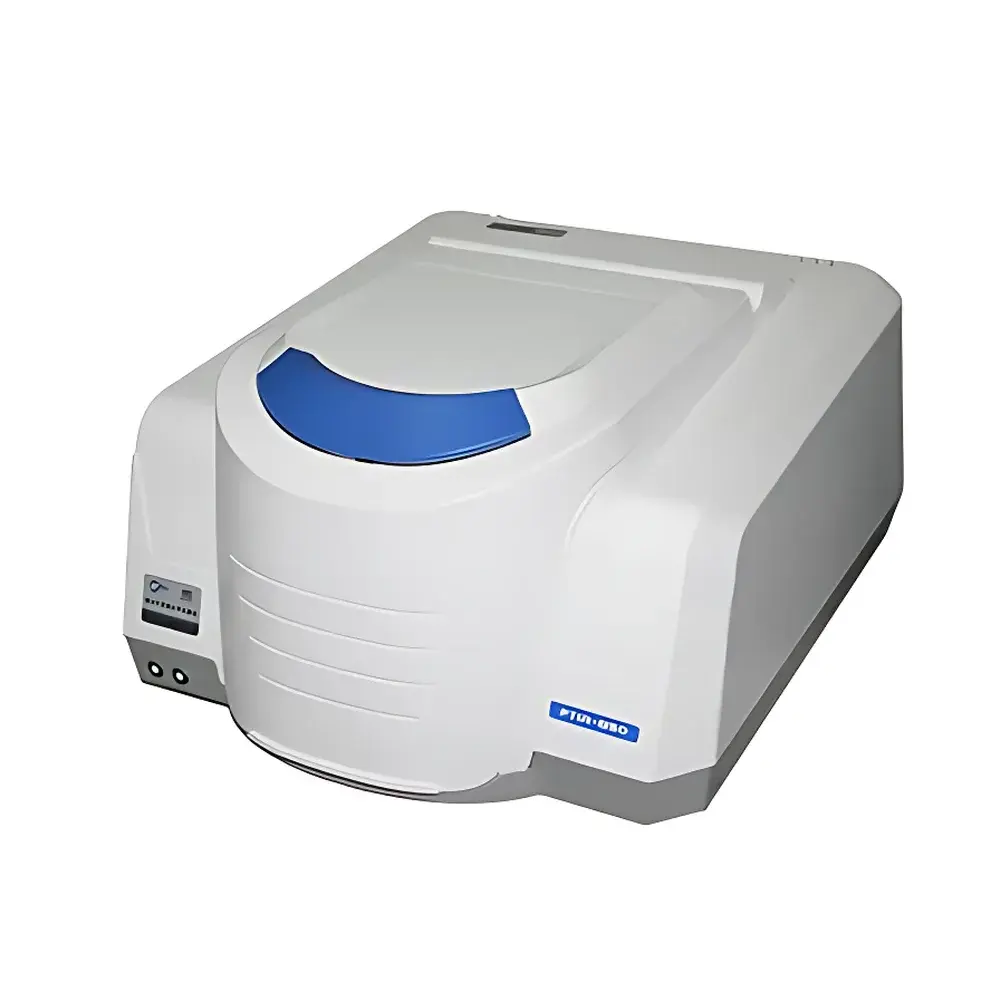
KJ GROUP FTIR-850 Fourier Transform Infrared Spectrometer
| Brand | KJ GROUP |
|---|---|
| Origin | Liaoning, China |
| Manufacturer Type | Authorized Distributor |
| Origin Category | Domestic |
| Model | FTIR-850 |
| Quotation | Upon Request |
| Spectral Range | 7800–350 cm⁻¹ |
| Resolution | 0.5 cm⁻¹ |
| Detector | Imported High-Sensitivity DLATGS |
| Beamsplitter | Ge-coated KBr substrate with moisture-resistant coating |
| Light Source | Air-cooled high-energy ceramic IR source |
| Signal-to-Noise Ratio | <2.2×10⁻⁵ AU (1-min scan, 4 cm⁻¹) |
| Wavenumber Accuracy | ±0.01 cm⁻¹ |
| Linearity | <0.1% |
| Laser Reference | He–Ne laser |
| Data Interface | USB 2.0 |
| Operating Systems | Windows XP, Windows 7 |
| Dimensions | 543 × 455 × 248 mm |
Overview
The KJ GROUP FTIR-850 Fourier Transform Infrared Spectrometer is a research-grade analytical instrument engineered for precision molecular identification and quantitative analysis across solid, liquid, and gaseous samples. Based on Michelson interferometry and rapid-scan data acquisition synchronized to a stabilized He–Ne laser reference, the FTIR-850 delivers high-fidelity spectral data in accordance with ISO 17025–compliant laboratory practices. Its optical architecture employs a dynamically aligned moving mirror system—adjusting at 130,000 Hz—to maintain path-length stability during acquisition, minimizing phase errors and ensuring reproducible peak shapes and intensities over extended operational cycles. The instrument operates across a broad spectral range of 7800–350 cm⁻¹, enabling detection of fundamental vibrational modes from high-energy O–H and N–H stretches down to low-frequency lattice vibrations and heavy-atom bending modes.
Key Features
- Sub-1 cm⁻¹ Spectral Resolution: Achieves 0.5 cm⁻¹ nominal resolution, supporting fine-structure analysis of overlapping bands in complex mixtures—critical for polymer crystallinity assessment, pharmaceutical polymorph differentiation, and catalyst surface characterization.
- Dynamic Mirror Alignment System: Real-time interferometer alignment eliminates manual recalibration; maintains optical throughput and phase fidelity without periodic maintenance or user intervention.
- Thermally Optimized Ceramic IR Source: Features a high-temperature ceramic emitter (>1600 °C) housed within a semi-enclosed thermal chamber, delivering stable radiant output with rapid thermal response and extended service life (>10,000 hours).
- Hermetically Sealed Optical Compartment: Fully sealed optics housing with oversized desiccant chamber (8× moisture capacity vs. conventional designs) significantly extends drying agent replacement intervals and mitigates hygroscopic degradation of KBr-based beamsplitters.
- Modular Sample Chamber: Extra-large sample compartment (≥150 mm clear aperture) accommodates OEM and third-party accessories including ATR prisms (ZnSe, diamond), specular reflectance stages, gas cells (path lengths up to 10 m), liquid transmission cells, and fiber-optic probes.
- Regulatory-Ready Software Architecture: Embedded audit trail functionality with role-based access control (three-tier permissions: Administrator, Supervisor, User), compliant with USP , FDA 21 CFR Part 11, and GLP/GMP documentation requirements.
Sample Compatibility & Compliance
The FTIR-850 supports standardized sampling methodologies per ASTM E1252 (general IR practice), ASTM E168 (qualitative analysis), and ASTM E1421 (quantitative multicomponent analysis). Solid samples are routinely analyzed via KBr pellet pressing, diffuse reflectance (DRIFTS), or horizontal ATR. Liquids are measured using demountable cells with CaF₂ or BaF₂ windows (compatible with aggressive solvents), while gases require sealed multi-pass cells calibrated to NIST-traceable reference spectra. All optical components—including the Ge-coated KBr beamsplitter—incorporate hydrophobic barrier layers to resist ambient humidity-induced degradation, satisfying ICH Q5C stability testing environmental tolerances.
Software & Data Management
The bundled FTIR Control Suite provides full instrument control, real-time interferogram monitoring, and spectral processing (baseline correction, smoothing, peak integration, library search via >15,000-entry commercial databases). Raw interferograms and processed spectra are stored in vendor-neutral .SPA format (compatible with OPUS, GRAMS/AI, and MATLAB). Audit logs record user ID, timestamp, parameter changes, and spectrum export events with immutable digital signatures. Data backups support network-attached storage (NAS) and encrypted cloud repositories meeting ISO/IEC 27001 information security standards.
Applications
- Pharmaceutical QC/QA: Identification of active pharmaceutical ingredients (APIs), excipient compatibility screening, and counterfeit drug detection per USP monographs.
- Polymer Science: Crystallinity index calculation, copolymer composition analysis, and oxidation induction time (OIT) evaluation under accelerated aging protocols.
- Environmental Monitoring: Quantification of VOCs in air samples, microplastic identification in wastewater sludge, and soil organic matter fingerprinting.
- Materials R&D: Surface functionalization verification of nanomaterials, thin-film thickness estimation via interference fringe analysis, and semiconductor dopant profiling.
- Forensic Chemistry: Trace evidence comparison (paint chips, adhesives, fibers) using hierarchical cluster analysis and Euclidean distance matching.
FAQ
Does the FTIR-850 comply with 21 CFR Part 11 requirements for electronic records and signatures?
Yes—the software implements full audit trail logging, electronic signature capture, and role-based permission tiers aligned with FDA validation expectations for regulated laboratories.
Is the instrument compatible with modern Windows operating systems beyond Windows 7?
While officially validated on Windows XP and Windows 7, the USB 2.0 interface and .NET Framework–based driver stack support Windows 10 and Windows 11 via compatibility mode; KJ GROUP provides updated drivers upon request.
Can the FTIR-850 be integrated into automated production lines?
Yes—RS-232 and TCP/IP command sets are available for OEM integration; optional PLC-compatible I/O modules enable trigger synchronization with conveyor belts, robotic samplers, or reactor control systems.
What calibration standards are recommended for routine performance verification?
NIST-traceable polystyrene film (SRM 1977) for wavenumber accuracy, and polyethylene film for resolution verification per ASTM E1421 Annex A1.
Is on-site 3Q qualification (IQ/OQ/PQ) available?
Yes—KJ GROUP offers certified GMP-compliant installation qualification (IQ), operational qualification (OQ), and performance qualification (PQ) services conducted by ISO 17025-accredited field engineers, including documented test protocols and final compliance reports.



