
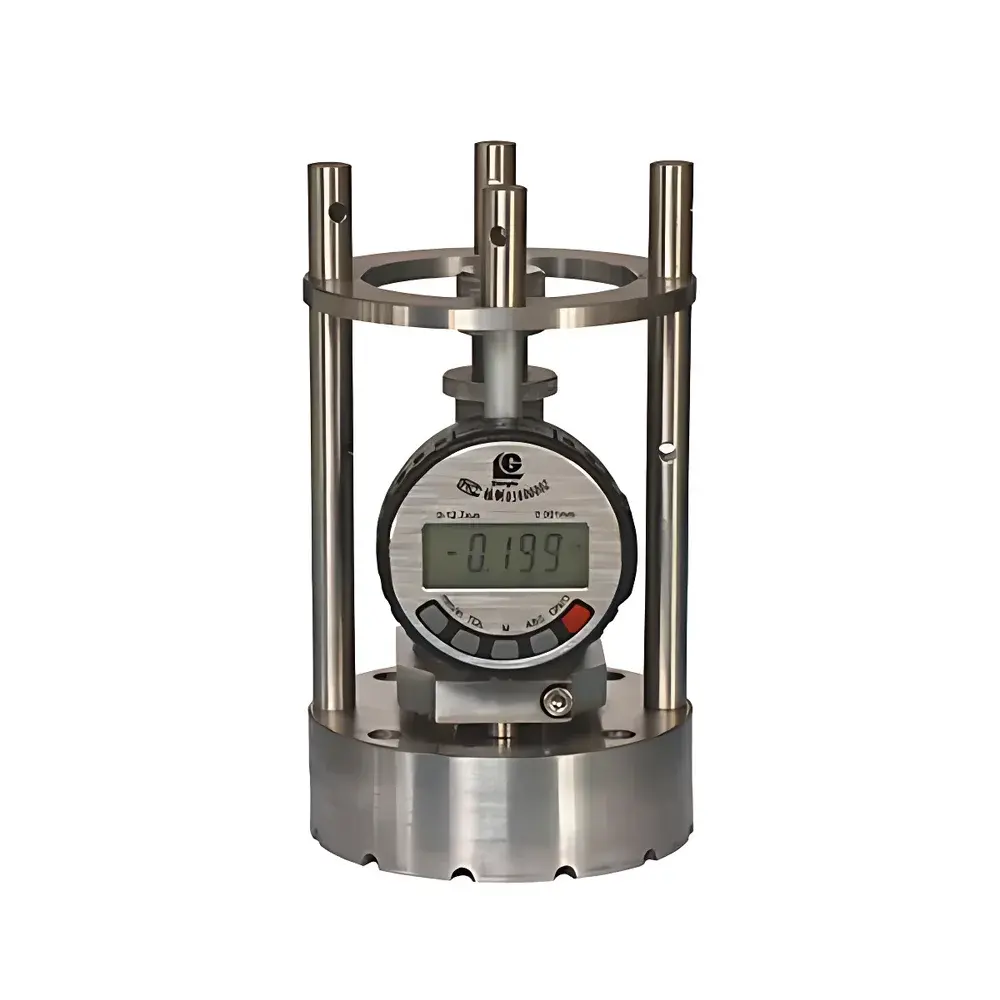
KJ GROUP GPC-50A Precision Lapping and Polishing Control Fixture
| Brand | KJ GROUP |
|---|---|
| Origin | Liaoning, China |
| Manufacturer Type | Authorized Distributor |
| Country of Origin | China |
| Model | GPC-50A |
| Pricing | Available Upon Request |
| Construction Material | High-Grade Stainless Steel |
| Compatible Equipment | UNIPOL-802 Lapping/Polishing System |
| Sample Mounting Method | Adhesive Bonding to Threaded Carrier Block |
| Max. Sample Diameter | ≤50 mm |
| Max. Sample Thickness | ≤8 mm |
| Carrier Plate Diameter | Ø52 mm |
| Axial Travel Range | 10 mm (0.025 mm per graduation on micrometer nut) |
| Digital Indicator Resolution | 0.001 mm |
| Carrier Plate Dead Load | 500 g |
| Dimensions | Ø89 mm × 154 mm |
| Operating Environment | Altitude <1000 m, Temperature 25°C ±15°C, Relative Humidity 55% RH ±10% RH |
| Cooling | Required ventilation |
| Water Supply | Required |
| Power Requirement | None |
| Pneumatic Requirement | None |
| Standard Accessories | 400 g Counterweight Set |
| Optional Accessories | 25 g & 50 g Auxiliary Weights |
Overview
The KJ GROUP GPC-50A Precision Lapping and Polishing Control Fixture is a manually operated, high-resolution mechanical fixture engineered for dimensional stability and surface geometry control during precision lapping and polishing operations. Designed exclusively for integration with the UNIPOL-802 lapping and polishing system, the GPC-50A functions as a kinematically constrained carrier platform that maintains strict axial repeatability and parallelism between the sample surface and the lapping plate. Its operation relies on a calibrated micrometer-driven axial adjustment mechanism—where each full rotation of the micrometer nut advances the carrier plate by 0.025 mm—enabling sub-micron incremental control over material removal depth. Unlike motorized or servo-controlled systems, the GPC-50A delivers deterministic, operator-guided positioning without electronic dependency, making it suitable for cleanroom-compatible, low-EMI environments and applications requiring traceable mechanical calibration.
Key Features
- Stainless steel construction ensures long-term dimensional stability, corrosion resistance, and compatibility with aqueous and mild chemical slurries used in semiconductor, optical, and ceramic processing.
- Precision-ground carrier plate (Ø52 mm) with integrated threaded interface for secure attachment to the dedicated carrier block; supports samples up to 50 mm in diameter and 8 mm in thickness.
- Mechanically indexed axial travel (10 mm total range) with 0.025 mm per graduation resolution and digital indicator readout (0.001 mm resolution) for real-time displacement monitoring.
- Preloaded carrier assembly (500 g dead weight) provides consistent contact pressure distribution across the sample–lapping plate interface, minimizing edge chipping and non-uniform wear.
- No electrical, pneumatic, or hydraulic requirements—ideal for inert atmosphere gloveboxes, Class 100 cleanrooms, or facilities with strict EMI/RFI constraints.
- Modular counterweight system (standard 400 g set; optional 25 g / 50 g increments) allows fine-tuning of applied load to match sample fragility, slurry viscosity, and material removal rate targets.
Sample Compatibility & Compliance
The GPC-50A is routinely deployed in applications demanding ISO 10110-7 (optical surface flatness), SEM/TEM specimen preparation per ASTM E3, and wafer-level metrology alignment per SEMI F20. It accommodates brittle, ductile, and composite substrates—including silicon wafers, sapphire optics, lithium niobate crystals, ferrite tiles, and thin-film coated glass—provided sample geometry remains within the specified envelope (≤50 mm Ø, ≤8 mm thick). The adhesive mounting method (using thermally reversible or UV-curable epoxies) preserves edge integrity and avoids clamping-induced stress birefringence. All mechanical interfaces conform to UNIPOL-802’s ISO metric threading standard (M30×1.5), ensuring interchangeability and repeatable run-to-run setup. No software-based compliance certification applies; however, its passive mechanical design supports GLP/GMP audit trails when paired with calibrated digital thickness gauges (e.g., Mitutoyo ID-C112XB) and documented SOPs.
Software & Data Management
The GPC-50A operates independently of software control. It produces no digital output, logs no telemetry, and requires no driver installation or firmware updates. All positional data is captured externally via third-party digital indicators or coordinate measuring instruments. For laboratories maintaining 21 CFR Part 11 compliance, manual entry of micrometer readings and thickness measurements into validated electronic lab notebooks (ELNs) or LIMS platforms satisfies audit requirements—provided operators follow defined change-control procedures for indicator calibration and environmental logging (temperature, humidity, ambient particulate count). KJ GROUP supplies NIST-traceable calibration certificates for included digital indicators upon request.
Applications
- Preparation of TEM cross-section specimens with ≤0.5 µm parallelism tolerance across 3 mm diameter areas.
- Lapping of optical window substrates (BK7, fused silica) to meet λ/10 surface flatness specifications prior to final polishing.
- Thickness uniformity control in piezoelectric ceramic disc fabrication (PZT, PMN-PT), where ±0.5 µm thickness variation across 25 mm diameter is required.
- Surface planarization of metallographic samples for quantitative grain size analysis per ASTM E112.
- Substrate leveling prior to thin-film deposition in R&D-scale PVD/CVD processes, ensuring uniform film stress distribution.
- Calibration artifact conditioning for profilometers and interferometers using certified reference flats.
FAQ
Is the GPC-50A compatible with lapping machines other than the UNIPOL-802?
No—the fixture’s mounting interface, height clearance, and centering geometry are mechanically optimized for the UNIPOL-802 spindle and platen configuration. Adaptation to other platforms would require custom adapter plates and recalibration of axial travel limits.
Can the GPC-50A be used for dry lapping processes?
Yes, provided appropriate dust extraction and thermal management are implemented; however, stainless steel construction and lack of sealed bearings limit continuous dry operation beyond 15-minute intervals without cooling pauses.
What adhesive types are recommended for sample mounting?
Low-viscosity, room-temperature-curing conductive epoxies (e.g., Epotek H20E) for conductive substrates; UV-curable adhesives (e.g., Norland NOA61) for transparent or temperature-sensitive materials; and thermoplastic waxes (e.g., Crystalbond 509) for reversible mounting in soft-metal or polymer samples.
Does the 0.001 mm digital indicator include data export capability?
No—the indicator is a standalone analog-to-digital display unit with no USB, RS-232, or Bluetooth interface. External data capture requires manual transcription or integration with third-party DAQ systems via analog voltage output (if equipped).
Is ISO/IEC 17025 calibration support available for the GPC-50A?
While the fixture itself is not a measuring instrument, KJ GROUP provides calibration documentation for the included digital indicator and can arrange third-party accredited calibration of the micrometer mechanism per ISO 17025 through authorized metrology labs upon request.



