
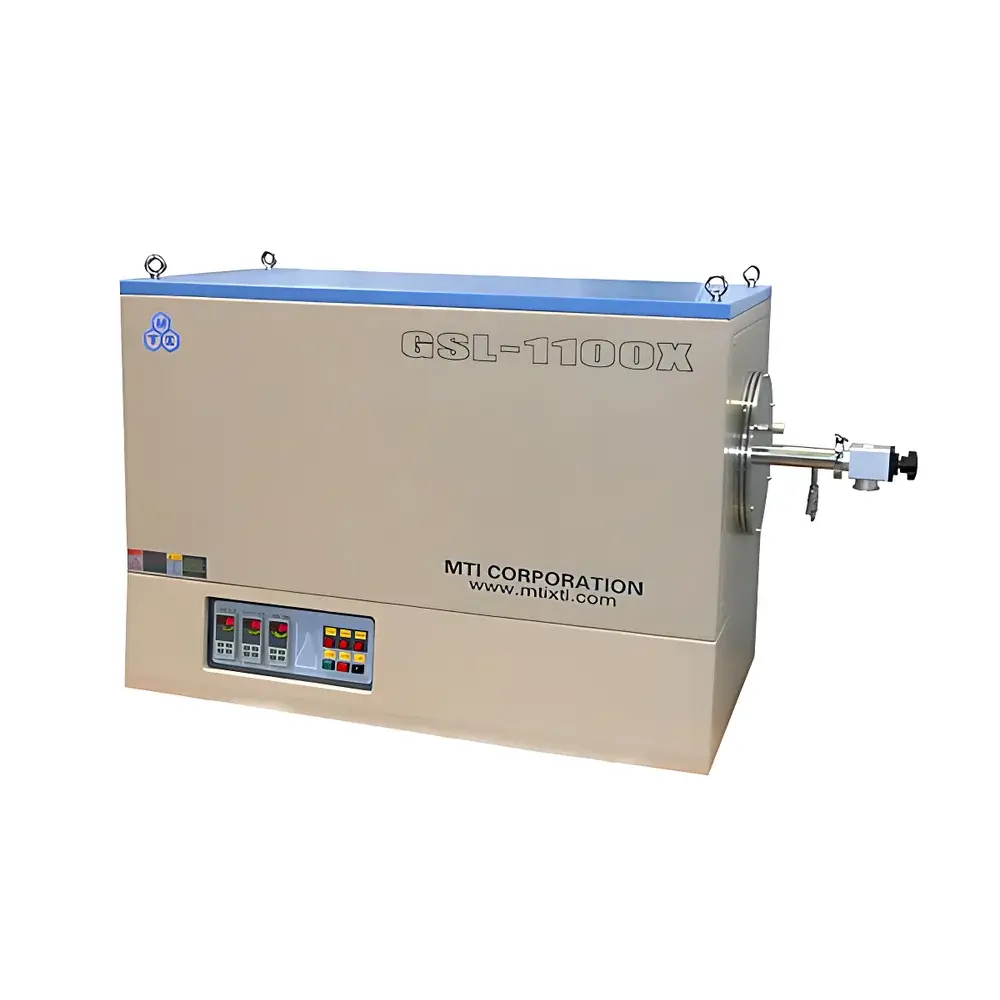
KJ GROUP GSL-1100X-11-III Triple-Zone 11-Inch High-Temperature Tube Furnace
| Brand | KJ GROUP |
|---|---|
| Origin | Liaoning, China |
| Manufacturer Type | Authorized Distributor |
| Country of Origin | China |
| Model | GSL-1100X-11-III |
| Power Supply | AC 220 V, 50/60 Hz, 8 kW (requires 50 A circuit breaker) |
| Maximum Operating Temperature | ≤1100 °C (≤1 h), Continuous Range: 200–1000 °C |
| Heating Zone Configuration | 3 independent zones, each 300 mm long |
| Total Heated Length | 900 mm |
| Uniform Temperature Zone | 500 mm (when all zones set to same setpoint) |
| Ramp/Soak Rate | ≤10 °C/min |
| Temperature Control | Three independent PID controllers, 30-segment programmable ramp-soak profiles |
| Thermocouples | Three K-type |
| Temperature Uniformity | ±1 °C (at setpoint, under steady-state conditions in uniform zone) |
| Vacuum Capability | 10⁻² torr (with external mechanical pump) |
| Quartz Tube Dimensions | OD 279 mm, ID 269 mm, L 1300 mm |
| External Dimensions | 1670 × 625 × 920 mm |
| Net Weight | 200 kg |
| Cooling System | Dual-layer housing with forced-air circulation |
| Max. Shell Surface Temperature | <70 °C |
| Vacuum Flange | Stainless steel with silicone O-ring seal |
| Certification | CE compliant |
Overview
The KJ GROUP GSL-1100X-11-III is a triple-zone, high-precision tube furnace engineered for controlled thermal processing of advanced materials under vacuum or inert/reducing atmospheres. Designed around a large-diameter 11-inch (279 mm OD) fused quartz tube, it supports scalable synthesis, annealing, sintering, and chemical vapor deposition (CVD) applications requiring spatially resolved thermal gradients or extended uniform temperature zones. Its three independently controlled heating zones—each 300 mm in length—enable precise axial temperature profiling across a total heated length of 900 mm, with a central 500 mm region achieving high thermal uniformity when operated in synchronized mode. The furnace employs Mo-doped Fe-Cr-Al resistance heating elements embedded in high-purity alumina insulation, ensuring stable heat distribution and long-term operational reliability at temperatures up to 1100 °C (short-term) and continuously from 200 °C to 1000 °C. Structural integrity and operator safety are reinforced by a dual-layer steel housing with integrated forced-air cooling, maintaining external surface temperatures below 70 °C during full-power operation.
Key Features
- Triple independent PID temperature controllers with 30-segment programmable ramp-soak capability, enabling complex multi-step thermal protocols including gradient heating, zone-specific dwell, and coordinated cooldown.
- High-efficiency thermal architecture: double-walled stainless steel chamber with circulating air cooling and high-purity alumina fiber insulation minimizes radiant loss and improves energy efficiency.
- Vacuum-compatible design featuring CNC-machined 304 stainless steel flanges with replaceable silicone O-rings; standard configuration includes male/female bayonet-style (Bunsen-type) fittings—adaptable to VCR or Swagelok dual-ferrule connections upon request.
- Integrated safety systems: over-temperature protection, ground-fault interruption, and automatic power cutoff triggered by door interlock or thermocouple failure.
- CE-certified construction compliant with EN 61000-6-3 (EMC emission) and EN 61000-6-2 (immunity), supporting integration into ISO/IEC 17025-accredited laboratories and GMP-aligned pilot-scale facilities.
Sample Compatibility & Compliance
The GSL-1100X-11-III accommodates cylindrical samples up to 265 mm in diameter and 1200 mm in length within its fused quartz reaction tube. It is routinely deployed for processing ceramics, battery cathode precursors (e.g., NMC, LFP), 2D materials (graphene, TMDs), metal-organic frameworks (MOFs), and semiconductor thin films. The system meets ASTM C1284-20 requirements for furnace classification in ceramic sintering and complies with ISO 15184:2022 for thermal treatment of functional oxide coatings. When configured with optional pressure-rated accessories and validated gas delivery modules, it supports processes aligned with USP environmental control standards for sterile pharmaceutical intermediate synthesis.
Software & Data Management
The furnace supports RS485 Modbus RTU communication via optional USB-to-serial interface module, enabling bidirectional control and real-time data logging through third-party SCADA platforms (e.g., LabVIEW, Ignition, or custom Python-based acquisition suites). All temperature profiles, runtime logs, and alarm events are timestamped and stored locally on the controller’s non-volatile memory. For regulated environments, the optional software interface module provides audit-trail functionality compliant with FDA 21 CFR Part 11 requirements—including electronic signatures, user access levels, and immutable record retention—when paired with validated PC-based supervision software.
Applications
- Controlled-atmosphere sintering of structural ceramics and refractory composites.
- Thermal annealing of flexible electronics substrates and perovskite photovoltaic layers.
- CVD growth of carbon nanotubes and transition metal dichalcogenides using precursor vapor transport.
- Calcination of catalyst supports and lithium-ion battery electrode materials under N₂ or Ar/H₂ mixtures.
- Multi-zone thermal cycling studies for evaluating interfacial stability in layered heterostructures.
- Pre-sintering and binder burnout in powder metallurgy workflows prior to hot isostatic pressing (HIP).
FAQ
What vacuum level can be achieved with the standard configuration?
With an externally connected two-stage rotary vane pump, the system achieves ≤10⁻² torr. For lower base pressures (≤10⁻⁵ torr), a turbomolecular pumping station with appropriate foreline trapping is recommended.
Is the quartz tube included with the furnace?
Yes, one standard fused quartz tube (OD 279 mm, ID 269 mm, L 1300 mm) is supplied as standard equipment.
Can the furnace be operated in oxidizing atmospheres?
Yes—provided the process gas is compatible with quartz and the heating elements. Continuous operation above 900 °C in air requires periodic inspection of the Mo-doped Fe-Cr-Al wire for oxidation-induced embrittlement.
What electrical infrastructure is required for installation?
A dedicated 220 V AC, 50/60 Hz circuit protected by a 50 A magnetic-thermal circuit breaker is mandatory. Grounding resistance must not exceed 4 Ω per IEC 60364-5-54.
Does the system support remote monitoring via Ethernet or Wi-Fi?
No native Ethernet/Wi-Fi interface is built-in; however, industrial protocol gateways (e.g., Modbus TCP converters) may be integrated externally to enable networked supervision in distributed lab environments.



