
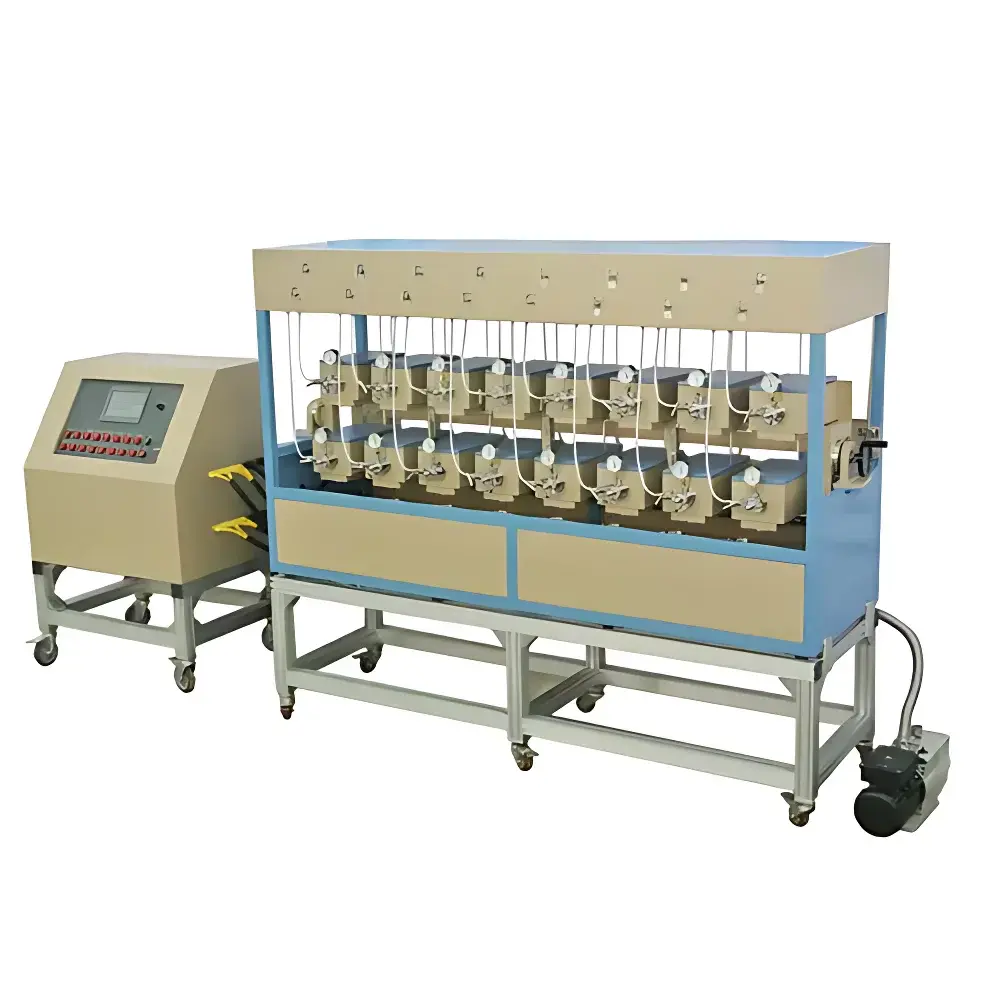
KJ GROUP GSL-1100X-MGI-16 16-Channel High-Throughput Tube Furnace for Annealing & Quenching
| Brand | KJ GROUP |
|---|---|
| Origin | Liaoning, China |
| Model | GSL-1100X-MGI-16 |
| Max Operating Temperature | 1100 °C (≤1 h) |
| Continuous Operating Temperature | 1000 °C |
| Heating Zone Uniformity | ±1 °C over 30 mm / ±5 °C over 60 mm |
| Max Ramp Rate | 10 °C/min |
| Temperature Control Accuracy | ±1 °C |
| Thermocouple Type | 16 × K-type, inserted into each tube |
| Tube Dimensions | 16 × (25 mm OD × 20 mm ID × 200 mm L) quartz tubes |
| Vacuum/Atmosphere Interface | KF25 quick-release flanges with mechanical vacuum gauge |
| Power Supply | 208–240 V AC, single-phase, 50/60 Hz |
| Total Power | 13 kW |
| Control System | 6-inch touchscreen HMI with 30-segment programmable PID profiles, over-temperature & thermocouple-failure protection |
| Physical Dimensions | 2350 mm L × 690 mm W × 1860 mm H (operational) |
| Sample Capacity | ≤100 g per channel |
| Certification | CE |
| Warranty | 12 months (excludes quartz tubes, heating elements, and O-rings) |
Overview
The KJ GROUP GSL-1100X-MGI-16 is a precision-engineered, 16-channel horizontal-to-vertical convertible tube furnace designed for high-throughput thermal processing in materials science research and development. It operates on resistive heating principles using high-purity Kanthal A1 or equivalent alloy heating elements embedded within refractory ceramic insulation zones. Each of the 16 independent quartz tube channels (25 mm OD × 20 mm ID × 200 mm L) is thermally isolated and controlled via dedicated K-type thermocouples positioned directly inside the tube bore—ensuring accurate, real-time temperature feedback and minimizing thermal lag. The system supports both inert/vacuum and reactive gas atmospheres (e.g., Ar, N₂, H₂, forming gas), with KF25 vacuum flanges enabling rapid sealing and pressure monitoring via integrated mechanical gauges. Its dual-position mechanical architecture—horizontal for uniform annealing/sintering and vertical for rapid quenching or melt casting—enables seamless transition between static thermal treatment and dynamic solidification protocols without sample transfer.
Key Features
- 16 fully independent heating channels, each with individual PID temperature control and embedded K-type thermocouple for localized thermal regulation
- Programmable 30-segment thermal profiles accessible via intuitive 6-inch industrial touchscreen HMI, supporting ramp-hold-cool sequences with user-defined dwell times
- KF25 quick-connect vacuum flanges on all 16 tubes, compatible with standard rotary vane or turbomolecular pumps (optional add-on)
- Mechanically actuated rotation mechanism enabling precise repositioning from horizontal (±0.5° leveling) to vertical (90° ±1°) orientation under load
- Over-temperature cutoff and thermocouple failure detection circuits compliant with IEC 61508 functional safety principles
- UL/MET/CSA-certified power distribution board and solid-state relays; CE-marked per Machinery Directive 2006/42/EC and EMC Directive 2014/30/EU
- Refractory ceramic fiber insulation with low thermal mass and <0.5 W/m·K conductivity at 1000 °C, minimizing standby energy loss
Sample Compatibility & Compliance
The GSL-1100X-MGI-16 accommodates diverse sample forms—including powders, pellets, thin films on substrates, and small ingots—within standardized quartz tubes rated for continuous operation up to 1000 °C and short-term exposure to 1100 °C. Quartz tube selection complies with ASTM F799 (high-purity fused silica specifications) and ISO 17025-accredited calibration traceability for thermocouple inputs. For GMP-aligned labs, the system supports audit-ready operation: all temperature setpoints, actual readings, alarm events, and program execution logs are timestamped and exportable via USB. While not natively 21 CFR Part 11-compliant, the firmware architecture permits integration with validated third-party electronic lab notebook (ELN) platforms for full data integrity governance. Pressure management adheres to ISO 27462 guidelines for vacuum-assisted thermal processing—maximum allowable internal pressure is strictly limited to 0.02 MPa (2 bar absolute), enforced by mechanical interlocks and visual pressure indicators.
Software & Data Management
Temperature programming and real-time monitoring are executed through an embedded Linux-based controller running KJ GROUP’s proprietary MGI-TempControl firmware. All 16 channels display simultaneously on the touchscreen interface, with color-coded status indicators (green = stable, amber = ramping, red = alarm). Data logging occurs at 1 Hz resolution per channel, storing up to 30 days of continuous history internally. Export formats include CSV (for Excel/Origin analysis) and XML (for LIMS ingestion). Optional Ethernet/Wi-Fi modules enable remote access via secure SSH or HTTPS endpoints, supporting integration with LabVIEW, Python (PySerial/PyModbus), or OPC UA clients. Audit trails record operator ID (via optional RFID badge reader), parameter changes, and emergency stops—all retaining SHA-256 hashed integrity for GLP compliance.
Applications
- Combinatorial materials screening: simultaneous annealing of 16 compositionally graded libraries for phase diagram mapping
- Post-deposition thermal treatment of CVD/PVD thin films (e.g., LiCoO₂ cathodes, perovskite photovoltaics)
- Rapid solidification studies: vertical quenching of molten alloys (Sn-Bi, Al-Si) to investigate metastable phase formation
- Catalyst activation: controlled calcination of supported metal oxides under flowing O₂/N₂ mixtures
- Pre-sintering of ceramic green bodies prior to hot isostatic pressing (HIP)
- Thermal aging validation per ASTM E1252 and IEC 60068-2-20 for electronic packaging reliability testing
FAQ
What is the maximum safe operating pressure inside the quartz tubes?
The absolute internal pressure must not exceed 0.02 MPa (2 bar). Mechanical pressure gauges on each KF25 flange provide real-time verification; exceeding this limit voids warranty and risks catastrophic tube rupture.
Can the furnace be used under high vacuum (<10⁻³ mbar)?
Yes—but only below 1000 °C. Above this temperature, quartz viscosity decreases significantly; maintaining vacuum increases risk of tube deformation. At ≥1000 °C, the system must operate at atmospheric pressure or under slight positive inert gas flow (≤200 SCCM).
Is the vertical quenching mode compatible with liquid metal handling?
Yes. The vertical configuration supports crucible-based melt pouring into pre-chilled copper or graphite molds. Load capacity per channel remains ≤100 g; thermal shock resistance of quartz is preserved only when ambient cooling media (e.g., air, N₂) is used—not direct water immersion.
How is temperature uniformity verified across the 30 mm hot zone?
Uniformity is certified per ASTM E220 using a 3-point axial probe scan during factory acceptance testing. Deviation is reported as ±1 °C at setpoints between 300 °C and 1000 °C, measured at center and ±15 mm positions.
Are replacement quartz tubes supplied with dimensional and purity certifications?
Yes. Each replacement tube ships with a CoA specifying OH content (<10 ppm), metallic impurities (<10 ppb Fe/Cu/Na), and concentricity tolerance (±0.05 mm), traceable to NIST SRM 2800.



