
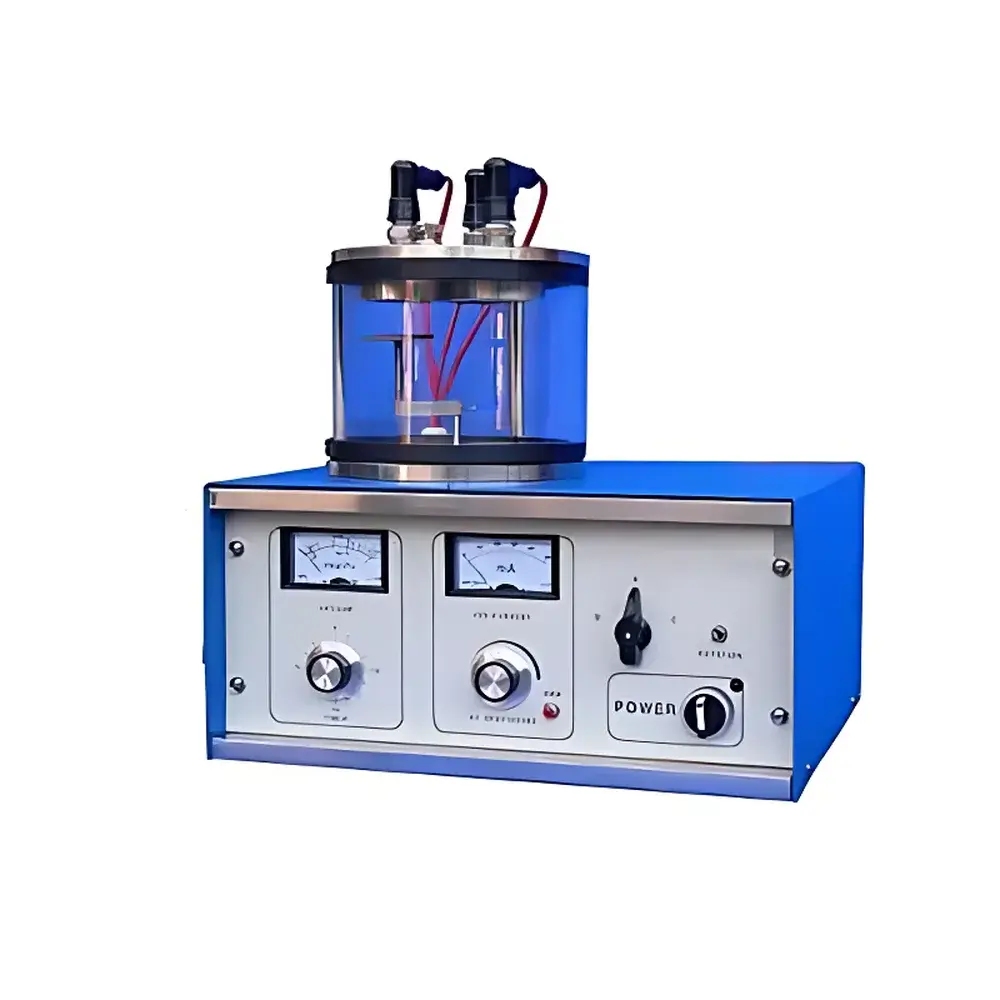
KJ GROUP GSL-1100X-SPC-16-3 Triple-Target DC Magnetron Sputtering System
| Brand | KJ GROUP |
|---|---|
| Origin | Liaoning, China |
| Model | GSL-1100X-SPC-16-3 |
| Vacuum Chamber | Ø160 mm × 120 mm |
| Target Diameter | Ø45 mm |
| Number of Targets | 3 |
| Max DC Voltage | 1600 V |
| Max DC Current | 50 mA |
| Ultimate Vacuum | ≤4 × 10⁻² mbar |
| Timer Range | 0–900 s |
| Base Pumping Speed | 2 L/s (mechanical pump) |
| Dimensions | 400 mm × 300 mm × 400 mm |
| Weight | 30 kg |
| Gas Compatibility | High-purity Ar (≥99.99%) |
| Electrical Supply | AC 220 V, 50 Hz, grounded |
Overview
The KJ GROUP GSL-1100X-SPC-16-3 Triple-Target DC Magnetron Sputtering System is a compact, benchtop-scale physical vapor deposition (PVD) instrument engineered for reproducible thin-film fabrication via direct-current (DC) diode sputtering. Operating on the principle of plasma-assisted physical sputtering, the system ionizes argon gas within a controlled vacuum environment to generate energetic Ar⁺ ions; these ions accelerate toward conductive target materials under applied DC bias, ejecting atoms from the target surface through momentum transfer. The sputtered atoms travel ballistically across the chamber and condense onto a substrate mounted on a motorized rotating stage, forming uniform, adherent thin films. Designed specifically for academic and industrial R&D laboratories, this system enables sequential or co-deposition of up to three distinct metallic layers—such as Au, Cu, and Al—on a single substrate without breaking vacuum, supporting studies in multilayer heterostructures, transparent conductive oxides, electrode development for electrochemical sensors, and model catalyst synthesis.
Key Features
- Triple-target configuration with independent electrical isolation, allowing rapid material switching or simultaneous sputtering under controlled current/voltage conditions.
- Motorized 360° rotation stage with precise angular positioning, ensuring enhanced film thickness uniformity across substrates up to 50 mm in diameter.
- Dual analog monitoring: integrated vacuum gauge (capacitance manometer or Pirani-type) and DC current meter for real-time process diagnostics and endpoint control.
- Adjustable micro-metering gas inlet valve (Ø3 mm hose interface) enabling fine-tuned Ar pressure regulation between 1 × 10⁻² mbar and 1 × 10⁻¹ mbar—critical for optimizing sputter yield and film stoichiometry.
- Robust ceramic high-voltage feedthroughs replacing conventional elastomeric seals, minimizing outgassing and extending service life under repeated thermal cycling and high-voltage operation.
- Reinforced silicone O-ring design at the bell-jar flange interface prevents chipping or cracking during repeated sealing cycles, maintaining long-term vacuum integrity.
- Optimized chamber geometry (Ø160 mm × 120 mm) paired with Ø45 mm targets ensures balanced plasma confinement and improved target utilization efficiency compared to smaller-volume systems.
Sample Compatibility & Compliance
The GSL-1100X-SPC-16-3 accommodates rigid planar substrates including silicon wafers (up to 2-inch), glass slides, quartz crystals, alumina ceramics, and metal foils. Substrate heating is not integrated but may be added externally via resistive heaters compatible with the chamber’s viewport and feedthrough layout. The system complies with CE marking requirements per Directive 2014/30/EU (EMC) and 2014/35/EU (LVD), confirming electromagnetic compatibility and low-voltage safety. While not certified to ISO/IEC 17025 or GLP standards out-of-the-box, its operational parameters—including timer accuracy (±0.5 s), pressure repeatability (±5% full scale), and current stability (<±2% over 30 min)—support traceable process documentation suitable for internal quality records and preliminary method validation in accordance with ASTM F1129 and ISO 18572 guidelines for PVD thin-film characterization.
Software & Data Management
This model operates via manual analog controls with no embedded digital controller or PC interface. All process parameters—including sputtering time, applied voltage, and gas flow—are set using front-panel dials and monitored via analog meters. For laboratories requiring audit-ready data capture, optional USB-connected data loggers can be interfaced with external pressure and current transducers (e.g., MKS Baratron and current shunt amplifiers), feeding time-stamped signals into LabVIEW or Python-based acquisition scripts. Such configurations support 21 CFR Part 11–compliant electronic records when paired with user-authenticated logging software and periodic calibration verification against NIST-traceable references.
Applications
- Preparation of multi-layer test structures for electrical transport measurements (e.g., Ti/Pt/Au electrodes on piezoelectric substrates).
- Rapid prototyping of transparent conducting films (ITO alternatives) via sequential oxide-metal-oxide stacking.
- Fabrication of reference electrodes for cyclic voltammetry and impedance spectroscopy.
- Deposition of calibration standards for X-ray photoelectron spectroscopy (XPS) and Auger electron spectroscopy (AES).
- Thin-film resistor and interconnect patterning for MEMS device integration.
- Controlled metallization of insulating substrates (e.g., SiO₂/Si) using intermediate adhesion layers (Cr or Ti).
FAQ
What substrates can be loaded into the chamber?
Standard substrates include flat, rigid samples up to 50 mm in diameter and 5 mm in thickness; flexible or oversized substrates require custom fixture adaptation.
Is RF sputtering supported?
No—this system is configured exclusively for DC magnetron sputtering and is not suitable for insulating targets such as oxides or nitrides without external RF matching networks.
Can the system operate continuously for extended durations?
Yes, provided cooling airflow is maintained around the power supply and vacuum pump; continuous operation beyond 900 s requires manual timer reset due to hardware limit.
What maintenance intervals are recommended?
Inspect O-rings and clean chamber interior every 20 operating hours; replace diffusion pump oil (if retrofitted) or mechanical pump oil every 500 hours; verify vacuum gauge calibration annually.
Are spare parts and consumables readily available?
KJ GROUP supplies OEM-certified replacement targets, high-voltage feedthroughs, fuses, and gas valves through authorized distributors in North America, Europe, and APAC regions.



