
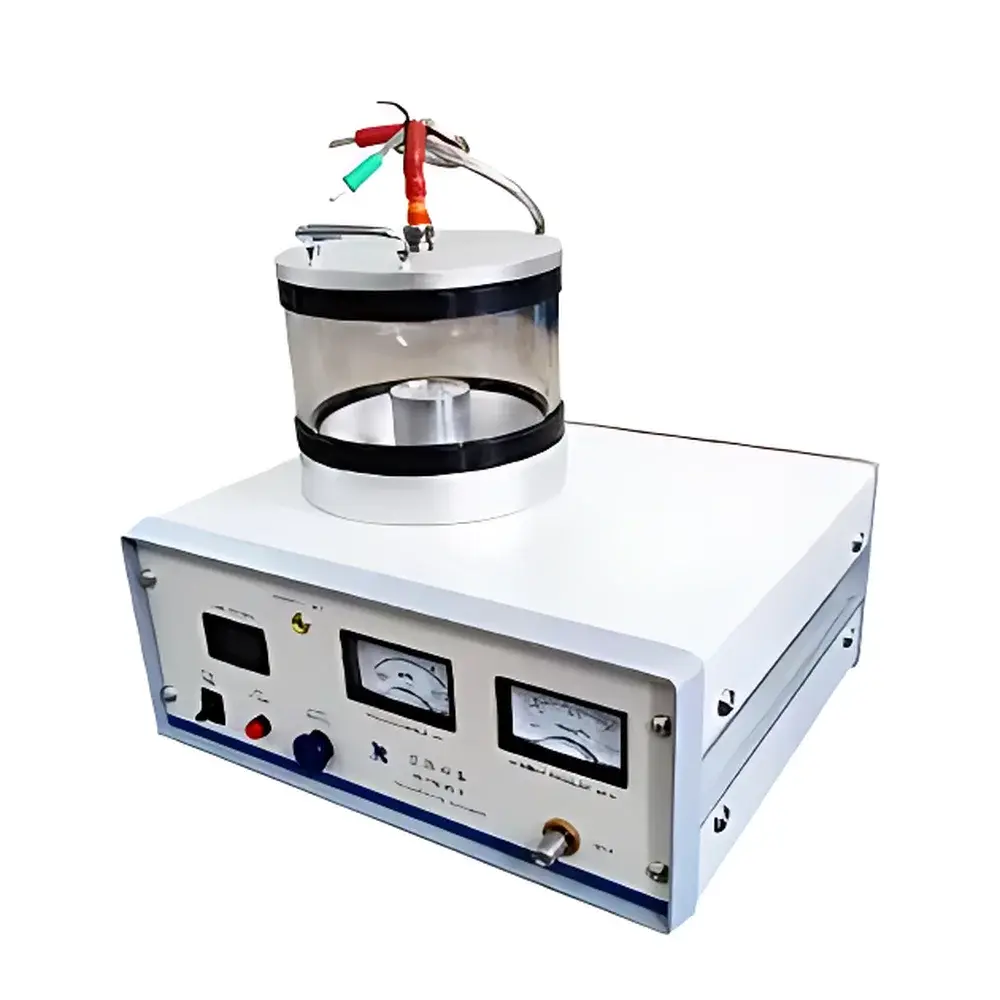
KJ GROUP GSL-1100X-SPC-16 Single-Target DC Magnetron Sputtering Coater
| Brand | KJ GROUP |
|---|---|
| Origin | Liaoning, China |
| Model | GSL-1100X-SPC-16 |
| Vacuum Chamber | Ø160 mm × 120 mm |
| Sample Stage Diameter | Ø50 mm (adjustable height) |
| Max Uniform Coating Area | Ø45 mm |
| Coating Thickness Range | Up to 300 Å |
| Power Supply | AC 220 V, 50 Hz |
| Total Power Consumption | <2000 W (including vacuum pump) |
| Dimensions | 400 mm × 300 mm × 400 mm |
| Weight | 30 kg |
| Certified | CE |
Overview
The KJ GROUP GSL-1100X-SPC-16 is a compact, benchtop single-target DC magnetron sputtering coater engineered for high-reproducibility thin-film deposition in academic and industrial research laboratories. It operates on the principle of plasma-assisted physical vapor deposition (PVD), where argon gas is ionized under low-pressure conditions (typically 1–50 mTorr) to generate energetic Ar+ ions that bombard a conductive target material (e.g., Au, Pt, Ag, In), ejecting atoms that subsequently condense onto substrates placed on a grounded, height-adjustable sample stage. Designed specifically for electron microscopy sample preparation, the system delivers uniform, ultra-thin conductive coatings—critical for mitigating charging artifacts during SEM imaging and improving secondary electron yield. Its integrated DC power supply enables stable, low-noise sputtering at controlled current levels (monitored via front-panel ammeter), while its optimized magnetic field geometry enhances plasma confinement and target utilization efficiency.
Key Features
- Compact footprint (400 × 300 × 400 mm) with modular vacuum architecture—ideal for space-constrained labs and shared instrumentation facilities.
- Dual analog instrumentation: real-time monitoring of chamber pressure (via calibrated Pirani-type vacuum gauge) and sputtering current (0–100 mA range), enabling precise process reproducibility.
- Robust ceramic-insulated high-voltage electrode feedthrough—replacing conventional elastomeric seals—to ensure long-term electrical integrity and eliminate outgassing-related vacuum degradation.
- Custom-engineered silicone rubber O-ring seal at the bell jar flange interface, preventing mechanical chipping (“edge崩边”) of the borosilicate glass chamber during repeated thermal cycling and vacuum cycling.
- Optimized sputter chamber volume (Ø160 mm × 120 mm) and target-to-substrate geometry to support uniform coating across Ø45 mm area—validated per ASTM F1937-20 (Standard Practice for Measuring Uniformity of Thin Films).
- Integrated fine-control micro-metering needle valve for accurate argon flow regulation (99.99% purity required), allowing dynamic adjustment of working pressure to balance deposition rate and film density.
Sample Compatibility & Compliance
The GSL-1100X-SPC-16 accommodates substrates up to Ø50 mm in diameter on a vertically adjustable stage, supporting simultaneous coating of up to eight standard 12.7-mm SEM stubs. Compatible substrates include silicon wafers, TEM grids, glass slides, polymer films, and biological specimens pre-mounted on conductive carbon tape. All wetted materials conform to ISO 8502-3 for cleanliness classification; chamber surfaces are electropolished stainless steel (304 grade) with low outgassing characteristics (<1×10⁻⁹ mbar·L/s·cm²). The system meets CE marking requirements under Directive 2014/30/EU (EMC) and 2014/35/EU (LVD), and supports GLP-compliant operation when paired with external logging tools for pressure/current traceability.
Software & Data Management
This model operates via fully manual analog control—no embedded firmware or proprietary software is required. All operational parameters (chamber pressure, sputtering current, exposure time) are recorded manually or via optional external data loggers (e.g., National Instruments USB-TC01 + LabVIEW). For audit-ready documentation, users may integrate the unit into laboratory information management systems (LIMS) using RS-232 or analog voltage output interfaces (available upon request). While not natively 21 CFR Part 11 compliant, the system supports ALCOA+ principles when used with controlled SOPs, handwritten batch records, and timestamped calibration logs for vacuum gauge and current meter.
Applications
- Routine conductive coating of non-conductive SEM samples—including ceramics, polymers, geological sections, and hydrated biological tissues—to suppress surface charging and enhance topographic contrast.
- Preparation of reference standards for EDS quantification and XPS depth profiling requiring sub-nanometer thickness control and minimal interfacial diffusion.
- Deposition of seed layers for subsequent electrochemical or CVD processes in microfabrication prototyping.
- Teaching laboratories: demonstration of plasma physics fundamentals, sputter yield dependence on ion energy, and thin-film nucleation kinetics.
- Quality control labs performing ASTM E1558-22 (Standard Guide for Specimen Preparation for Scanning Electron Microscopy) compliance verification.
FAQ
What argon purity is required for optimal sputtering performance?
Argon gas with minimum purity of 99.99% (4.0 grade) is mandatory; higher purity (99.999%) is recommended for ultra-low contamination applications such as XPS-prep.
Can the system be upgraded to support RF sputtering or multi-target configurations?
No—the GSL-1100X-SPC-16 is a fixed-configuration DC-only platform. Multi-target or RF-capable alternatives are available in the KJ GROUP SPC-3000 series.
Is a separate vacuum pump included with the system?
Yes—a two-stage rotary vane pump (ultimate vacuum ≤5×10⁻³ mbar) is supplied as standard equipment.
How often should the vacuum gauge and current meter be calibrated?
Annual calibration is recommended per ISO/IEC 17025 guidelines; traceable certificates are provided with initial delivery.
What safety interlocks are implemented?
Hardware-based high-voltage cutoff activates automatically upon chamber opening; emergency stop button interrupts all power to sputter source and vacuum pump.



