
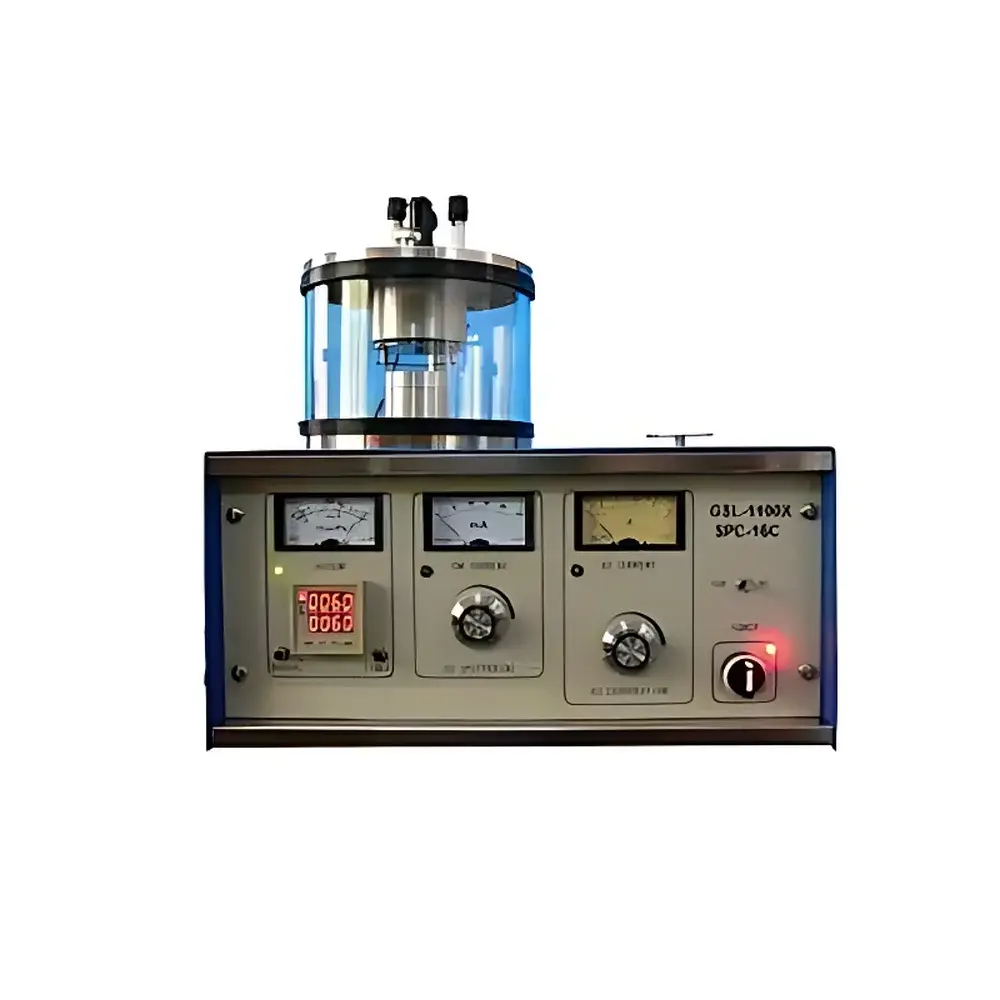
KJ GROUP GSL-1100X-SPC-16C Sputter and Thermal Evaporation Coater
| Brand | KJ GROUP |
|---|---|
| Origin | Liaoning, China |
| Model | GSL-1100X-SPC-16C |
| Vacuum Chamber | Ø160 mm × 110 mm |
| Sample Stage | Ø50 mm |
| Target Diameter | Ø50 mm |
| Base Pressure | 2×10⁻² mbar (with 4 L/s two-stage rotary pump) |
| Operating Pressure Range | 4×10⁻¹–2×10⁻² mbar |
| DC Sputtering Power Supply | 0–1600 V DC adjustable, up to 50 mA |
| Timer Range | 0–9999 s |
| Dimensions (L×W×H) | 400×310×390 mm |
| Weight | 50 kg |
| Argon Purity Requirement | ≥99.99% |
| Electrical Supply | AC 220 V, 50 Hz, grounded |
Overview
The KJ GROUP GSL-1100X-SPC-16C is a compact, dual-mode thin-film deposition system engineered for laboratory-scale physical vapor deposition (PVD) applications. It integrates both magnetron sputtering and resistive thermal evaporation within a single vacuum chamber, enabling precise, reproducible coating of conductive and non-conductive substrates. The system operates on the principle of plasma-assisted sputtering—where high-purity argon ions bombard a solid target (e.g., Au, Pt, or In), ejecting atoms that condense onto a substrate—and simultaneous thermal evaporation—where resistively heated filaments (e.g., carbon wire or aluminum foil) generate vapor flux under controlled vacuum conditions. This hybrid architecture supports routine sample preparation for electron microscopy (e.g., SEM conductive coating), electrode fabrication for electrochemical testing, and exploratory thin-film studies in materials science, nanotechnology, and surface physics laboratories.
Key Features
- Integrated dual-deposition capability: DC magnetron sputtering + resistive thermal evaporation in one chamber, eliminating cross-contamination risk and reducing setup time.
- Compact benchtop design (400 × 310 × 390 mm) optimized for space-constrained academic and industrial labs; weighs only 50 kg with full mechanical pump integration.
- Stainless-steel vacuum chamber (Ø160 mm × 110 mm) with quartz viewport and O-ring sealed flanges compliant with ISO-KF25 standards.
- Adjustable DC power supply (0–1600 V, current-limited to 50 mA) for stable, low-heat sputtering—ideal for heat-sensitive substrates and low-melting-point targets.
- Programmable digital timer (0–9999 s) with automatic shutoff, supporting repeatable process replication and unattended operation.
- Standard configuration includes gold target, carbon filament, thermal evaporation accessory kit, precision needle valve, and safety fuses—ready for immediate commissioning.
Sample Compatibility & Compliance
The GSL-1100X-SPC-16C accommodates substrates up to Ø50 mm on a manually centered, non-rotating stage. It supports rigid and semi-rigid samples—including silicon wafers, glass slides, ceramic pellets, polymer films, and biological specimens mounted on conductive stubs. For SEM sample preparation, it delivers uniform, sub-5 nm gold or carbon coatings with minimal topographic shadowing. All vacuum components meet ISO 286-2 (medium tolerance class) dimensional specifications. While not certified to ISO/IEC 17025, the system is routinely used in GLP-aligned research environments where process documentation (time, voltage, pressure, gas flow) is maintained per internal SOPs. Argon gas inlet requires external cylinder with dual-stage regulator (≥99.99% purity); no reactive gas mixing capability is included in base configuration.
Software & Data Management
This model operates via front-panel digital controls with LED display—no embedded software or PC interface is provided. All operational parameters (voltage, timer setting, status indicators) are manually entered and retained only during active session. Users are expected to log process parameters externally (e.g., lab notebook or LIMS) to support traceability requirements under FDA 21 CFR Part 11–aligned workflows. Optional RS232 or USB-to-serial adapters may be integrated via third-party hardware for basic data logging; however, KJ GROUP does not supply or validate such configurations. Calibration of pressure gauges (Pirani-type) and current/voltage meters is recommended annually using NIST-traceable references.
Applications
- SEM sample preparation: Conductive metal (Au, Pt, Cr) or amorphous carbon coating to prevent charging artifacts during high-vacuum imaging.
- Electrode fabrication: Deposition of thin-film working electrodes (e.g., Au on ITO, Ni on Si) for cyclic voltammetry and impedance spectroscopy.
- Optical thin-film prototyping: Preliminary deposition of reflective or anti-reflective layers (Al, Ag, TiO₂ via co-evaporation with optional upgrades).
- Materials interface engineering: Creation of model bilayer structures (e.g., Fe/Cu, MoS₂/Au) for interfacial transport or catalytic activity screening.
- Teaching laboratories: Hands-on demonstration of PVD fundamentals—mean free path, Knudsen number, sticking coefficient, and nucleation kinetics—under instructor supervision.
FAQ
What vacuum level is required for stable sputtering?
A base pressure ≤2×10⁻² mbar is required before introducing argon; operating pressure during sputtering is typically maintained between 4×10⁻¹ and 5×10⁻² mbar using the integrated needle valve.
Can this system deposit insulating films like SiO₂ or Al₂O₃?
No—this unit provides only DC sputtering, which is unsuitable for dielectric targets without RF or pulsed-DC capability. Reactive sputtering (e.g., with O₂) is not supported in standard configuration.
Is rotational sample motion available?
No—the sample stage is static. Uniformity relies on source-to-substrate geometry and process duration; for critical uniformity, manual repositioning or custom rotation add-ons are required.
What maintenance is required for long-term reliability?
Monthly cleaning of chamber interior and target surface with isopropanol; annual replacement of vacuum pump oil and inspection of O-rings; biannual verification of electrical grounding integrity.
Does the system comply with CE or UL safety standards?
It carries no CE marking or UL certification; users must perform local electrical safety assessment per national lab regulations prior to installation.



