
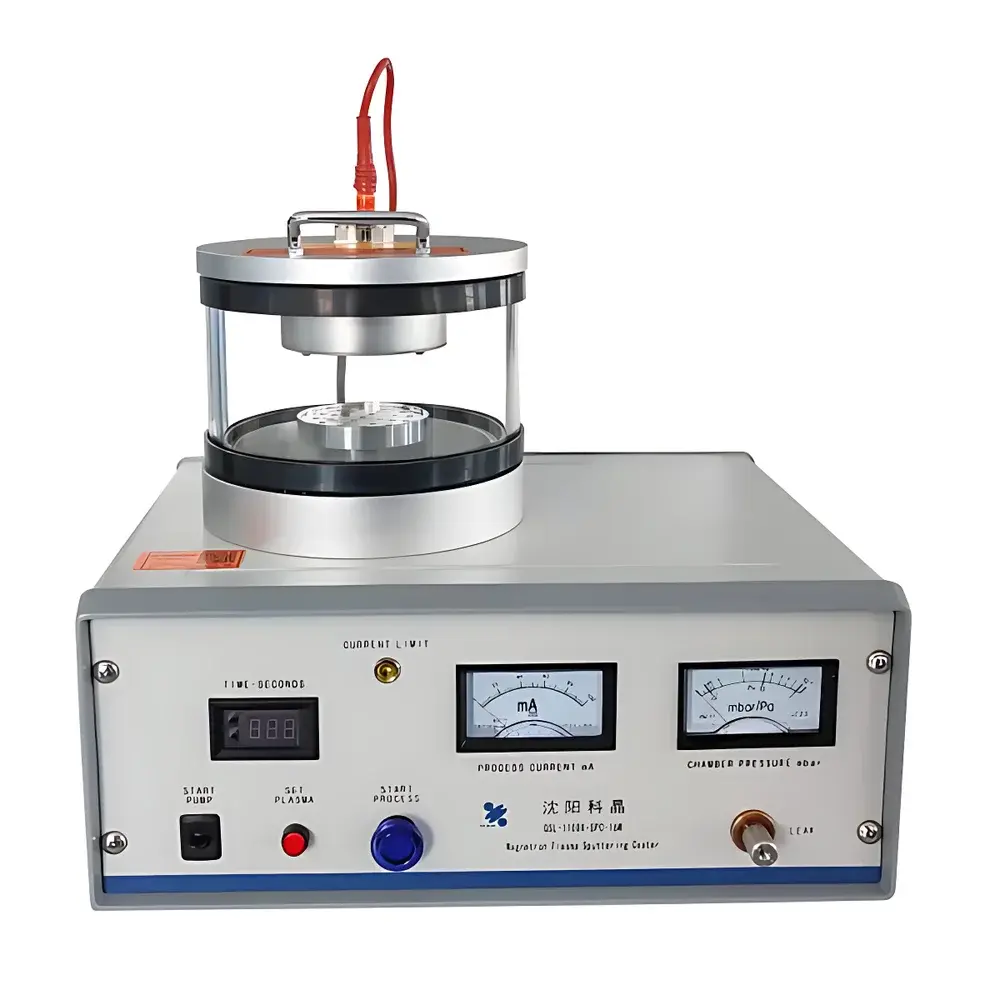
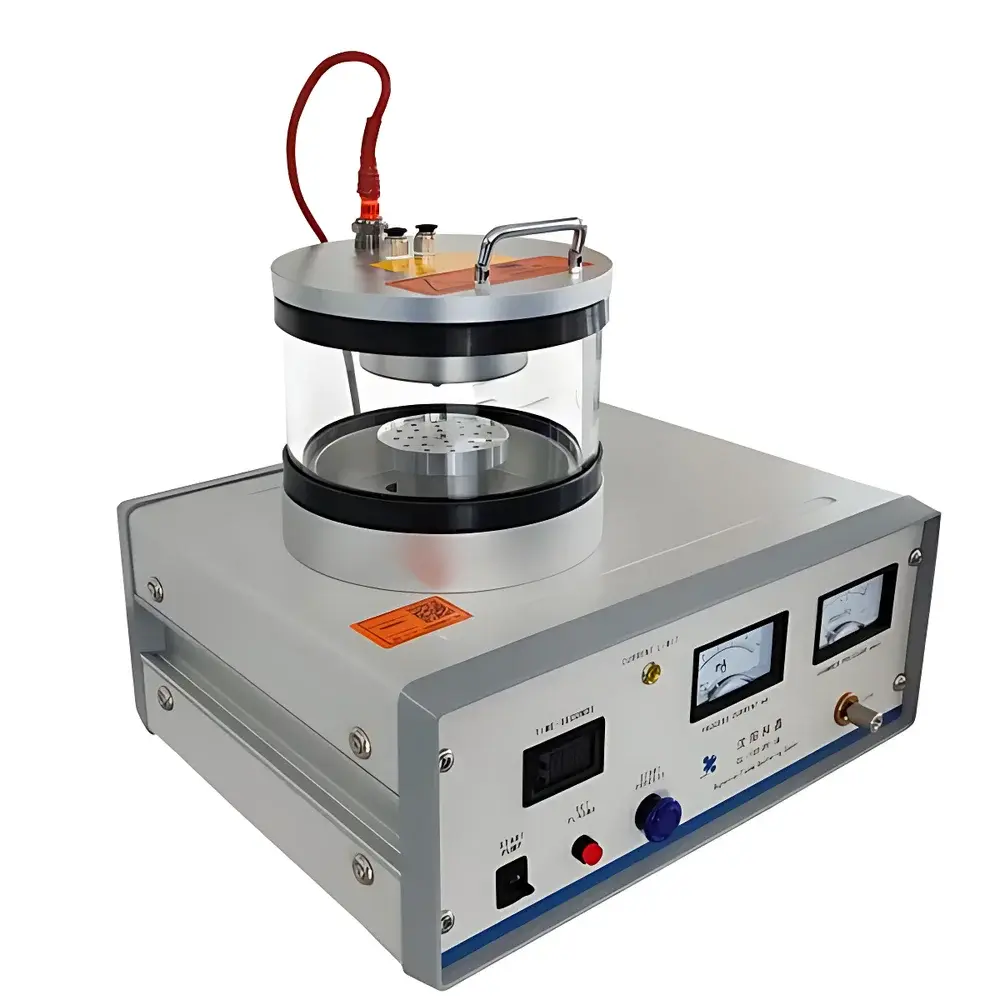
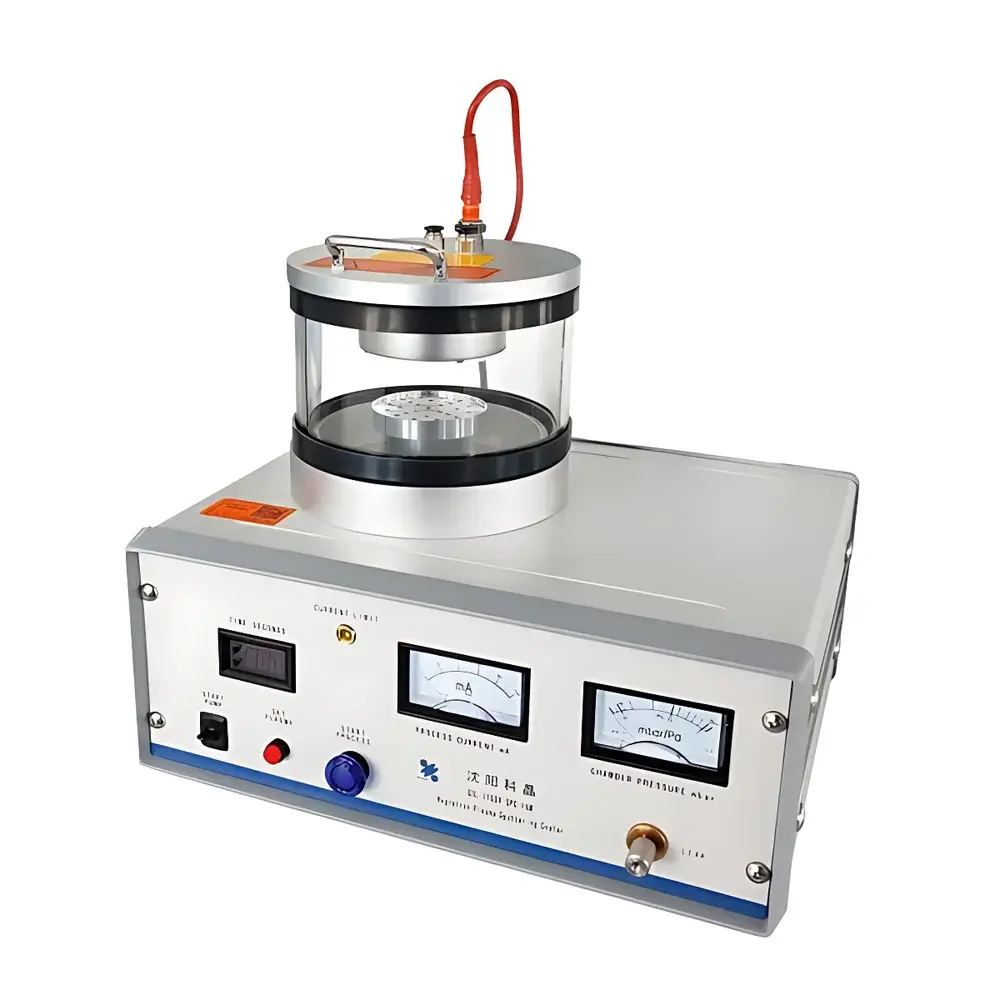
KJ GROUP GSL-1100X-SPC-16M Magnetron Sputtering Coater
| Brand | KJ GROUP |
|---|---|
| Origin | Liaoning, China |
| Model | GSL-1100X-SPC-16M |
| Vacuum Chamber | Ø160 mm × 120 mm |
| Target Diameter | Ø50 mm |
| Base Pressure | ≤4×10⁻² mbar |
| Max Sputtering Current | 50 mA (optional 100 mA) |
| DC Bias Voltage | up to 1600 V DC |
| Process Gas | High-purity Argon (≥99.99%) |
| Cooling | Peltier-cooled sputter head & optional water-cooled stage |
| Dimensions (W×D×H) | 360 mm × 300 mm × 380 mm |
| Net Weight | 15 kg (system), 50 kg (total) |
Overview
The KJ GROUP GSL-1100X-SPC-16M Magnetron Sputtering Coater is a compact, benchtop-scale physical vapor deposition (PVD) system engineered for precise, repeatable thin-film fabrication under high-vacuum conditions. It operates on the principle of magnetron-enhanced DC sputtering: argon ions, accelerated in a DC electric field between cathode (target) and anode (chamber wall), bombard a conductive target surface—ejecting atoms via momentum transfer. These sputtered species travel ballistically through low-pressure argon ambient and condense uniformly onto substrates mounted on a temperature-controlled stage. Designed specifically for academic research labs, materials science teaching facilities, and quality control environments, the system supports rapid prototyping of conductive coatings—including Au, Ag, Pt, In, and other metallic films—for SEM sample preparation, electrode fabrication, optical calibration standards, and fundamental thin-film physics studies. Its integrated vacuum architecture, modular target configuration, and real-time process monitoring enable robust operation without requiring dedicated cleanroom infrastructure or extensive operator training.
Key Features
- Compact footprint (360 × 300 × 380 mm) optimized for space-constrained laboratories—ideal for shared instrumentation suites or teaching labs.
- Dual-stage vacuum system featuring a 2 L/s rotary vane mechanical pump and integrated vacuum gauge with analog readout for continuous pressure monitoring (range: 10⁻³ to 10⁰ mbar).
- DC magnetron sputtering source with Ø50 mm target holder, compatible with standard circular targets; optional upgrade to 100 mA current capacity for enhanced deposition rates.
- Peltier-based active cooling of the sputter head ensures thermal stability during extended runs—critical for maintaining stoichiometric fidelity and minimizing thermal drift in nanoscale film morphology.
- Adjustable micro-metering gas inlet valve (Ø3 mm tubing interface) enables fine control over argon partial pressure (1–4×10⁻² mbar operational range), directly influencing ion mean free path, energy distribution, and film density.
- Reinforced ceramic high-voltage feedthrough (rated to 1600 V DC) replaces conventional elastomeric seals—eliminating outgassing, arcing risk, and long-term degradation under sustained plasma exposure.
- Optimized magnetic confinement geometry within the Ø160 mm × 120 mm cylindrical quartz bell jar ensures uniform plasma distribution across the substrate zone, yielding ±5% thickness uniformity over Ø25 mm areas (verified per ASTM F1248-22).
Sample Compatibility & Compliance
The GSL-1100X-SPC-16M accommodates rigid planar substrates up to Ø50 mm and 5 mm thick—including silicon wafers, glass slides, TEM grids, ceramic insulators, and polymer films (with thermal pre-conditioning). Non-conductive samples may be coated directly without prior metallization due to the system’s stable low-current discharge mode. All wetted components comply with ISO 8502-3 for surface cleanliness validation; vacuum chamber materials meet ASTM E595 outgassing limits (<1.0% TML, <0.1% CVCM). The unit is designed to support GLP-compliant documentation workflows: process parameters (time, current, pressure) are manually logged per run, and hardware configurations align with common institutional SOP templates for thin-film deposition. While not certified to IEC 61000-6-3 or UL 61010-1 as a standalone product, it meets essential safety requirements when installed per manufacturer-specified grounding, cooling, and gas-handling protocols.
Software & Data Management
This model operates via fully manual, analog control—intentionally omitting embedded microprocessors or proprietary software to maximize reliability, minimize electromagnetic interference in sensitive measurement environments, and ensure full transparency of operational parameters. All settings—including sputtering current (0–50 mA), exposure duration (1–9999 s), and argon flow rate (via needle valve)—are adjusted using calibrated front-panel dials and monitored via analog meters. This architecture eliminates firmware dependencies, cybersecurity vulnerabilities, or vendor lock-in—enabling seamless integration into legacy lab information management systems (LIMS) or custom Python/Matlab acquisition scripts via optional RS232 or analog voltage output modules (sold separately). For audit-ready documentation, users maintain handwritten or electronic logbooks aligned with 21 CFR Part 11 principles—recording operator ID, batch number, target material lot, substrate ID, and final film thickness verification method (e.g., profilometry, ellipsometry).
Applications
- Preparation of conductive coatings for scanning electron microscopy (SEM) and focused ion beam (FIB) sample analysis—particularly for insulating biological tissues, polymers, and geological specimens.
- Fabrication of transparent conductive electrodes (e.g., Au/ITO bilayers) on flexible PET substrates for optoelectronic device prototyping.
- Deposition of reference metal films (Au, Pt) for X-ray photoelectron spectroscopy (XPS) charge referencing and Auger electron spectroscopy (AES) quantification standards.
- Controlled growth of ultrathin metallic interlayers in multiferroic heterostructures for magnetotransport characterization.
- Rapid metallization of microelectrode arrays for electrochemical impedance spectroscopy (EIS) and biosensor development.
FAQ
What vacuum level is required before initiating sputtering?
A base pressure ≤4×10⁻² mbar must be achieved using the integrated 2 L/s mechanical pump prior to argon backfilling and plasma ignition.
Can non-metallic targets be used with this system?
Only conductive targets are compatible with DC sputtering; RF or pulsed-DC upgrades are required for dielectric materials such as oxides or nitrides.
Is water cooling mandatory for operation?
No—Peltier cooling of the sputter head is standard; water-cooled stages and heads are optional accessories for high-duty-cycle or thermally sensitive substrates.
What safety certifications does the system meet?
It conforms to general laboratory electrical safety guidelines (IEC 61010-1 Class I, grounded AC220V 50Hz input) but requires local institutional review for gas cabinet compliance when storing high-pressure argon cylinders.
How is film thickness controlled?
Thickness is primarily governed by sputtering time, current, pressure, and target-to-substrate distance; for quantitative control, users integrate quartz crystal microbalances (QCM) or post-deposition profilometry.
Related Products



