
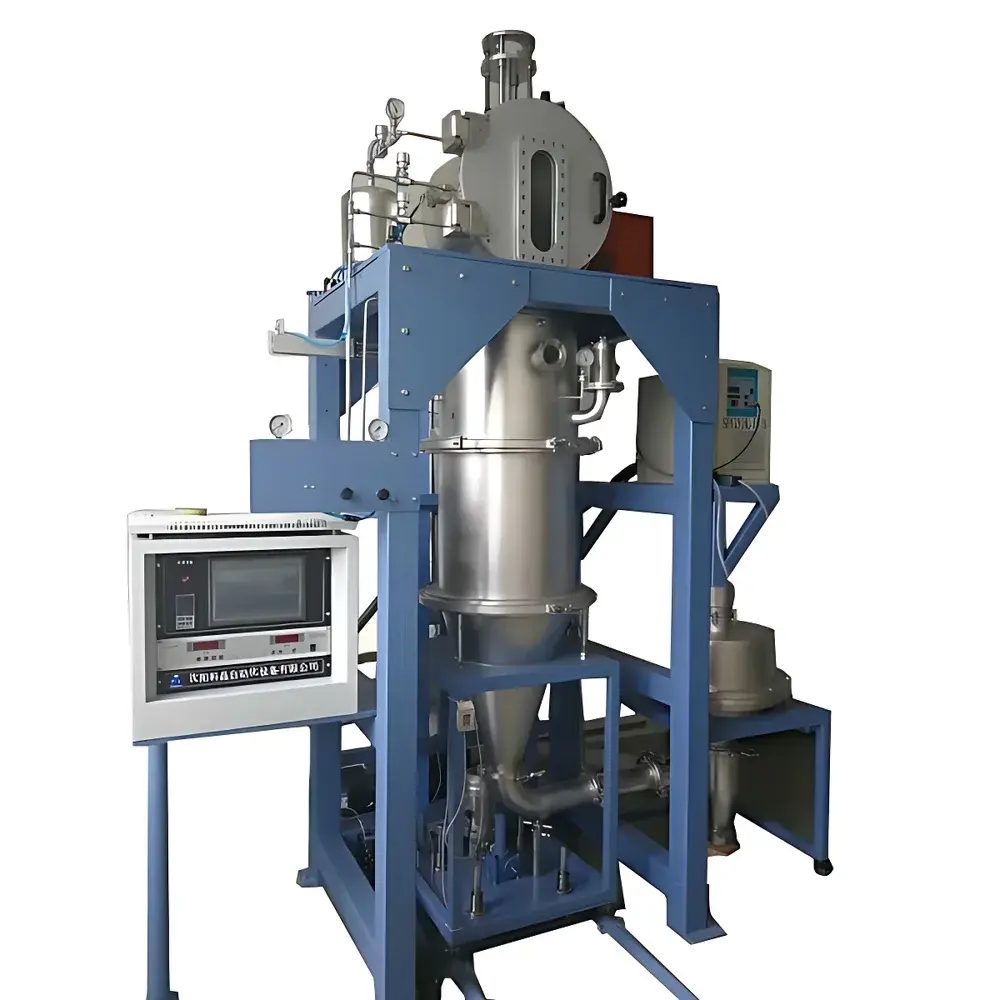
KJ GROUP GSL-1600X-VIGA300 Gas Atomization System for Metal Powder Production
| Brand | KJ GROUP |
|---|---|
| Origin | Liaoning, China |
| Manufacturer Type | Authorized Distributor |
| Country of Origin | China |
| Model | GSL-1600X-VIGA300 |
| Power Supply | AC 380 V, 50 Hz |
| Max. Power Consumption | <20 kW |
| Ultimate Vacuum | <8×10⁻⁵ mbar |
| Pressure Rise Rate | <0.67 Pa/h |
| Melting Chamber Dimensions | Ø500 × 430 mm |
| Max. Operating Temperature | 1600 °C |
| Induction Power Supply | 15 kW, 20–100 kHz |
| Induction Coil Dimensions | Ø48 × 90 mm |
| Cooling Method | Water-cooled (0.2–0.3 MPa) |
| Crucible Size | Ø38 × 155 mm |
| Sphericity | ~1 |
| d₅₀ Particle Size | ≤50 µm |
| Batch Yield | 40–300 g |
| Atomization Duration | 20–150 s |
| Overall Dimensions | 2700 × 2600 × 3200 mm |
| Weight | 2200 kg |
Overview
The KJ GROUP GSL-1600X-VIGA300 is a laboratory-scale vacuum induction gas atomization (VIGA) system engineered for the controlled production of high-purity, spherical metal powders under inert atmosphere conditions. It integrates vacuum metallurgy, high-frequency induction melting, and high-velocity inert gas jet atomization into a single compact platform. The system operates on the principle of electromagnetic induction heating to melt feedstock alloys—such as Fe-, Ni-, Cu-, and precious-metal-based compositions—within a water-cooled copper crucible, followed by rapid disintegration of the molten stream via supersonic argon or nitrogen jets in a sealed, ultra-high-vacuum chamber. This process yields powders with high sphericity (~1), low oxygen content (<100 ppm typical for Ni- and Fe-based alloys under optimized conditions), narrow particle size distribution (d₅₀ ≤ 50 µm), and minimal satellite formation—critical attributes for additive manufacturing (AM), metal injection molding (MIM), and thermal spray applications.
Key Features
- Vacuum induction melting subsystem with 15 kW, 20–100 kHz solid-state power supply and precision water-cooled induction coil (Ø48 × 90 mm)
- Integrated ultra-high-vacuum environment: base pressure <8×10⁻⁵ mbar, verified by calibrated capacitance manometer and backed by dual-stage pumping (mechanical + diffusion pump)
- Automated inert gas handling: compatible with high-purity Ar or N₂ (≥99.99%) supplied via standardized 10 mm double-ferrule fittings and regulated pressure control
- Compact monolithic design (2700 × 2600 × 3200 mm) with modular chamber access, enabling rapid crucible exchange and internal surface cleaning without disassembly
- Industrial-grade 10.1-inch touchscreen HMI with programmable logic controller (PLC)-based sequencing: independent control of vacuum ramping, melt temperature profiling, gas pressurization, and atomization trigger timing
- Water-cooled structural components and integrated closed-loop chiller (deionized water or purified water recommended) with real-time pressure monitoring (0.2–0.3 MPa operational range)
Sample Compatibility & Compliance
The GSL-1600X-VIGA300 supports feedstock materials including but not limited to stainless steels (e.g., 316L, 17-4PH), nickel superalloys (Inconel 625, 718), titanium alloys (Ti-6Al-4V pre-alloyed), cobalt-chrome, copper alloys, and noble metals (Au, Pt, Pd). All wetted surfaces are constructed from oxygen-free high-conductivity (OFHC) copper and 316L stainless steel, compliant with ASTM F3049–14 for AM powder characterization prerequisites. The system meets mechanical safety requirements per ISO 12100 and electrical safety standards IEC 61000-6-2/6-4. Vacuum and gas delivery interfaces conform to ISO 8573-1 Class 2 for compressed gas purity. While not certified for GMP production, its programmable process logs and parameter locking support GLP-aligned documentation for R&D and preclinical material development.
Software & Data Management
The embedded control firmware records time-stamped operational parameters—including vacuum level, melt temperature (via dual-wavelength pyrometer input), gas pressure, coil current, and cooling water flow—at 1 Hz resolution. Exportable CSV datasets include full sequence logs for each run, enabling traceability and statistical process analysis (SPC). Optional OPC UA interface allows integration into centralized lab data infrastructure (e.g., LabArchives, ELN systems). Audit trail functionality satisfies FDA 21 CFR Part 11 requirements when paired with user authentication and electronic signature modules (available as add-on configuration). No cloud connectivity is enabled by default; all data remains on-device unless explicitly exported via USB or Ethernet.
Applications
- Development and optimization of AM-qualified metal powders for laser powder bed fusion (LPBF) and electron beam melting (EBM)
- Production of MIM feedstocks requiring high green strength and uniform debinding behavior
- Synthesis of catalytic metal nanoparticles (e.g., Pt/Cu bimetallics) via post-atomization thermal treatment
- Fundamental studies of melt ejection dynamics, droplet solidification kinetics, and gas–metal interaction under variable pressure and velocity regimes
- Small-batch qualification of legacy alloy compositions for aerospace or biomedical regulatory submissions (e.g., ASTM F3302, ISO/ASTM 52900)
FAQ
What inert gases are compatible with the GSL-1600X-VIGA300?
Argon and nitrogen are supported, both requiring ≥99.99% purity and delivery via CGA-580 or equivalent 10 mm double-ferrule connections with adjustable pressure regulation.
Is the system suitable for reactive metals such as titanium or aluminum?
Yes—provided the entire vacuum path, crucible, and atomization nozzle are pre-baked under high vacuum and purged thoroughly with inert gas prior to melting; standard operating procedures include a 2-hour outgassing cycle at 10⁻⁴ mbar minimum.
Can particle size distribution be tuned during operation?
Yes—d₅₀ and span are modulated via real-time adjustment of melt superheat, gas pressure (0.5–7 MPa range), nozzle geometry (interchangeable orifice inserts available), and melt flow rate, all accessible through the HMI process editor.
What maintenance intervals are recommended for the diffusion pump?
Oil replacement every 1,000 hours of cumulative operation; cold trap cleaning every 200 hours when processing volatile or oxide-prone alloys.
Does the system include validation documentation for IQ/OQ protocols?
Factory-issued installation and operational qualification templates (in English) are provided; site-specific PQ must be executed by the end user per ISO/IEC 17025 guidelines using NIST-traceable calibration standards.



