
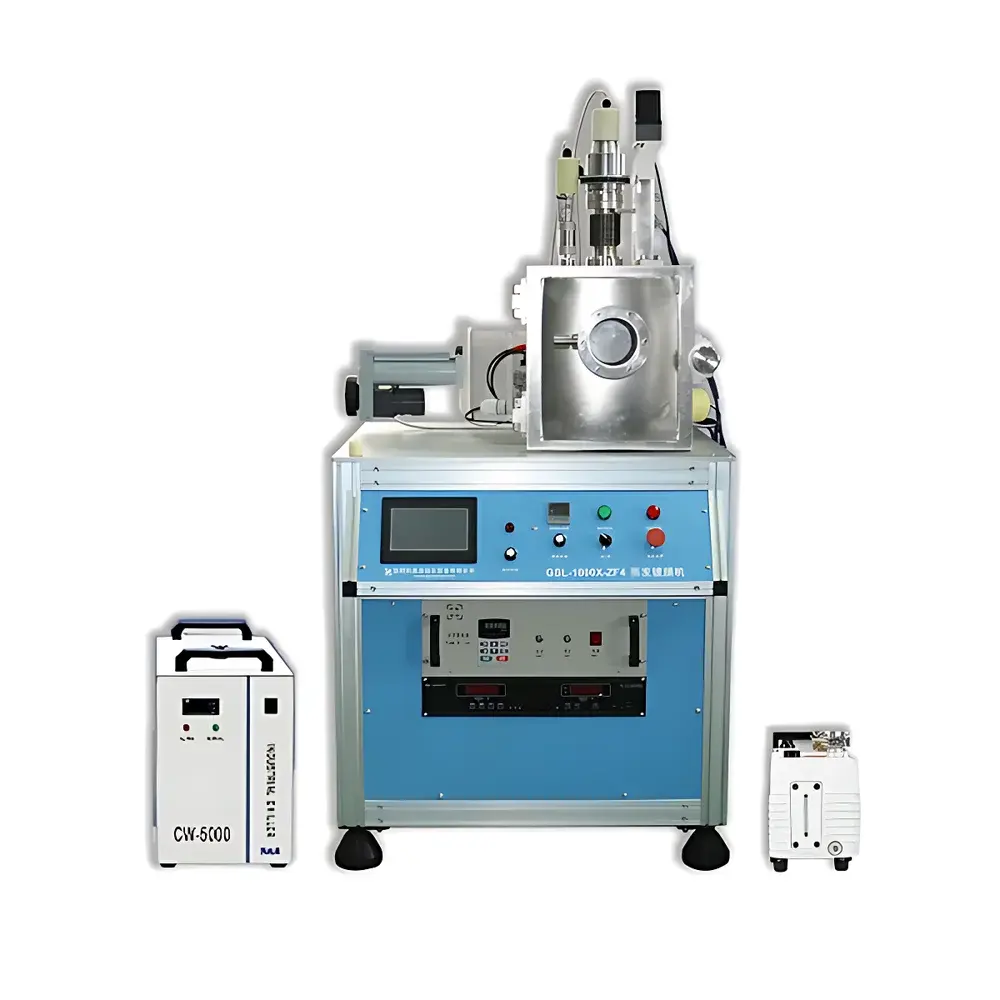
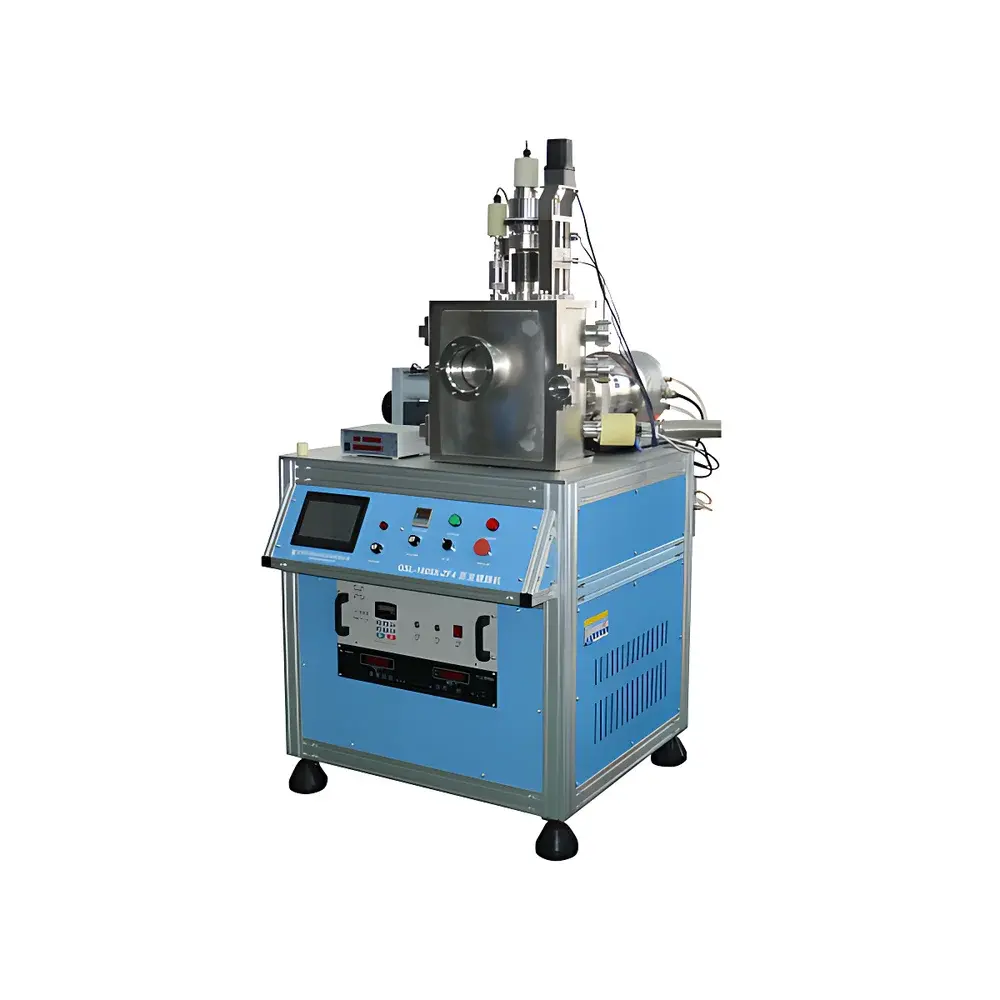
KJ GROUP GSL-1800X-ZF4 High-Vacuum Thermal Evaporation Coater
| Brand | KJ GROUP |
|---|---|
| Origin | Liaoning, China |
| Manufacturer Type | Authorized Distributor |
| Country of Origin | China |
| Model | GSL-1800X-ZF4 |
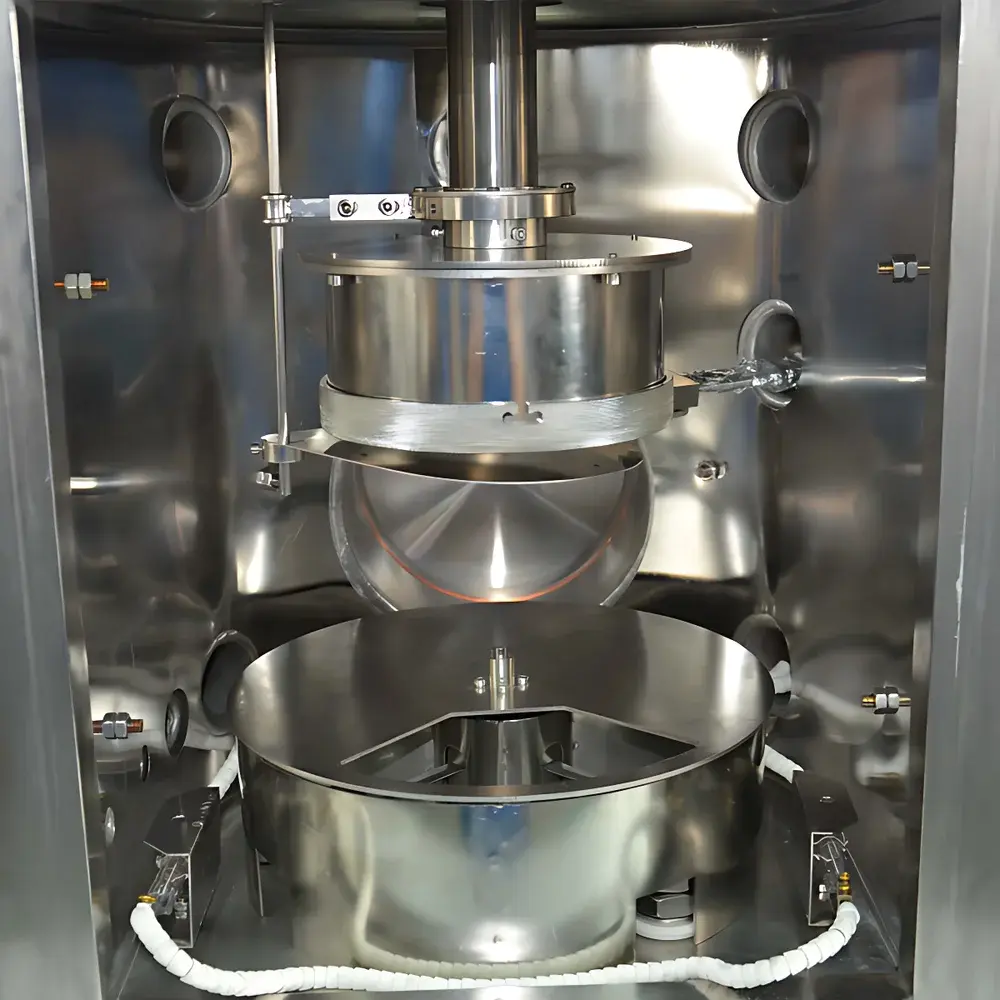
| Vacuum Chamber | Ø300 mm × 400 mm (stainless steel, electropolished interior) |
| Base Pressure | ≤8.0×10⁻⁵ Pa |
| Ultimate Vacuum | ≤8.0×10⁻⁴ Pa |
| Leak Rate | ≤6.7×10⁻⁸ Pa·L/s |
| Evaporation Sources | 4 independent tungsten boat heaters (water-cooled base with 5 water-cooled electrodes) |
| Substrate Heater | Temperature-controlled, RT–500 °C |
| Film Thickness Resolution (Al) | 0.1 Å |
| Substrate-to-Source Distance | 140–200 mm |
| Viewing Port | Ø100 mm fused quartz window with metal-sealed O-ring |
| Pumping System | 600 L/s turbo-molecular pump + KF40 bypass valve + CF150 gate valve |
| Electrical Input | AC 220 V, 50/60 Hz, <2.16 kW (excl. pumps) |
| Evaporation Power Supply | 0–8 V AC, up to 200 A, max 1.6 kW |
| Cooling Water Flow | 15 L/min (deionized or purified water) |
| Dimensions (W×D×H) | 900×1100×1800 mm |
| Weight | 230 kg |
Overview
The KJ GROUP GSL-1800X-ZF4 High-Vacuum Thermal Evaporation Coater is an engineered solution for controlled, multi-source physical vapor deposition (PVD) under ultra-low background pressure. Operating on the principle of resistive thermal evaporation—where electrically heated refractory metal boats (typically tungsten or molybdenum) vaporize solid source materials—the system enables precise, layer-by-layer thin-film fabrication in a high-reproducibility vacuum environment. With a base pressure of ≤8.0×10⁻⁵ Pa and a leak rate below 6.7×10⁻⁸ Pa·L/s, the GSL-1800X-ZF4 meets stringent requirements for oxygen-sensitive deposition processes, including metallization of Ti, Al, Au, and Ag, as well as vacuum evaporation of small-molecule organic semiconductors (e.g., Alq₃, NPB, TPD) used in OLEDs and organic photovoltaics (OPVs). Its stainless-steel chamber features electropolished internal surfaces to minimize outgassing and particle generation, while the integrated water-cooled electrode architecture ensures long-term thermal stability during high-current evaporation cycles.
Key Features
- Four independently controllable tungsten boat evaporation sources, each equipped with dedicated current regulation and isolated shielding via a motorized rotating baffle to prevent cross-contamination between sequential depositions.
- Top-mounted, temperature-regulated substrate stage (RT–500 °C) with PID feedback control and embedded thermocouple monitoring—enabling in-situ thermal annealing or substrate pre-heating prior to film growth.
- High-resolution quartz crystal microbalance (QCM) compatible mounting (CF35 flange), supporting real-time thickness monitoring with sub-angstrom resolution (0.1 Å for Al calibration) and rate control down to 0.01 nm/s.
- Integrated vacuum control module housing all electrical interfaces—including separate evaporator current controllers, vacuum gauge readouts (Bayard-Alpert ionization gauge + Pirani resistance gauge), and interlock logic—for centralized operational safety and repeatability.
- Robust pumping configuration: 600 L/s turbo-molecular pump backed by a dual-stage rotary vane pump, coupled with a CF150 gate valve for rapid isolation and a KF40 bypass valve for efficient rough pumping—reducing pump-down time to <30 minutes from atmosphere to 10⁻³ Pa.
- Five water-cooled electrodes at the chamber base provide uniform thermal management across all four evaporation zones, accommodating sustained 200 A operation without electrode deformation or oxidation.
Sample Compatibility & Compliance
The GSL-1800X-ZF4 accommodates substrates up to Ø120 mm and supports a broad range of deposition-compatible materials: elemental metals (Ti, Cr, Ni, Cu, Pt), alloys (NiCr, MoCr), oxides (ITO, SiO₂, Al₂O₃ via reactive evaporation), and thermally stable organics (e.g., C₆₀, pentacene, spiro-OMeTAD). All chamber hardware—including CF and KF flanges, water-cooling circuits, and electrical feedthroughs—complies with ISO 8573-1 (compressed air purity class 4) and ISO 10110-7 (optical surface cleanliness standards) where applicable. The system’s vacuum integrity and traceable parameter logging (via optional data acquisition interface) support GLP-compliant thin-film process documentation. While not certified to FDA 21 CFR Part 11 out-of-the-box, its architecture permits integration with audit-trail-capable software platforms meeting GMP validation requirements for R&D-scale optoelectronic device prototyping.
Software & Data Management
The coater operates via front-panel digital controls with analog metering for voltage, current, and vacuum levels. Optional RS485/Modbus RTU or Ethernet-based communication modules enable integration into laboratory-wide SCADA or LIMS environments. When paired with third-party thin-film process software (e.g., LabVIEW-based deposition sequencers or custom Python scripts), users can script multi-step recipes—including ramped substrate heating, staggered source activation, shutter sequencing, and synchronized QCM feedback loops—with timestamped parameter logging compliant with ISO/IEC 17025 data integrity guidelines. All vacuum gauges output calibrated analog signals (0–10 V DC) suitable for external recording systems requiring NIST-traceable pressure correlation.
Applications
- Development of emissive and charge-transport layers in organic light-emitting diodes (OLEDs) and perovskite light-emitting diodes (PeLEDs).
- Fabrication of transparent conductive electrodes (e.g., ultrathin Au or Ag films) and reflective back contacts for organic solar cells (OSCs) and dye-sensitized solar cells (DSSCs).
- Deposition of diffusion barriers (TiN, CrN) and adhesion promoters (Cr, Ti) in MEMS packaging and semiconductor metallization research.
- Preparation of model catalytic surfaces (e.g., size-selected Pd or Pt nanoparticles) for surface science studies under UHV-adjacent conditions.
- Controlled bilayer and heterostructure synthesis for fundamental investigations of interfacial charge transfer, exciton dissociation, and energy level alignment.
FAQ
What vacuum level is required before initiating evaporation?
A pressure ≤5.0×10⁻⁴ Pa must be achieved and stabilized for ≥10 minutes to ensure minimal residual gas interference during metal or organic evaporation.
Can the system deposit oxide films such as SiO₂ or Al₂O₃?
Yes—when operated in reactive mode using oxygen partial pressure control (requires optional MFC and residual gas analyzer), though stoichiometric control is limited compared to e-beam or sputtering methods.
Is the substrate heater capable of real-time temperature profiling during deposition?
Yes—the integrated K-type thermocouple and PID controller support programmable ramp-hold-cool profiles synchronized with shutter and source activation events.
What maintenance intervals are recommended for the turbo-molecular pump?
Per manufacturer specifications: oil inspection every 2000 hours; full bearing service every 12,000 hours; annual calibration of ionization and Pirani gauges.
Does the system support automated recipe execution?
Not natively—but with optional PLC or PC-based controller integration, full sequence automation—including source selection, shutter timing, thickness termination, and cooldown protocols—is fully implementable.



