
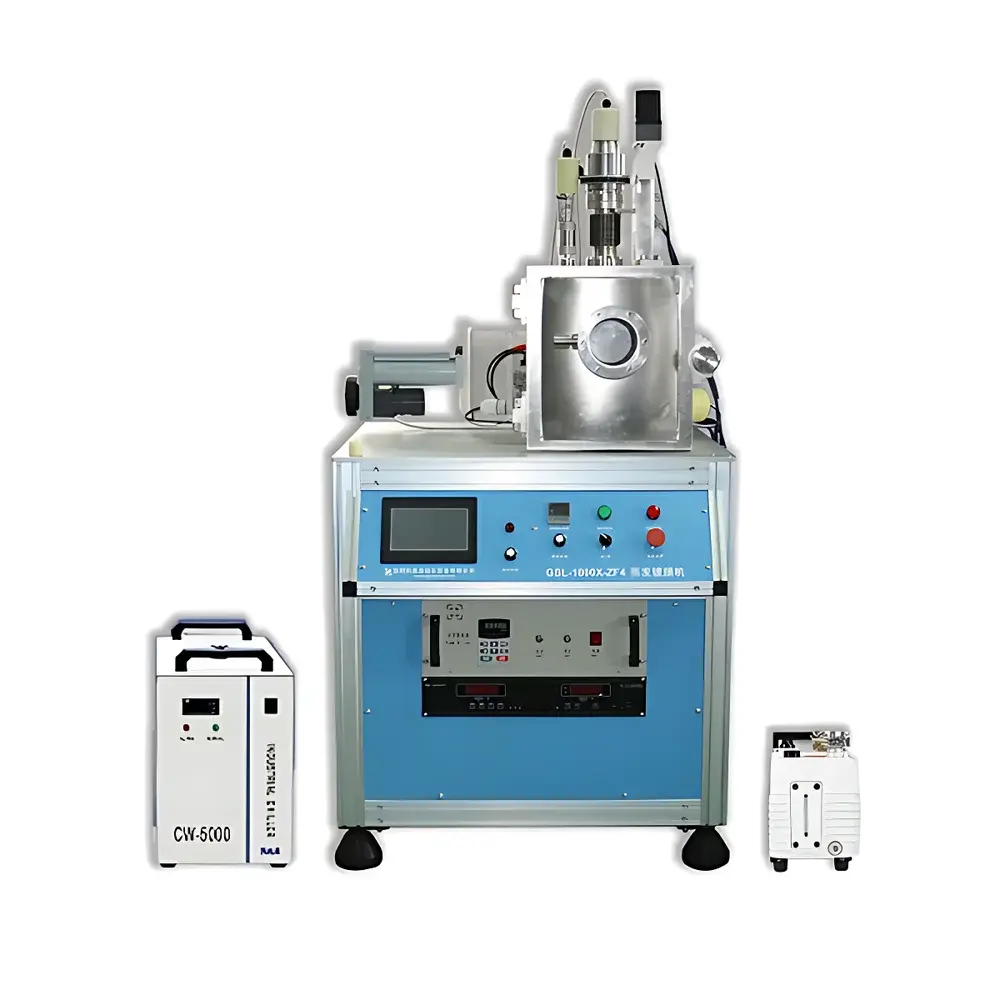
KJ GROUP GSL-1800X-ZF4 High-Vacuum Thermal Evaporation Coater
| Brand | KJ GROUP |
|---|---|
| Origin | Liaoning, China |
| Manufacturer Type | Authorized Distributor |
| Country of Origin | China |
| Model | GSL-1800X-ZF4 |
| Vacuum Chamber | Ø300 mm × 400 mm (stainless steel, electropolished interior) |
| Base Pressure | ≤8.0×10⁻⁵ Pa |
| Ultimate Vacuum | ≤8.0×10⁻⁴ Pa |
| Leak Rate | ≤6.7×10⁻⁸ Pa·L/s |
| Evaporation Sources | 4 independent tungsten heating boats |
| Substrate Heater | 0–500 °C, PID-controlled |
| Film Thickness Resolution (Al) | 0.1 Å |
| Cooling Water Flow | 15 L/min |
| Power Input | AC 220 V, 50/60 Hz, <2.16 kW (excl. pumps) |
| Evaporation Output | 0–8 V AC, up to 200 A, max. 1.6 kW |
| Substrate Stage Diameter | Ø120 mm |
| Source-to-Substrate Distance | 140–200 mm |
| Dimensions (W×D×H) | 900×1100×1800 mm |
| Weight | 230 kg |
Overview
The KJ GROUP GSL-1800X-ZF4 is a high-vacuum thermal evaporation coater engineered for precise, contamination-controlled thin-film deposition of oxygen-sensitive metals (e.g., Ti, Al, Au) and small-molecule organic semiconductors. It operates on the principle of resistive thermal evaporation under ultra-high vacuum conditions, where electrically heated tungsten boats vaporize source materials, and directional condensation forms uniform films on substrates held on a temperature-regulated stage. The system achieves a base pressure of ≤8.0×10⁻⁵ Pa—enabled by a 600 L/s turbo-molecular pump backed by a robust mechanical roughing pump—and maintains exceptional vacuum integrity with a leak rate of ≤6.7×10⁻⁸ Pa·L/s. Its electropolished stainless-steel chamber (Ø300 mm × 400 mm) minimizes outgassing and particulate generation, while integrated water-cooled electrodes (5 total, supporting 4 evaporation sources) ensure thermal stability during high-current operation. Designed for reproducible R&D in optoelectronics, the GSL-1800X-ZF4 supports controlled deposition kinetics critical for fabricating emissive layers in OLEDs and active layers in organic photovoltaics.
Key Features
- Four independently controllable tungsten evaporation boats with motorized rotating shutter assembly—prevents cross-contamination between sequential depositions.
- Top-mounted substrate stage (Ø120 mm) with programmable heating (room temperature to 500 °C) and real-time thermocouple feedback for thermal process control.
- Dedicated high-resolution quartz crystal microbalance (QCM) film thickness monitor (0.1 Å resolution for Al), mounted via CF35 flange with dedicated feedthrough.
- Integrated vacuum control unit consolidating all interlocks, pressure sequencing, and valve actuation logic into a single operator interface.
- Modular flange configuration: 1×KF40 bypass valve (to roughing pump), 1×CF150 gate valve (to turbo pump), 1×KF16 for Pirani gauge, and 6×CF35 ports—including dedicated locations for ion gauge, dual-pin electrical feedthrough, QCM, and three spares.
- Water-cooled electrode architecture with 15 L/min flow capacity—ensures sustained operation at up to 200 A evaporation current without thermal degradation.
- Optional integration with external recirculating chiller (deionized water or ultrapure water compatible).
Sample Compatibility & Compliance
The GSL-1800X-ZF4 accommodates rigid planar substrates up to Ø120 mm, including silicon wafers, glass slides, ITO-coated PET, and pre-patterned OLED test substrates. Its high-vacuum environment and low residual gas partial pressures (<10⁻⁷ mbar O₂-equivalent) are essential for depositing oxidation-prone metals and air-sensitive organics without interfacial oxide formation or molecular decomposition. While not certified to ISO/IEC 17025 or FDA 21 CFR Part 11 out-of-the-box, the system’s hardware architecture supports GLP/GMP-aligned workflows: vacuum logs, heater setpoint records, and shutter timing can be exported via RS232/USB for audit-ready documentation. All vacuum components comply with ASTM F2627-20 (Standard Guide for Vacuum System Integrity Testing) and meet material compatibility requirements per ISO 14644-1 Class 5 cleanroom installation guidelines when housed in appropriate lab infrastructure.
Software & Data Management
The coater utilizes a dedicated embedded controller with local touchscreen HMI for real-time monitoring of chamber pressure (Pirani + cold cathode ion gauge), boat current/voltage, substrate temperature, and QCM deposition rate. All operational parameters—including shutter open/close timestamps, power ramp profiles, and thermal soak durations—are timestamped and stored internally (≥10,000 event log capacity). Data export is supported via USB mass storage or RS232 serial output in CSV format, enabling traceability for method validation and inter-laboratory comparison. Optional LabVIEW™ or Python-based API integration allows synchronization with external metrology tools (e.g., ellipsometers, PL quantum yield systems) for closed-loop process development.
Applications
- Deposition of electron/hole transport layers (e.g., LiF, MoO₃, NPB) and emissive dopants (e.g., Ir(ppy)₃) in OLED device prototyping.
- Fabrication of transparent conductive electrodes (Ti, Al, Ag alloys) on flexible substrates for touch sensor and display R&D.
- Controlled growth of model metal-organic interfaces for fundamental surface science studies (e.g., work function tuning, interfacial dipole analysis).
- Evaporation of small-molecule donors/acceptors (e.g., C₆₀, CuPc, DIP) in bilayer and bulk heterojunction organic solar cell architectures.
- In-situ calibration of optical thin-film sensors and reference coatings for spectroscopic instrumentation.
FAQ
What vacuum level is required before initiating evaporation?
A stable base pressure ≤5.0×10⁻⁵ Pa must be achieved and maintained for ≥15 minutes prior to power ramp-up, as verified by both Pirani and cold cathode gauges.
Can the system deposit multilayer structures with sub-nanometer interlayer control?
Yes—via sequential shutter actuation and QCM feedback, layer-by-layer deposition with ≤0.3 nm repeatability (RMS) is achievable under optimized thermal stabilization protocols.
Is remote operation or network connectivity supported?
The standard configuration includes RS232 and USB host ports; Ethernet or Wi-Fi modules are available as factory-installed options for centralized facility management.
What maintenance intervals are recommended for the turbo-molecular pump?
Per manufacturer specifications, the pump requires annual bearing inspection and every 12,000 operating hours for full service—including rotor balancing and lubricant replacement—when operated within specified inlet pressure limits.
Does the system comply with CE or UL safety standards?
The GSL-1800X-ZF4 meets IEC 61000-6-2 (EMC immunity) and IEC 61000-6-4 (EMC emissions); CE marking applies to the vacuum control cabinet; UL certification for the full system is available upon request with additional conformity testing.



