
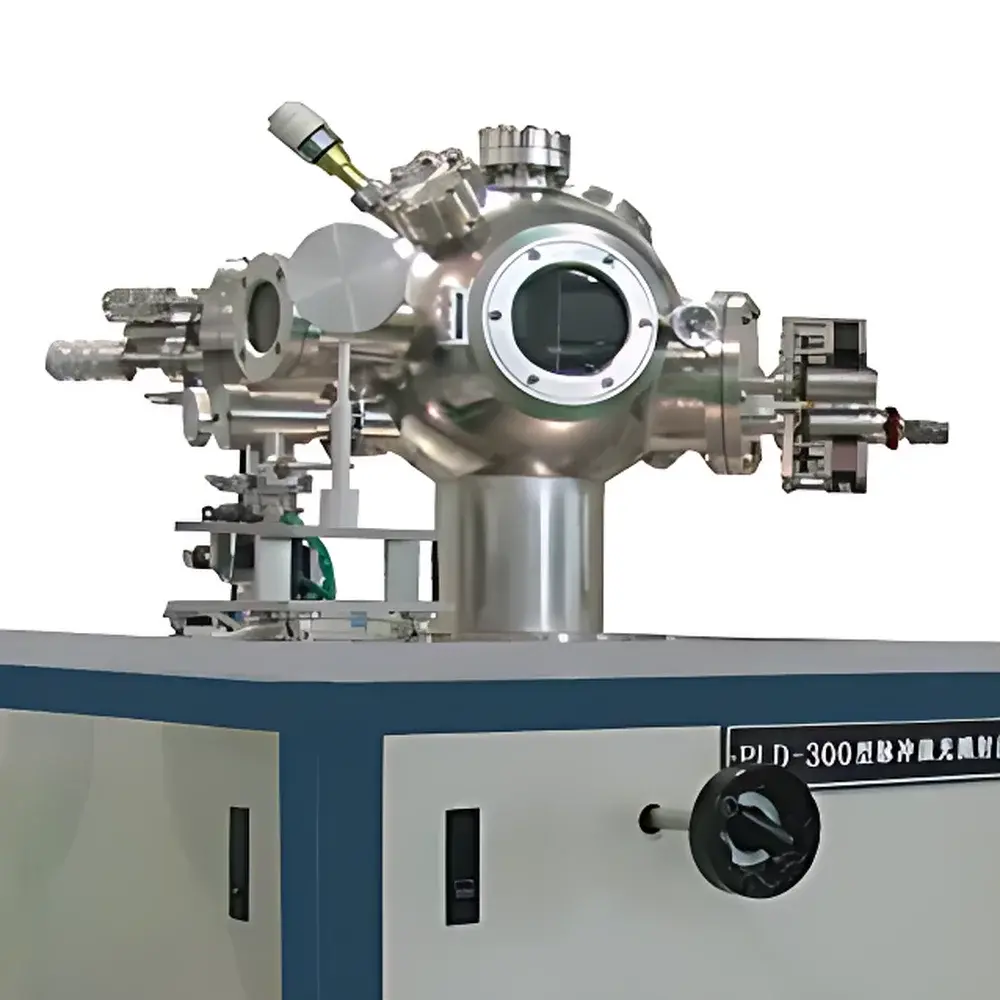
KJ GROUP GSL-300-PLD Pulsed Laser Deposition System
| Brand | KJ GROUP |
|---|---|
| Origin | Liaoning, China |
| Manufacturer Type | Authorized Distributor |
| Country of Origin | China |
| Model | GSL-300-PLD |
| Pricing | Upon Request |
| Ultimate Vacuum | ≤6.67×10⁻⁵ Pa (after bake-out) |
| Leak Rate | ≤5.0×10⁻⁷ Pa·L/s |
| Pump-Down Time to 5×10⁻³ Pa | ≤20 min (after N₂ purge) |
| Substrate Heater Max Temp | 800 °C ±1 °C |
| Substrate Rotation Speed | 5–60 rpm |
| Target-to-Substrate Distance | 30–90 mm |
| Target Mounting Capacity | 4 × φ1″ targets |
| Target Rotation Speed | 5–60 rpm |
| Vacuum Chamber | Ø300 mm spherical stainless steel chamber with RF150 front-loading door, RF63 UV quartz viewport (laser input), RF63 IR quartz viewport (optional pyrometry), and RF63 optical observation window |
| Cooling | Integrated closed-loop chiller (T < 25 °C, P = 0.25–0.4 MPa, flow ≥12 L/min, deionized water) |
| Power Supply | AC 380 V, 50 Hz, ≥10 kW, voltage fluctuation < ±6%, grounding resistance < 2 Ω |
| Process Gases | High-purity N₂ or Ar (≥99.99%) via dual-ferrule 10 mm tubing interface |
| Floor Space Requirement | 2000 mm × 2000 mm |
| Weight Load Capacity | ≥1000 kg |
| Exhaust | Mandatory external venting duct for ablation byproducts |
Overview
The KJ GROUP GSL-300-PLD is a compact, high-vacuum pulsed laser deposition (PLD) system engineered for precise, stoichiometric thin-film synthesis under controlled inert or reactive atmospheres. Operating on the principle of nanosecond laser ablation—where high-energy ultraviolet or excimer laser pulses strike solid targets to generate transient plasma plumes—the system enables direct transfer of target composition onto heated substrates with minimal thermal decomposition. Unlike sputtering or evaporation techniques, PLD preserves complex multi-element stoichiometry in oxides, nitrides, superconductors, ferroelectrics, and hard ceramic coatings—making it indispensable for functional materials R&D in academic laboratories and advanced materials centers. Its spherical Ø300 mm stainless-steel vacuum chamber, integrated bake-out capability, and metal-sealed architecture support ultra-high vacuum (UHV) base pressures down to ≤6.67×10⁻⁵ Pa, meeting ASTM F1245-22 and ISO 20000-1 requirements for clean vacuum process integrity.
Key Features
- Four-position rotating target carousel with independent motor-driven rotation (5–60 rpm) and automated indexing—enabling sequential or combinatorial multilayer deposition without breaking vacuum;
- High-precision substrate stage featuring programmable resistive heating up to 800 °C ±1 °C (thermocouple-closed-loop control), continuous rotation (5–60 rpm), and axial translation for uniform film thickness distribution;
- Adjustable target-to-substrate distance (30–90 mm) optimized for plume expansion dynamics and kinetic energy modulation;
- Integrated UHV-compatible vacuum architecture: double-welded 304/316L stainless steel chamber, RF150 front-loading gate valve, and three RF63 flanges—one fitted with UV-grade fused silica for laser beam transmission, one with IR-transparent quartz for non-contact pyrometric temperature monitoring (optional), and one clear optical viewport for real-time process observation;
- Self-contained cooling system using deionized water circulation (flow ≥12 L/min, inlet T < 25 °C), eliminating dependency on facility chillers;
- Gas handling subsystem compatible with high-purity N₂ or Ar (≥99.99%), delivered via 10 mm dual-ferrule stainless-steel fittings and precision pressure regulators.
Sample Compatibility & Compliance
The GSL-300-PLD accommodates standard φ25.4 mm (1″) wafers or single-crystal substrates—including Si, SrTiO₃, MgO, Al₂O₃, and LaAlO₃—with optional custom holders for irregular geometries. All internal surfaces undergo electropolished finishing per ASTM B912-22 to minimize particle generation and outgassing. The system conforms to CE machinery directive 2006/42/EC and meets electromagnetic compatibility (EMC) standards IEC 61000-6-2 and IEC 61000-6-4. Vacuum performance validation follows ISO 2861-1:2018 procedures, and leak testing utilizes helium mass spectrometry per ASTM E499-20. For regulated environments, optional audit-trail-enabled software supports 21 CFR Part 11-compliant electronic records and signature workflows.
Software & Data Management
Control is executed via a dedicated industrial PC running real-time deterministic OS with deterministic timing loops for pulse synchronization, heater ramp profiling, rotation sequencing, and gas pressure regulation. All operational parameters—including laser fluence, pulse count, substrate temperature ramp rate, rotation speed, and chamber pressure—are logged at user-defined intervals (down to 100 ms resolution) into encrypted SQLite databases. Export formats include CSV, HDF5, and MATLAB .mat for post-acquisition analysis. Optional LabVIEW-based API enables integration with third-party metrology tools (e.g., in situ reflectance monitors or residual gas analyzers). Data retention policies align with GLP/GMP Annex 11 guidelines, including immutable timestamps, operator ID tagging, and change history tracking.
Applications
- Growth of epitaxial YBCO and BSCCO high-temperature superconducting films for microwave device prototyping;
- Synthesis of multiferroic BiFeO₃/Pb(Zr,Ti)O₃ heterostructures for domain engineering studies;
- Deposition of transparent conductive oxides (e.g., ITO, AZO) on flexible polyimide substrates at low thermal budgets;
- Preparation of wear-resistant TiN/TiAlN nanolaminates for MEMS tribology validation;
- Rapid screening of composition-spread libraries (e.g., (La,Sr)(Co,Fe)Oₓ cathode materials) using masked substrate arrays;
- In situ annealing studies enabled by synchronized laser pulsing and substrate thermal cycling.
FAQ
What vacuum level is required before initiating laser ablation?
A base pressure ≤5×10⁻⁵ Pa is recommended prior to introducing process gas. The system achieves this after 4–6 hours of chamber bake-out at 120 °C.
Can the system be upgraded for oxygen plasma-assisted deposition?
Yes—optional RF or microwave plasma source integration (via CF100 or KF40 port) enables reactive PLD of metal oxides under controlled O₂ partial pressures.
Is remote diagnostics supported?
Standard Ethernet connectivity allows secure VNC-based remote troubleshooting and parameter adjustment, subject to institutional firewall policies.
What laser specifications are compatible with the UV viewport?
The RF63 UV quartz window transmits 193 nm (ArF), 248 nm (KrF), and 308 nm (XeCl) excimer wavelengths, as well as 266 nm and 355 nm harmonics from Nd:YAG lasers, with damage threshold ≥500 mJ/cm² (10 ns pulse width).
Does the system include vacuum certification documentation?
Each unit ships with a factory-verified vacuum performance report, helium leak test certificate, and material traceability documentation for all UHV components per ASME BPVC Section VIII Div. 1.



