
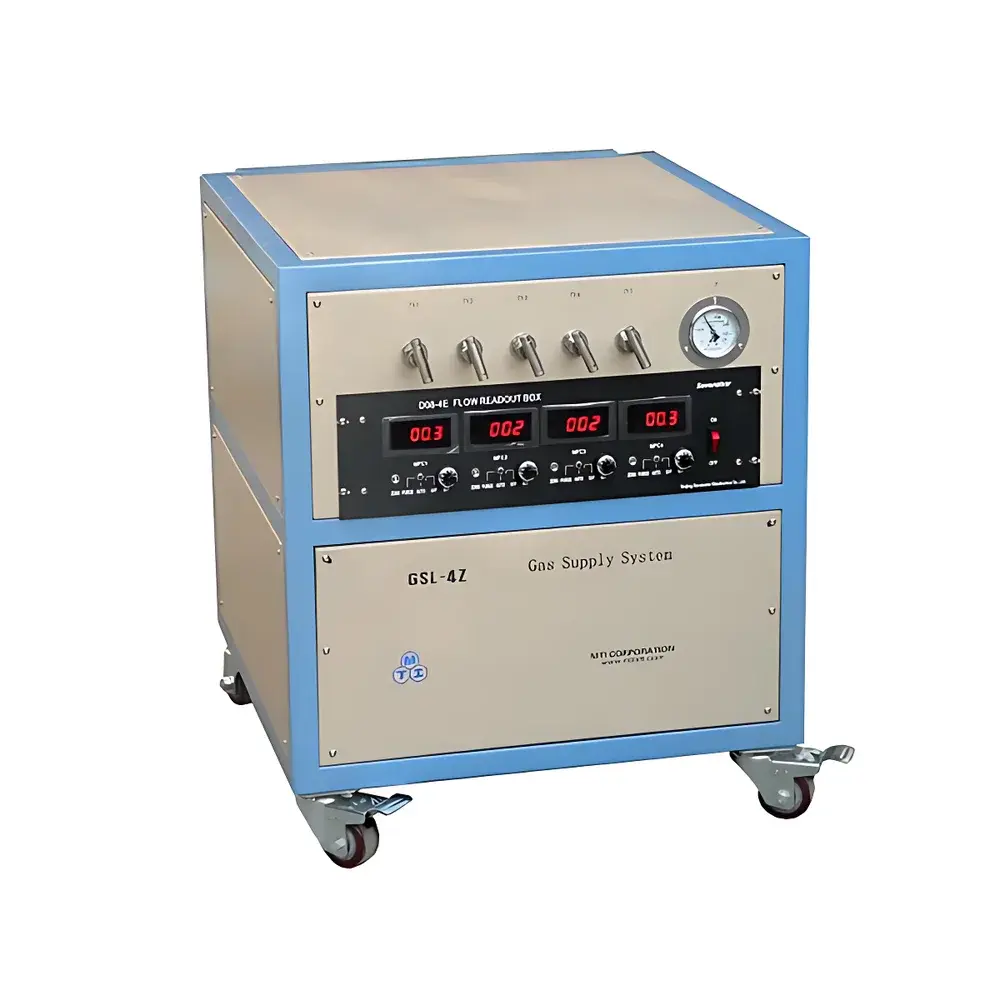
KJ GROUP GSL-4Z Four-Channel Mass Flow Controlled Gas Mixing System
| Brand | KJ GROUP |
|---|---|
| Origin | Liaoning, China |
| Manufacturer Type | Authorized Distributor |
| Country of Origin | China |
| Model | GSL-4Z |
| Pricing | Available Upon Request |
| Power Supply | 185–245 VAC, 50 Hz |
| Max. Output Power | 18 W |
| Flow Control Ranges | MFC1: 0–100 SCCM |
| MFC2 | 1–199 SCCM |
| MFC3 | 1–199 SCCM |
| MFC4 | 1–499 SCCM |
| Max. Operating Pressure | 3 MPa |
| Accuracy | ±1% FS |
| Linearity | ±0.5–1.5% FS |
| Repeatability | ±0.2% FS |
| Response Time (Gas) | 1–4 s |
| Response Time (Electrical) | ≤10 s |
| Needle Valves | 316 Stainless Steel |
| Operating Pressure Drop Range | 0.1–0.5 MPa |
| Vacuum/Pressure Gauge Range | –0.1 to +0.15 MPa (0.01 MPa/division) |
| Mixing Chamber | Ø80 mm × 120 mm |
| Shut-off Valves | 1/4″ BSP, 316 SS |
| Ambient Operating Temperature | 5–45 °C |
| Dimensions (W×D×H) | 600 × 600 × 650 mm |
Overview
The KJ GROUP GSL-4Z Four-Channel Mass Flow Controlled Gas Mixing System is an engineered solution for precise, independent regulation and blending of up to four process gases in vacuum-compatible or pressurized thermal environments—particularly tube furnaces used in chemical vapor deposition (CVD), annealing, diffusion, oxidation, and thin-film synthesis. Built upon a modular mobile cart architecture, the system integrates four calibrated thermal mass flow controllers (MFCs), stainless-steel fluidic components, and real-time analog monitoring into a single compact unit. Its core operational principle relies on thermal dispersion sensing, where gas-specific heat capacity and flow-induced temperature differentials are converted into linear, digitally compensated mass flow signals—ensuring traceable, repeatable delivery under variable backpressure conditions. Designed for integration with both atmospheric and vacuum-based reactors (down to 10⁻³ mbar), the GSL-4Z supports stable operation across wide pressure gradients (0.1–0.5 MPa differential) and ambient temperatures (5–45 °C), making it suitable for laboratories requiring GLP-aligned gas delivery consistency in semiconductor process development, functional materials research, and catalytic reaction screening.
Key Features
- Four independently programmable thermal mass flow controllers with gas-specific calibration curves (N₂, O₂, Ar, He, N₂O, NH₃, H₂, CO, CH₄, and custom blends supported via firmware configuration)
- High-stability 316 stainless-steel needle valves and 1/4″ BSP shut-off valves rated for 3 MPa maximum service pressure and compatible with aggressive process chemistries
- Integrated mixing chamber (Ø80 mm × 120 mm) with turbulent-flow geometry optimized for homogenization prior to furnace inlet
- Analog front-panel interface with individual flow setpoint dials, LED digital displays (0.1 SCCM resolution), and real-time pressure indication (–0.1 to +0.15 MPa, 0.01 MPa grid)
- Robust mechanical design: powder-coated steel chassis, vibration-damped mounting, and IP20-rated enclosure for cleanroom-adjacent lab environments
- Low-power consumption (≤18 W total) enabling continuous unattended operation without thermal drift concerns
Sample Compatibility & Compliance
The GSL-4Z is compatible with inert, oxidizing, reducing, and mildly corrosive gases commonly employed in microelectronics fabrication and advanced materials synthesis—including but not limited to Ar, N₂, O₂, H₂, NH₃, SiH₄, PH₃, B₂H₆, and Cl₂ (with optional corrosion-resistant MFC options). All wetted parts conform to ASTM F840-22 standards for stainless-steel fluid system components. The system meets CE marking requirements for electromagnetic compatibility (EN 61326-1) and low-voltage safety (EN 61010-1). While not inherently 21 CFR Part 11 compliant, its analog control architecture supports external data logging via 0–5 V or 4–20 mA outputs—enabling integration into validated LIMS or SCADA platforms that enforce audit trails, electronic signatures, and change control per GMP/GLP workflows.
Software & Data Management
The GSL-4Z operates as a standalone analog-controlled instrument; no embedded software or onboard firmware is required for basic functionality. For enhanced traceability, optional analog-to-digital signal conditioning modules provide isolated 0–5 V outputs corresponding to each MFC’s instantaneous flow rate and integrated pressure gauge reading. These signals may be acquired by third-party DAQ systems (e.g., National Instruments USB-6009, Keysight 34972A) running LabVIEW, Python (PyVISA), or MATLAB-based acquisition scripts. Raw time-series data can be timestamped, archived in CSV/HDF5 format, and cross-referenced with furnace temperature profiles for full experimental reproducibility—supporting ISO/IEC 17025-compliant reporting frameworks.
Applications
- CVD precursor delivery and stoichiometric ratio control during graphene, MoS₂, or perovskite thin-film growth
- In-situ annealing atmosphere modulation for dopant activation and defect passivation in SiC and GaN wafers
- Controlled oxidation/reduction cycling in catalyst stability testing (e.g., Ni/Al₂O₃, Pt/TiO₂)
- Multi-gas calibration of environmental sensors and gas-phase IR/MS analyzers
- Process gas blending for plasma-enhanced CVD (PECVD) and atomic layer deposition (ALD) tool qualification
- Atmospheric-controlled sintering of solid-state electrolytes in all-solid-state battery R&D
FAQ
Can the GSL-4Z be used under high vacuum conditions?
Yes—the system is designed for operation with inlet pressures as low as 10⁻³ mbar when paired with appropriate vacuum-compatible tubing and feedthroughs. Backpressure must remain within the specified 0.1–0.5 MPa differential range across each MFC.
Is gas-specific recalibration possible?
Factory calibration is performed using N₂; however, users may apply correction factors per ISO 14644-3 Annex D for alternative gases using known thermal conductivity and specific heat ratios. Custom calibration certificates are available upon request.
Does the system support remote control or automation?
Not natively—but analog voltage outputs (0–5 V) enable seamless integration with PLCs, Arduino-based controllers, or PC-based DAQ systems for closed-loop gas ratio scheduling.
What maintenance intervals are recommended?
Visual inspection and leak checking every 6 months; MFC zero-point verification annually; needle valve lubrication with fluorinated grease (e.g., Dow Corning® 111) every 2 years under continuous use.
Are replacement MFCs and spare parts available?
Yes—KJ GROUP provides OEM-specified thermal MFC modules, 316 SS needle valves, and pressure gauges with documented calibration histories and RoHS-compliant material certifications.



