
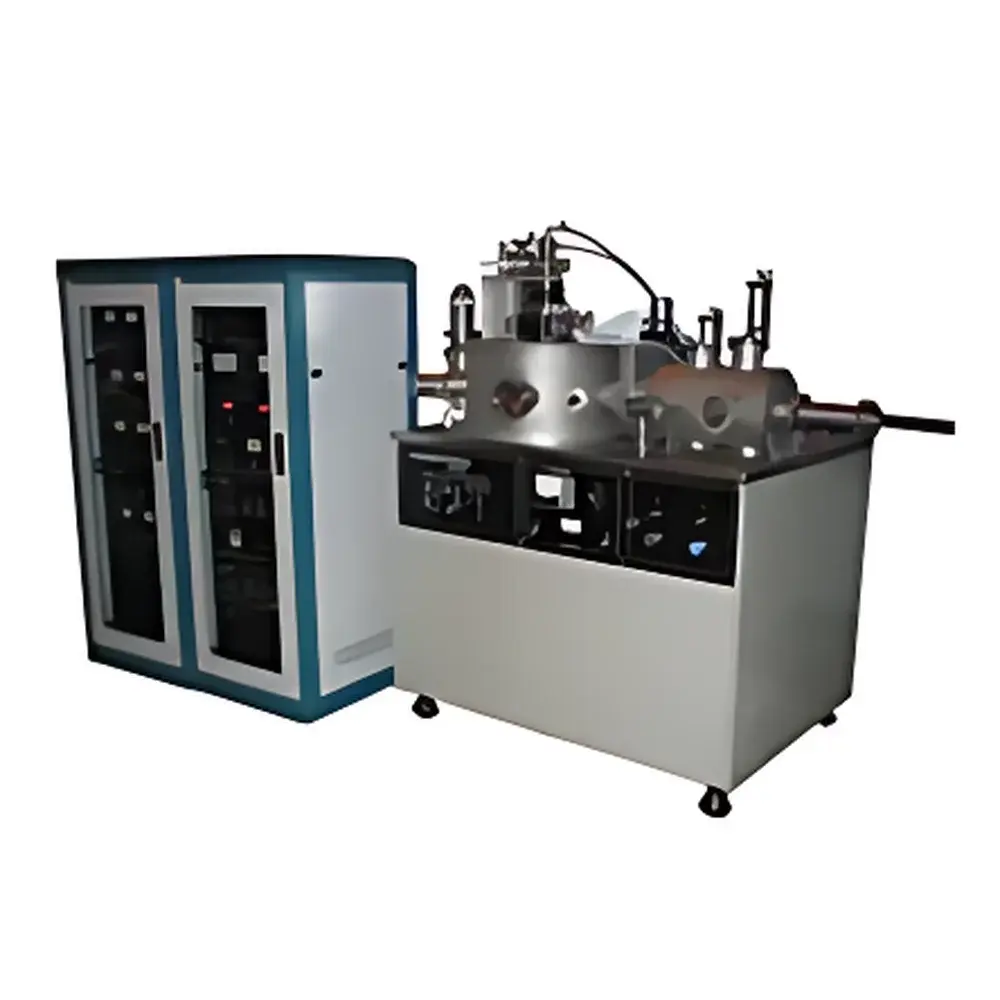
KJ GROUP GSL-CKJS-560-B2 Magnetron Sputtering System
| Brand | KJ GROUP |
|---|---|
| Origin | Liaoning, China |
| Manufacturer Type | Authorized Distributor |
| Origin Category | Domestic |
| Model | GSL-CKJS-560-B2 |
| Pricing | Upon Request |
| Main Chamber Dimensions | Ø560 × 355 mm (Pear-shaped Vacuum Chamber) |
| Base Pressure | 5 × 10⁻⁶ Pa |
| Load-lock Chamber Dimensions | Ø255 × 430 mm |
| Load-lock Base Pressure | 5 × 10⁻⁴ Pa |
| Magnetron Targets | 5 × Ø2″ Permanent Magnet Targets |
| Sputtering Modes | DC & RF Compatible per Target (1 Target Enables Ferromagnetic Material Sputtering) |
| Sample Stage | 6-Position Rotating Substrate Holder (5 Water-Cooled Positions + 1 Heated Position up to 600 °C ±1 °C) |
| Substrate Size | Ø25.4 mm (1″), 6 Slots |
| Substrate Bias | Adjustable DC Bias up to –200 V |
| Load-lock Annealing Capability | Up to 800 °C ±1 °C |
| In-situ Reverse Sputter Cleaning | Yes |
| Inter-chamber Transfer | Magnetic Coupling Sample Transfer Mechanism |
| Cooling | Integrated Recirculating Chiller (Deionized/Purified Water Required) |
| Electrical Supply | AC 380 V, 50 Hz, Grounded |
| Process Gases | High-Purity Ar or N₂ (≥99.99%) |
| Ambient Operating Conditions | Altitude ≤1000 m |
| Overall Footprint | 2700 × 900 × 2000 mm (L×W×H) |
| Weight Support Requirement | ≥1000 kg |
Overview
The KJ GROUP GSL-CKJS-560-B2 Magnetron Sputtering System is a high-vacuum, multi-target thin-film deposition platform engineered for reproducible physical vapor deposition (PVD) of conductive, semiconducting, and insulating thin films. Based on the principle of magnetically confined plasma generation—where crossed electric and magnetic fields trap electrons near the target surface to enhance ionization efficiency—the system enables stable, low-pressure sputtering with high deposition rates and excellent film uniformity. Designed for academic and applied research environments, it supports both DC and RF sputtering across five independently configurable Ø2″ magnetron sources, including one ferromagnetic-compatible target capable of sputtering Fe, Ni, Co, and their alloys without magnetic shielding degradation. Its pear-shaped main chamber (Ø560 × 355 mm) achieves a base pressure of 5 × 10⁻⁶ Pa via a turbomolecular pump backed by a dry scroll pump, ensuring minimal residual gas contamination during reactive or inert-gas sputtering.
Key Features
- Five independent Ø2″ permanent-magnet sputter targets with full DC/RF compatibility—enabling deposition of metals (e.g., Al, Cu, Ti), oxides (e.g., ITO, SiO₂), nitrides (e.g., TiN, AlN), and ferromagnetic materials (e.g., FePt, CoCr).
- 6-position rotating sample stage with five water-cooled positions and one thermally isolated heating position (up to 600 °C ±1 °C), supporting in-situ thermal treatment and stress control during growth.
- Dual-chamber architecture: a load-lock chamber (Ø255 × 430 mm, base pressure 5 × 10⁻⁴ Pa) allows batch loading of six 1″ substrates, integrated annealing up to 800 °C ±1 °C, and reverse sputter cleaning prior to transfer.
- Magnetic-coupled inter-chamber sample transfer mechanism ensures ultra-high vacuum integrity between load-lock and main chamber—eliminating air exposure and cross-contamination during substrate handling.
- Integrated recirculating chiller (deionized/purified water coolant), grounded 380 V / 50 Hz power interface, and standardized 10 mm double-ferrule gas fittings for Ar/N₂ supply (≥99.99% purity required).
- Optional all-in-one industrial touchscreen controller with programmable deposition sequences, real-time pressure/voltage/current logging, and user-accessible recipe storage.
Sample Compatibility & Compliance
The GSL-CKJS-560-B2 accommodates standard 1″ (25.4 mm) circular substrates—including silicon wafers, fused silica, alumina, sapphire, and flexible polymer foils—with precise rotational positioning and optional substrate bias (–200 V DC) to tailor film density and adhesion. Its vacuum architecture complies with ISO 27874:2015 (vacuum equipment safety) and meets mechanical stability requirements per ISO 14644-1 Class 8 cleanroom installation guidelines when housed in controlled laboratory environments. While not certified to FDA 21 CFR Part 11 out-of-the-box, the system’s digital control interface supports audit-trail-ready data export (CSV/TXT) compatible with GLP/GMP-aligned lab information management systems (LIMS). All metallic wetted components are electropolished stainless steel (AISI 304/316), and O-rings conform to ASTM F104 Class E specifications for low-outgassing elastomers.
Software & Data Management
The optional integrated control system features a Linux-based HMI with a 10.1″ capacitive touchscreen, supporting multistep process recipes with time-stamped parameter logging (chamber pressure, target power, bias voltage, stage temperature). Real-time graphs display sputter current/voltage transients during ignition and steady-state operation—critical for plasma stability assessment. Exported datasets include UTC timestamps, operator ID fields, and metadata tags (recipe name, target ID, gas flow setpoints), facilitating traceability in peer-reviewed publications or internal R&D documentation. Raw log files are stored on an internal SSD and can be retrieved via USB or Ethernet (TCP/IP), enabling integration with third-party analysis tools such as MATLAB, Python Pandas, or LabVIEW for statistical process control (SPC) and film property correlation studies.
Applications
This system serves as a core tool in university thin-film laboratories, national research institutes, and corporate R&D centers focused on functional material development. Typical use cases include: fabrication of transparent conducting oxides (TCOs) for photovoltaic and display applications; synthesis of magnetic multilayers for spintronics prototyping; deposition of wear-resistant nitride coatings (TiN, CrN) on MEMS devices; growth of amorphous or nanocrystalline semiconductor layers (a-Si, MoS₂) for 2D device exploration; and combinatorial library screening via sequential sputtering from multiple targets under identical vacuum conditions. Its load-lock annealing capability further supports solid-phase crystallization studies and interfacial reaction kinetics in metal/oxide heterostructures.
FAQ
What vacuum pumps are included in the standard configuration?
The system ships with a turbomolecular pump (≥600 L/s pumping speed for N₂) and a dry scroll backing pump—fully integrated into the vacuum frame with automated valve sequencing.
Can the system operate under reactive gas mixtures (e.g., Ar/O₂ or Ar/N₂)?
Yes—mass flow controllers (optional add-on) enable precise blending of reactive gases; chamber design and RF compatibility support stable oxide/nitride deposition without arcing.
Is remote monitoring or automation integration supported?
The control system provides Modbus TCP and RS-485 interfaces for PLC-level integration; OPC UA support is available upon request for Industry 4.0 lab infrastructure alignment.
What maintenance intervals are recommended for long-term vacuum integrity?
Turbopump bearing inspection every 12 months; O-ring replacement every 24 months under continuous operation; cryo-trap or cold trap installation recommended if depositing volatile compounds or organometallic precursors.
Does the system meet electromagnetic compatibility (EMC) standards for laboratory deployment?
Yes—it conforms to EN 61326-1:2013 for laboratory equipment emissions and immunity, verified via third-party EMC testing reports available upon request.



