
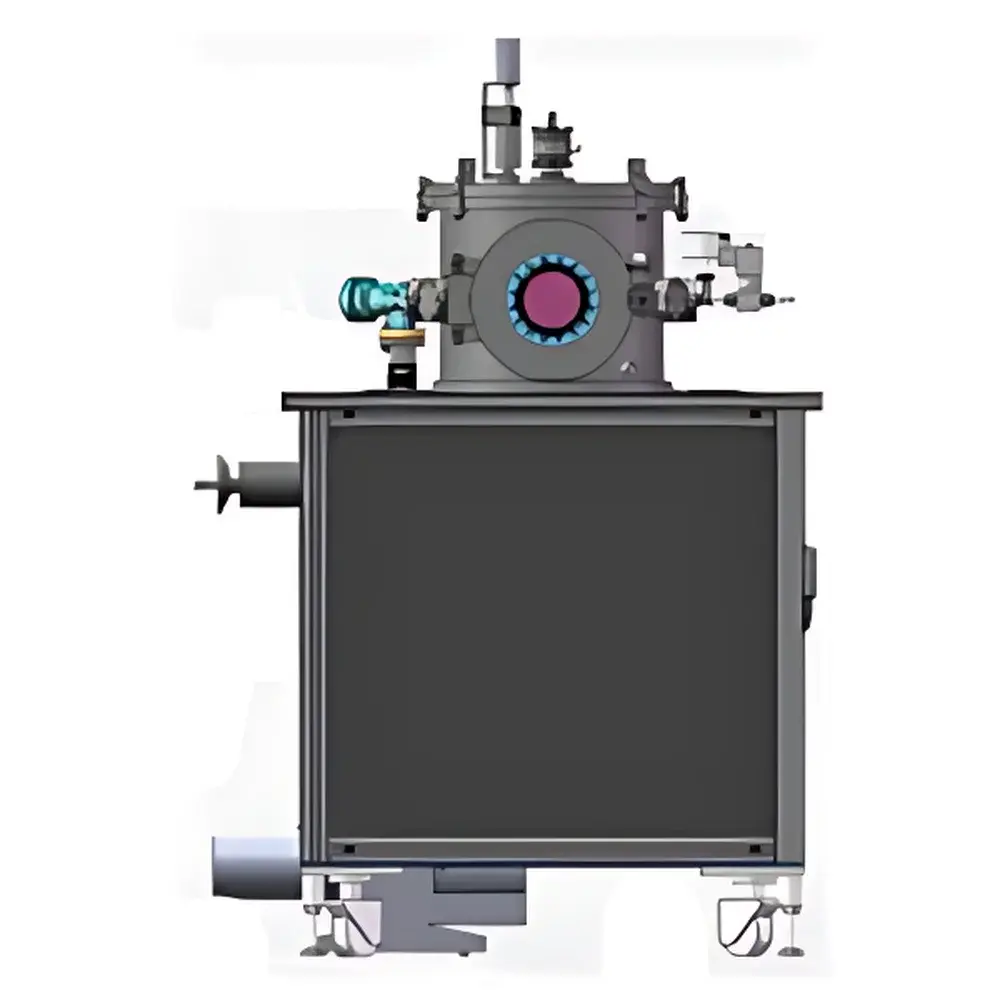
KJ GROUP GSL-PECVD-300 Plasma-Enhanced Chemical Vapor Deposition System
| Brand | KJ GROUP |
|---|---|
| Origin | Liaoning, China |
| Manufacturer Type | Authorized Distributor |
| Product Origin | Domestic (China) |
| Model | GSL-PECVD-300 |
| Pricing | Upon Request |
Overview
The KJ GROUP GSL-PECVD-300 is a bench-scale plasma-enhanced chemical vapor deposition (PECVD) system engineered for low-temperature thin-film synthesis with high process reproducibility and operational stability. Unlike conventional thermal CVD systems, this unit utilizes 13.56 MHz radio-frequency (RF) capacitively coupled plasma to activate precursor gases—enabling film growth at substrate temperatures as low as room temperature up to 500 °C. This capability is critical for temperature-sensitive substrates such as optical glass, fused quartz, silicon wafers, and stainless steel, where thermal budget constraints prohibit high-temperature processing. The system is widely deployed in academic laboratories and R&D centers for the fabrication of hydrogenated amorphous silicon (a-Si:H), microcrystalline silicon (μc-Si), and silicon nitride (SiNx) films—key functional layers in photovoltaic devices, passivation stacks, optical coatings, and MEMS encapsulation.
Key Features
- Compact single-chamber cylindrical design with manual front-loading door for rapid sample access and process iteration
- Ultra-high vacuum architecture: base pressure ≤6.67×10⁻⁴ Pa (after bake-out), achieved using a 600 L/s turbo-molecular pump backed by a 4 L/s dry scroll pump
- Stainless steel 304 vacuum chamber fabricated via TIG welding, surface-treated with glass bead blasting followed by electrochemical passivation; includes viewport with mechanical shutter
- Capacitively coupled RF plasma source: 13.56 MHz, 0–500 W output with fully automatic impedance matching network
- Precision substrate heating: programmable up to 500 °C with ±1 °C thermal stability, controlled via PID-regulated temperature controller
- Adjustable electrode gap: 40–100 mm between Φ90 mm showerhead and sample stage, calibrated with integrated scale indicator
- Process pressure range: 0.133–133 Pa, compatible with standard MFC-controlled gas delivery (N2, Ar, NH3, SiH4, etc.)
- Integrated touchscreen HMI interface enabling recipe storage, real-time parameter monitoring, and sequential step programming
Sample Compatibility & Compliance
The GSL-PECVD-300 accommodates substrates up to Φ300 mm × 300 mm in the main chamber, supporting flat and planar geometries including wafers, slides, and metal foils. It meets fundamental safety and operational requirements outlined in IEC 61000-6-3 (EMC emission standards) and complies with Chinese GB/T 19001–2016 (equivalent to ISO 9001). While not certified to UL or CE for direct EU/US market deployment, its modular construction supports integration into GLP-compliant laboratory environments when paired with validated SOPs, audit-ready log files, and traceable calibration records. Users must implement external abatement (e.g., scrubber or catalytic oxidizer) for reactive exhaust streams per local environmental regulations (e.g., EPA 40 CFR Part 63 Subpart A).
Software & Data Management
The embedded control software provides full automation of vacuum sequencing, RF ignition, gas flow ramping, temperature ramping, and plasma power modulation. All operational parameters—including chamber pressure, RF forward/reflected power, substrate temperature, and MFC setpoints—are logged at user-defined intervals (1–60 s) and exported in CSV format for post-processing. Audit trails record operator ID, timestamp, and parameter changes—supporting basic 21 CFR Part 11 readiness when deployed with networked authentication and electronic signature protocols. No cloud connectivity is included; data remains local unless interfaced via RS-232 or Ethernet TCP/IP to third-party SCADA or LIMS platforms.
Applications
- Deposition of intrinsic and doped a-Si:H layers for thin-film solar cells and TFT backplanes
- Growth of stoichiometric SiNx anti-reflection and surface passivation films on c-Si photovoltaics
- Preparation of μc-Si:H absorber layers in tandem junction architectures
- Low-k dielectric and barrier layer development for flexible electronics substrates
- Functional coating research on optical components requiring high transparency and low stress
- Plasma-surface interaction studies under controlled ion energy and flux conditions
FAQ
What vacuum level can the system achieve after bake-out?
The system reaches ≤6.67×10⁻⁴ Pa following standard 12-hour vacuum bake-out at 120 °C.
Is the RF generator internally matched?
Yes—the 500 W, 13.56 MHz RF source includes an integrated auto-matching network with real-time VSWR compensation.
Can the system operate with corrosive precursors such as silane or ammonia?
Yes—provided appropriate wetted materials (e.g., stainless steel, Viton-free seals), MFC compatibility, and external abatement are implemented per gas safety guidelines.
What cooling method is used for the RF electrode and chamber walls?
A closed-loop chiller (included) circulates deionized water through jacketed sections of the showerhead and flange interfaces.
Does the system support automated multi-step recipes?
Yes—up to 99 programmable steps per recipe, each with independent control over pressure, power, temperature, and gas flows.
Related Products



