
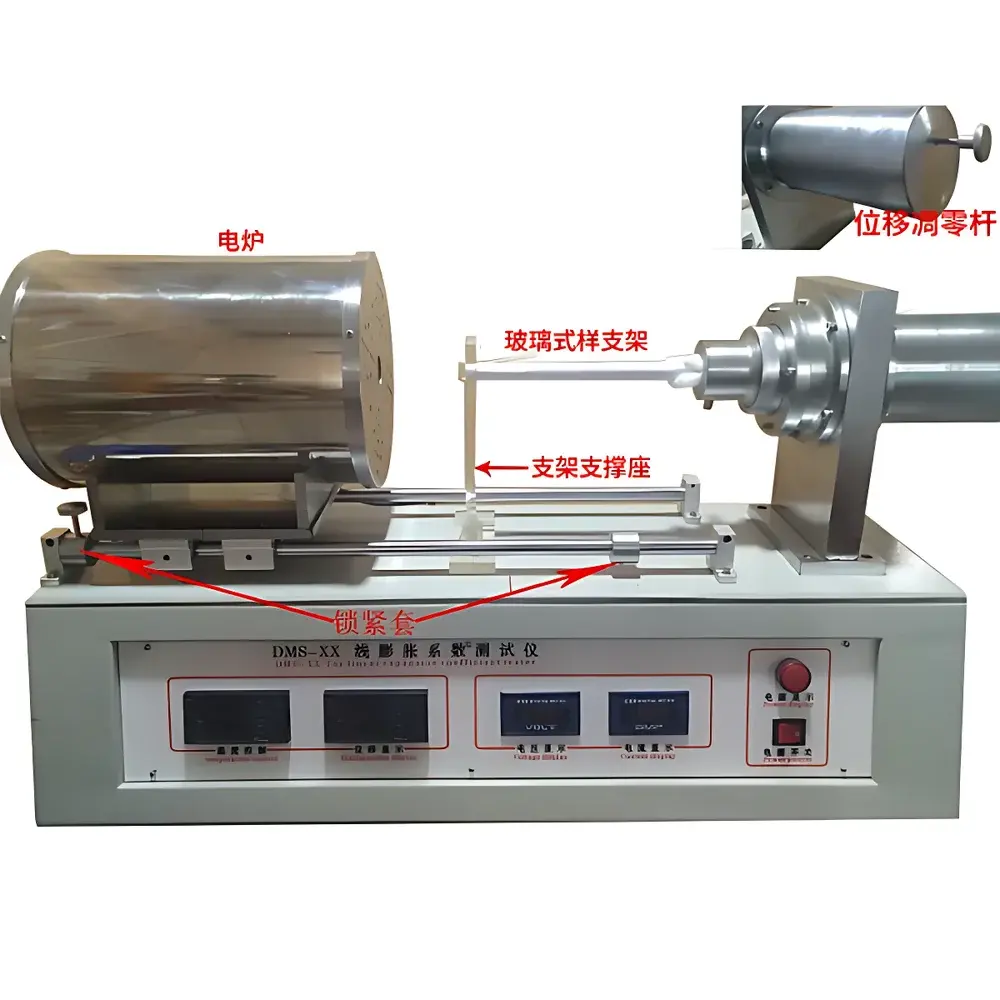
KJ GROUP HF-PJ-10/14 Thermal Expansion and Phase Transition Analyzer
| Brand | KJ GROUP |
|---|---|
| Origin | Liaoning, China |
| Manufacturer Type | Authorized Distributor |
| Country of Origin | China |
| Model | HF-PJ-10/14 |
| Max. Operating Temperature | 1000 °C (optional 1400 °C) |
| Heating Rate | 0–20 °C/min (programmable) |
| Expansion Measurement Range | 0–3 mm |
| Resolution | 0.1–1 µm |
| Sample Dimensions | Ø6–10 mm × 50 mm (cylindrical or prismatic) |
| Accuracy | ±0.1–0.5% |
| Power Supply | 220 V ±10%, 50 Hz |
| Max. Power Consumption | 2.5 kW |
| Interface | Standard RS-232/USB computer interface |
| Compliance | GB/T 3810.8–2016, GB/T 16920–1997, YB/T 4-2003, GB/T 7320–2008 |
Overview
The KJ GROUP HF-PJ-10/14 Thermal Expansion and Phase Transition Analyzer is a precision dilatometric instrument engineered for the quantitative determination of linear and volumetric thermal expansion behavior in solid inorganic materials across controlled temperature profiles. It operates on the principle of push-rod dilatometry: a calibrated quartz or alumina probe contacts the sample end-face and transmits dimensional changes—induced by thermal expansion or phase transitions—to a high-resolution displacement transducer (e.g., LVDT or capacitive sensor). Simultaneous real-time temperature measurement via Pt100 or thermocouple enables synchronized calculation of coefficient of linear expansion (αL), coefficient of volumetric expansion (αV), and abrupt dimensional shifts associated with solid-state phase transformations (e.g., α↔β quartz inversion, martensitic transitions in ceramics, or crystallization onset in glass-ceramics). Designed for laboratory-grade reproducibility under ISO/IEC 17025-aligned practices, the system supports both static and dynamic heating protocols, delivering traceable data essential for materials qualification, process optimization, and failure analysis in refractory, ceramic, metallurgical, and advanced composite R&D.
Key Features
- Programmable heating rate control (0–20 °C/min) with PID-regulated furnace stability ≤±1 °C over full range
- High-resolution displacement detection (0.1–1 µm) with auto-ranging and real-time electronic zero-point correction
- Integrated compensation algorithm for furnace thermal lag and probe expansion—applies material-specific correction factors per ASTM E228 and ISO 11359-1
- Automated calculation of αL, αV, ΔL/L0, and rapid-heating expansion (RHE) parameters at user-defined intervals (minimum 1 °C step)
- Full digital data acquisition: temperature, displacement, time, and derived coefficients logged synchronously at ≥1 Hz sampling rate
- Robust mechanical architecture with vibration-damped base, low-thermal-drift probe housing, and sealed furnace chamber for inert or air atmospheres
- Compliance-ready firmware supporting audit trails, user access levels, and electronic signature capability for GLP/GMP environments
Sample Compatibility & Compliance
The HF-PJ-10/14 accommodates cylindrical or prismatic specimens (Ø6–10 mm × 50 mm) including sintered oxides (Al2O3, ZrO2), refractory castables, investment casting shell materials, graphite electrodes, technical ceramics, glazes, and metallic alloys. Its measurement methodology aligns with multiple international and national standards: GB/T 3810.8–2016 (ceramic tile linear expansion), GB/T 16920–1997 (glass mean linear expansion), YB/T 4-2003 (graphite electrode CTE), and GB/T 7320–2008 (refractory制品 thermal expansion testing). While not certified to ASTM E228 or ISO 11359-2 out-of-the-box, its hardware architecture and software calibration routines are fully compatible with those protocols when configured with NIST-traceable reference materials (e.g., fused quartz SRM 735).
Software & Data Management
The included Windows-based application provides intuitive graphical setup for multi-segment temperature ramps, dwell times, and cooling profiles. All raw and processed data—including displacement vs. temperature curves, derivative dL/dT plots for transition onset identification, and tabular CTE outputs—are stored in vendor-neutral CSV and XML formats. The software implements FDA 21 CFR Part 11–compliant features: role-based login, immutable audit trail logging (operator, timestamp, parameter change), electronic signatures for report approval, and encrypted database backups. Export modules support direct integration with LIMS platforms and third-party analysis tools (e.g., OriginLab, MATLAB) via API hooks. Calibration certificates and uncertainty budgets can be embedded into final reports per ISO/IEC 17025 documentation requirements.
Applications
- Quantification of thermal mismatch in ceramic-metal brazing systems and multilayer capacitor stacks
- Characterization of phase transformation temperatures (e.g., cristobalite formation in silica refractories, spinel inversion in MgAl2O4)
- Quality control of investment casting shell materials to prevent cracking during dewaxing and firing
- Development of low-expansion glass-ceramics for optical substrates and cooktop panels
- Validation of thermal aging effects in nuclear-grade graphite moderators
- Correlation of sintering shrinkage kinetics with dilatometric expansion inflection points
FAQ
What standard reference materials are recommended for system calibration?
NIST Standard Reference Material 735 (fused quartz) is recommended for linear expansion verification between 25–1000 °C; optional calibration kits include α-alumina and Invar standards for extended range validation.
Can the system operate under controlled atmosphere conditions?
Yes—the furnace chamber includes gas inlet/outlet ports compatible with N2, Ar, or forming gas purging; optional quartz tube encapsulation enables reducing or oxidizing environments.
Is remote monitoring or networked operation supported?
The instrument supports TCP/IP-enabled remote access via secure VNC or dedicated client software; up to 8 units can be managed centrally using KJ GROUP’s LabLink™ supervisory module.
How is thermal lag compensated during rapid heating cycles?
The software applies a physics-based correction model incorporating probe thermal mass, furnace wall emissivity, and sample thermal diffusivity—validated against differential scanning calorimetry (DSC) transition onset benchmarks.
Does the system meet requirements for ISO/IEC 17025 accredited testing laboratories?
When operated with documented calibration procedures, environmental monitoring logs, and trained personnel, the HF-PJ-10/14 satisfies clause 6.4 (equipment) and 6.5 (traceability) of ISO/IEC 17025:2017; full accreditation requires lab-specific validation per CNAS-CL01 or A2LA criteria.



