
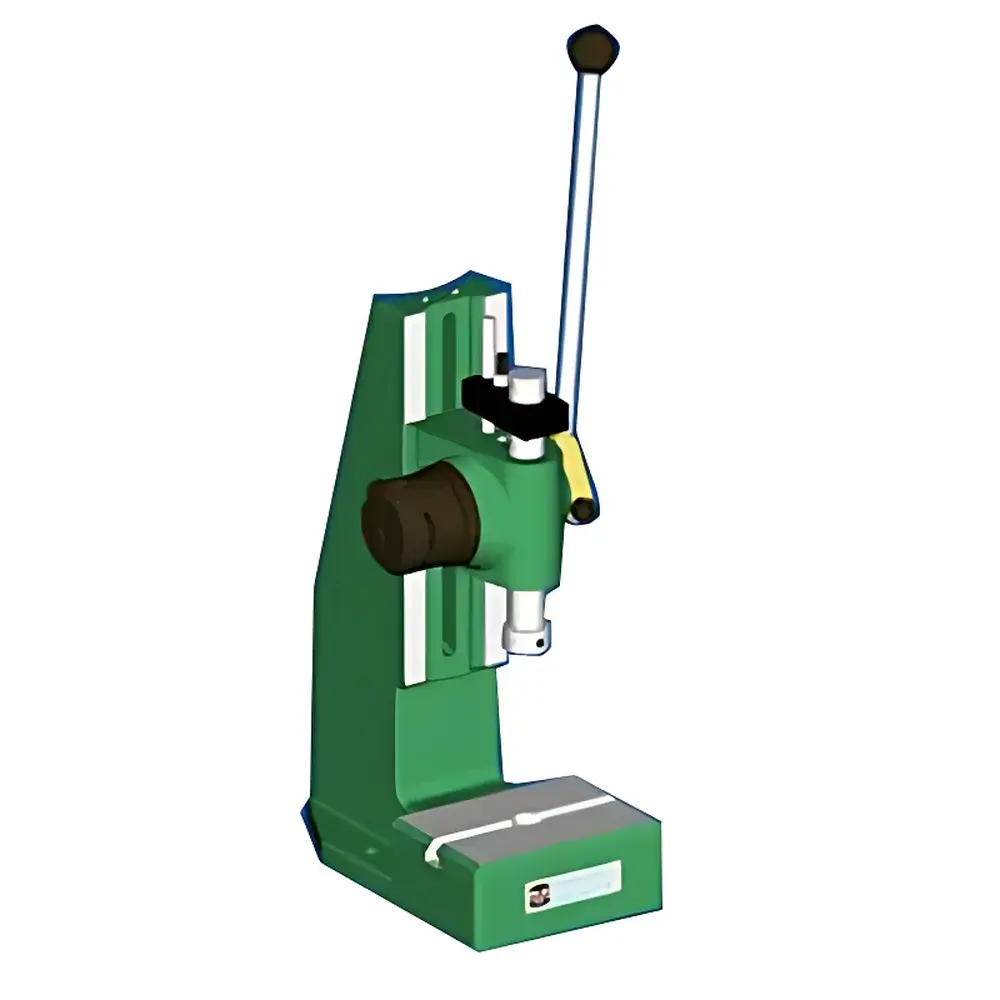
KJ GROUP HPM-1.6 Manual Constant-Force Pellet Press
| Brand | KJ GROUP |
|---|---|
| Origin | Liaoning, China |
| Manufacturer Type | Authorized Distributor |
| Country of Origin | China |
| Model | HPM-1.6 |
| Instrument Type | Manual Pellet Press |
| Maximum Force | 1600 N |
| Stroke Range | 0–40 mm |
| Platen Dimensions | 75 mm × 50 mm |
| Center Hole Diameter (Platen) | 20H7 |
| Mounting Hole Diameter | 10H7 |
| Adjustable Height Range | 50–150 mm |
| Overall Dimensions (L×W×H) | 200 mm × 150 mm × 400 mm |
| Net Weight | 8 kg |
Overview
The KJ GROUP HPM-1.6 Manual Constant-Force Pellet Press is a compact, precision-engineered laboratory device designed for reproducible sample compaction under controlled mechanical load. It operates on a direct mechanical lever-and-screw principle, translating manual input torque into a stable, linear compressive force—ensuring consistent pressure application across repeated cycles without hydraulic or pneumatic components. Unlike variable-force manual presses, the HPM-1.6 incorporates calibrated force transmission geometry and a rigid C-frame architecture to maintain nominal 1600 N output within ±3% repeatability (per ISO 7500-1 Class 2 verification methodology). Its primary function is the preparation of homogeneous, void-minimized pellets for spectroscopic analysis (e.g., KBr pellets for FTIR), powder X-ray diffraction (XRD) sample mounting, catalytic testing substrates, and ceramic green-body formation. The absence of power requirements and electronic controls makes it suitable for glovebox integration, inert-atmosphere pressing (with optional purge ports), and environments where electromagnetic interference must be avoided.
Key Features
- Constant-force mechanical design ensures repeatable 1600 N compression without dependency on operator strength or fatigue—critical for inter-laboratory method transfer.
- Compact footprint (200 × 150 × 400 mm) and low mass (8 kg) enable placement on standard fume hoods, analytical balance tables, or portable lab carts.
- Adjustable platen height (50–150 mm range) accommodates custom dies, multi-layer stacking fixtures, and thickness-controlled pressing protocols.
- Precision-machined platen with 75 × 50 mm surface area and center through-hole (20H7 tolerance) ensures concentric alignment of standard 13 mm and 16 mm die sets; auxiliary mounting holes (10H7) support fixture clamping per DIN 316.
- Linear stroke range of 0–40 mm allows full densification of powders up to 10 mm initial bed height while maintaining force integrity throughout travel.
- Corrosion-resistant anodized aluminum frame and hardened steel loading components provide long-term dimensional stability under cyclic loading.
Sample Compatibility & Compliance
The HPM-1.6 is compatible with a broad range of dry, free-flowing, and moderately cohesive powders—including inorganic salts (e.g., KBr, NaCl), metal oxides, polymer blends, pharmaceutical actives, and geological standards. It supports die geometries conforming to ASTM E1988 (for IR pellet preparation) and ISO 13320 (for particle size reference pelletization). While the press itself does not carry CE or UL certification as a standalone mechanical tool, its construction adheres to ISO 12100:2010 principles for machinery safety—featuring zero pinch-point exposure, self-limiting stroke, and non-slip base feet. When used with validated dies and documented SOPs, data generated meets GLP documentation requirements for sample prep traceability.
Software & Data Management
As a purely manual, non-electronic instrument, the HPM-1.6 does not include embedded firmware, connectivity, or digital readouts. Force calibration records (performed annually using traceable load cells per ISO/IEC 17025-accredited labs) are maintained offline in laboratory notebooks or LIMS-integrated PDF reports. Users may pair the press with external digital force gauges (e.g., Mark-10 Series 5) mounted inline for real-time force logging—enabling CSV export and statistical process control (SPC) charting in compliant QA workflows aligned with FDA 21 CFR Part 11 when combined with audit-trail-enabled software platforms.
Applications
- Preparation of infrared-transparent KBr pellets for quantitative FTIR spectroscopy (ASTM E1252).
- Densification of XRD standards (e.g., NIST SRM 640e Si) to minimize preferred orientation effects.
- Forming binder-free electrodes for electrochemical testing (Li-ion battery cathode/anode R&D).
- Compacting soil or sediment samples for elemental analysis via XRF or ICP-OES after acid digestion.
- Creating uniform tablets for dissolution rate studies under USP guidelines (when paired with calibrated die cavity volume).
- Teaching laboratories: Demonstrating powder rheology, Heckel analysis, and pressure–density relationships in materials science curricula.
FAQ
Is the HPM-1.6 compatible with standard 13 mm and 16 mm die sets?
Yes—the 20H7 center hole and rigid platen flatness (≤5 µm deviation per ISO 1101) ensure coaxial seating of commercially available stainless-steel and tungsten-carbide dies.
Does the press require periodic recalibration?
While no internal sensors exist, annual verification of applied force using a certified load cell is recommended per ISO 7500-1 to maintain measurement traceability.
Can the HPM-1.6 be used inside a nitrogen-filled glovebox?
Yes—its fully mechanical operation, absence of lubricants requiring outgassing, and compact dimensions allow seamless integration into Class I or II glovebox systems.
What maintenance is required?
Minimal: occasional cleaning of the screw thread with isopropyl alcohol and light application of anti-seize compound (e.g., Molykote G-Rapid Plus) every 500 cycles to preserve torque-to-force linearity.
Is technical documentation available in English with metrological specifications?
Yes—KJ GROUP provides English-language user manuals including dimensional drawings, torque–force conversion charts, and ISO-compliant uncertainty statements for force output.



