
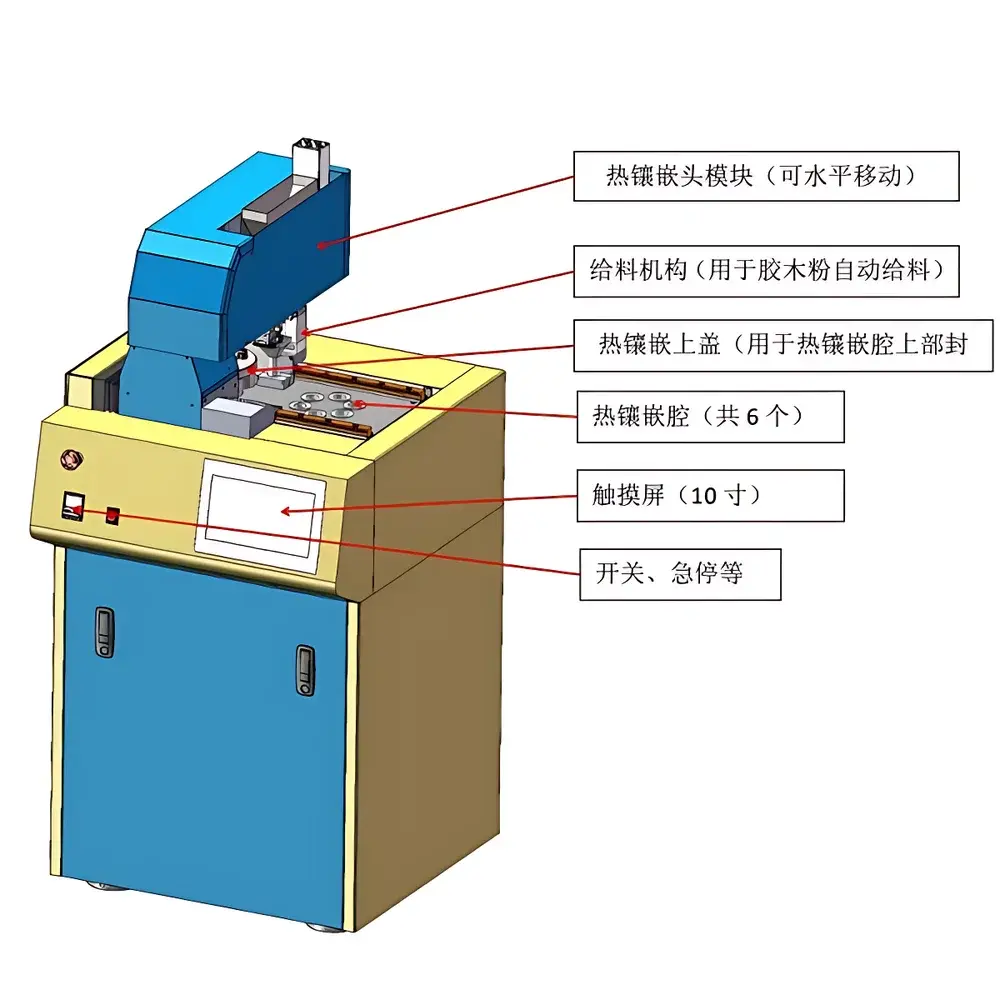
KJ GROUP HXQ-25-6 Six-Station Automatic Hot Mounting Press
| Brand | KJ GROUP |
|---|---|
| Origin | Liaoning, China |
| Manufacturer Type | Direct Manufacturer |
| Instrument Type | Hot Mounting Press |
| Model | HXQ-25-6 |
| Voltage | 220 V, 50 Hz |
| Rated Power | < 2500 W |
| Maximum Sample Diameter | Φ25 mm |
| Capacity | 6 samples per cycle |
| Dimensions (L×W×H) | 850 × 750 × 1500 mm |
Overview
The KJ GROUP HXQ-25-6 Six-Station Automatic Hot Mounting Press is an engineered solution for high-throughput, repeatable specimen encapsulation in metallurgical, materials science, and quality control laboratories. It operates on the principle of thermosetting resin compression molding under controlled temperature, pressure, and dwell time—enabling reproducible embedding of metallic, ceramic, composite, or geological specimens within phenolic, epoxy, or acrylic resins. Unlike manual or semi-automatic systems, the HXQ-25-6 executes a fully sequenced thermal mounting cycle—including automated resin feed, heated platen compression, isothermal curing, and programmable forced-air cooling—without operator intervention between cycles. Its six independent mounting stations allow parallel processing of up to six Φ25 mm specimens per batch, significantly reducing per-sample turnaround time while maintaining inter-batch consistency required for ISO/IEC 17025-accredited testing environments.
Key Features
- Six synchronized mounting stations with individual thermal and pressure actuation—ensuring uniform resin flow and cross-linking across all specimens.
- Programmable process parameters: temperature (range: ambient to 200 °C, typical operating band 130–180 °C), pressure (adjustable from 0.5 to 15 MPa), and dwell time (1–30 min)—all configurable via intuitive touchscreen interface with password-protected parameter libraries.
- Integrated resin dispensing mechanism with volumetric calibration—minimizes material waste and eliminates manual pre-weighing or pre-pouring steps.
- Active cooling system with PID-controlled fan array and thermal monitoring—reduces post-cure sample ejection temperature to ≤40 °C within ≤90 seconds, enabling rapid downstream handling.
- Precision-machined hardened steel platens with ±0.02 mm parallelism tolerance—guarantees consistent specimen height and edge integrity critical for subsequent grinding and polishing.
- Modular mechanical interface compliant with ISO 9407 and ASTM E3-22 mounting standards—facilitates seamless integration with KJ GROUP’s automated grinding-polishing systems (e.g., P-2000 series) via I/O signaling and RS-485 communication.
Sample Compatibility & Compliance
The HXQ-25-6 accommodates standard metallographic specimens up to Φ25 mm in diameter and ≤30 mm in height—including ferrous and non-ferrous alloys, sintered powders, coated substrates, and brittle ceramics. It supports common thermosetting resins (phenolic, epoxy, and acrylic formulations) and is compatible with vacuum-assisted resin infiltration accessories (sold separately). The system complies with CE safety directives (2014/30/EU EMC, 2014/35/EU LVD), meets IEC 61000-6-2/6-4 immunity and emission requirements, and supports GLP/GMP documentation workflows through optional audit-trail-enabled firmware. All thermal and pressure profiles are traceable and exportable in CSV format for internal validation or regulatory submission (e.g., ISO 17025 clause 7.7, ASTM E3-22 Annex A1).
Software & Data Management
The embedded control software features a multi-user role-based interface with three access levels (Operator, Technician, Administrator), each with configurable permissions. Process logs—including start/stop timestamps, actual vs. setpoint temperature/pressure curves, resin dispense volume, and cooling ramp data—are stored locally on industrial-grade SD card (≥16 GB) with automatic rollover. Data export supports USB mass storage mode and network transfer via Ethernet (TCP/IP) to LIMS or MES platforms. Optional software upgrade enables FDA 21 CFR Part 11 compliance with electronic signatures, user activity logging, and immutable record retention—suitable for pharmaceutical or aerospace QA/QC labs requiring full process traceability.
Applications
- Routine metallographic preparation in foundry QC labs—enabling batch-level microstructure analysis per ASTM E3, E407, and ISO 643.
- Failure analysis laboratories performing cross-sectional evaluation of solder joints, thermal barrier coatings, or additive-manufactured parts.
- Academic research facilities conducting comparative studies on heat-affected zones, grain boundary corrosion, or phase transformation kinetics.
- Third-party testing organizations requiring auditable, standardized mounting protocols aligned with ISO/IEC 17025 clause 7.2.2 (method validation) and clause 7.8 (reporting).
- Automated production line integration—where the HXQ-25-6 serves as the first node in end-to-end digital metallography workflows, feeding directly into robotic sample transfer and AI-assisted image analysis pipelines.
FAQ
What resin types are compatible with the HXQ-25-6?
Standard phenolic, epoxy, and acrylic thermosetting resins—both standard and fast-cure variants—are supported. Resin viscosity must fall within 500–5000 mPa·s at 25 °C for reliable dispensing.
Can the system be validated for GMP environments?
Yes—when equipped with the Part 11 firmware option and paired with IQ/OQ documentation packages (available upon request), it supports full qualification per ASTM E2500 and ISPE GAMP5 guidelines.
Is vacuum embedding capability built-in?
No—vacuum resin infiltration requires external vacuum chamber integration; however, the HXQ-25-6 includes dedicated I/O ports and protocol templates for third-party vacuum pump synchronization.
What maintenance intervals are recommended?
Platen surface inspection and thermal sensor calibration every 500 cycles; resin delivery nozzle cleaning after each resin type change; full mechanical alignment verification annually or after 2000 cycles.
Does the system support custom mounting mold configurations?
Yes—standard Φ25 mm molds are supplied, but the press platform accepts ISO 9407-compliant interchangeable mold holders (including rectangular, dual-specimen, and low-profile variants) without tooling modification.
Related Products



