
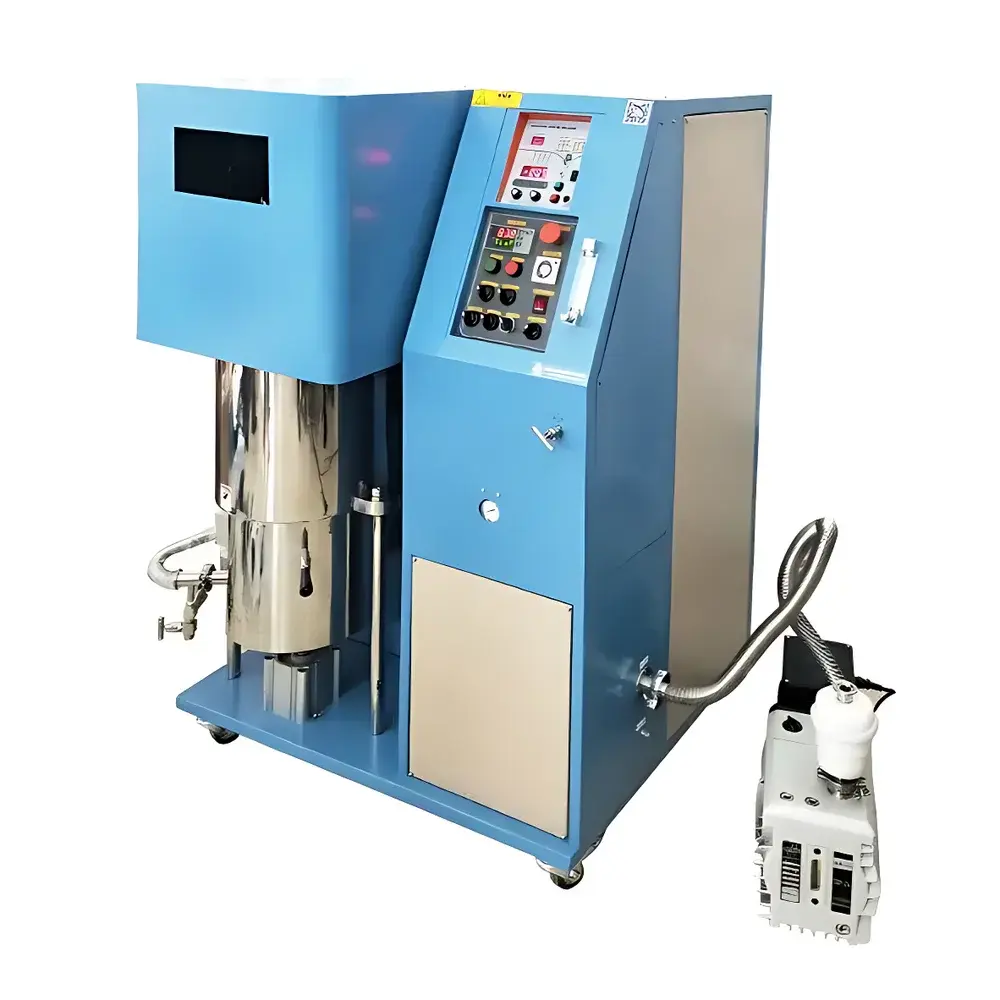
KJ GROUP IMCS-1700HP High-Pressure Atmosphere-Controlled Induction Melting and Centrifugal Atomization Furnace
| Brand | KJ GROUP |
|---|---|
| Origin | Liaoning, China |
| Manufacturer Type | Authorized Distributor |
| Origin Category | Domestic (China) |
| Model | Stainless Steel Vacuum Ball Mill Jar |
| Quotation | Upon Request |
| Heating Power | 25 kW |
| Input Voltage | 3-phase 380 VAC, 50 Hz |
| Heating Current Range | 4–40 A |
| Oscillation Frequency | 30–80 kHz (fixed) |
| Induction Coil ID × H | 170 mm × 110 mm |
| Cooling | Rear-mounted fan + external recirculating chiller (KJ-6300, ≥58 L/min flow) |
| Chamber Material | SS304 with water-cooled jacket |
| Max Working Pressure | 1 MPa |
| Furnace Liner | High-purity alumina fiber |
| Temp. Range | 500–1600 °C continuous, 1700 °C (<1 h) |
| Temp. Control | 30-segment PID, B-type thermocouple |
| Temp. Accuracy | ±5 °C |
| Max Ramp Rate | 4 °C/s (1000–1200 °C), 3 °C/s (1200–1500 °C), 1–2 °C/s (1500–1700 °C) |
| Casting Chamber | SS304 with KF25 vacuum port, digital vacuum gauge, dual-stage rotary vane pump included |
| Crucible | Graphite crucible set (1 kg Fe-based alloy capacity), conical graphite seal, centrifugal atomization (bead casting) design for 1–6 mm spherical particles |
| Dimensions (L×W×H) | 950 × 770 × 1450 mm |
| Weight | 300 kg |
Overview
The KJ GROUP IMCS-1700HP is a fully integrated high-pressure atmosphere-controlled induction melting and centrifugal atomization furnace engineered for advanced metallurgical research and small-batch production of spherical metal powders. It combines high-frequency induction heating (30–80 kHz) with a dual-chamber architecture — an upper high-pressure melting chamber and a lower vacuum casting/atomization chamber — enabling precise control over thermal, pressure, and atmospheric conditions during melt processing. The system operates on the principle of electromagnetic induction to generate localized Joule heating within conductive metallic charges, while centrifugal force from a rotating mold or crucible base facilitates controlled droplet ejection and solidification into near-spherical particles. Designed for reproducible synthesis under inert or reactive gas environments up to 1 MPa, the IMCS-1700HP supports development of high-performance alloys (e.g., Ni-, Co-, Fe-, Ti-, and Al-based systems) for additive manufacturing feedstock, thermal spray applications, and functional powder metallurgy.
Key Features
- Robust dual-chamber stainless steel (SS304) construction with water-cooled jackets ensuring surface temperature remains below 60 °C during extended operation at 1700 °C melt temperatures.
- High-power 25 kW induction power supply with fixed-frequency oscillation (30–80 kHz), optimized for rapid, uniform heating of conductive charge materials without contact or contamination.
- Integrated safety architecture including automatic water pressure monitoring, over-temperature cutoff, power overload protection, and mechanical pressure relief valve rated to 1 MPa.
- Precision PID temperature controller with 30-segment programmable ramp/soak profiles, B-type thermocouple feedback, and ±5 °C accuracy across the full operating range (500–1700 °C).
- Dedicated centrifugal atomization crucible assembly featuring conical graphite sealing interface, thermal insulation layers, and calibrated bead-casting geometry for consistent 1–6 mm spherical particle generation.
- Built-in vacuum system comprising a dual-stage rotary vane pump and digital vacuum gauge (KF25 interface), enabling pre-melt degassing and post-melt controlled atmosphere backfilling.
Sample Compatibility & Compliance
The IMCS-1700HP accommodates a broad spectrum of electrically conductive metallic and intermetallic feedstocks, including but not limited to ferrous and non-ferrous alloys (Fe-, Ni-, Co-, Ti-, Al-, Cu-, and Mg-based), refractory metals (Mo, W, Nb), and reactive compositions requiring inert (Ar, He) or reducing (H₂/Ar mixtures) atmospheres. Its pressure-rated chamber and validated sealing methodology meet structural integrity requirements per ASME BPVC Section VIII Division 1 guidelines for low-pressure vessels. While not certified to ISO 17025 or ASTM E1126 as a test instrument, the system’s thermal stability, repeatability, and documented process parameters support GLP-compliant experimental reporting in academic and industrial R&D settings. All electrical components comply with IEC 61000-6-3 (EMC emission) and IEC 61000-6-2 (immunity) standards.
Software & Data Management
The furnace integrates a standalone microprocessor-based controller with an intuitive LCD interface for real-time monitoring of temperature, power output, cooling water flow, and chamber pressure. Although no proprietary PC software is bundled, all process data — including time-stamped temperature profiles, segment dwell times, and alarm logs — are stored internally and exportable via USB flash drive in CSV format. The system supports audit-trail-ready operation when paired with external SCADA or LabVIEW-based acquisition platforms compliant with FDA 21 CFR Part 11 requirements (user authentication, electronic signatures, and immutable log retention). Optional analog voltage outputs (0–10 V) enable integration into centralized facility monitoring networks.
Applications
- Development of spherical metal powders for laser powder bed fusion (LPBF) and electron beam melting (EBM) additive manufacturing processes.
- Synthesis of high-purity master alloys and intermetallic compounds under controlled partial pressures to suppress volatile element loss.
- Thermophysical property studies requiring rapid quenching or directional solidification under elevated pressure.
- Small-scale production of spherical catalyst supports, battery electrode precursors, and soft magnetic powder cores.
- Process validation for HIP (hot isostatic pressing) feedstock qualification, especially where oxygen content and particle sphericity must meet AMS 7020 or ASTM B213 specifications.
FAQ
What types of atmospheres can be used inside the melting chamber?
Inert gases (Ar, He), reducing mixtures (e.g., 4% H₂ in Ar), and vacuum (≤10⁻² mbar) are supported. Reactive gases such as N₂ or CO require prior consultation due to compatibility with graphite components.
Is the crucible system compatible with non-ferrous alloys like titanium or aluminum?
Yes, provided appropriate crucible coatings (e.g., ZrO₂ or Y₂O₃) are applied; standard graphite crucibles are recommended for Fe-, Ni-, and Co-based systems only.
Can the system be upgraded to include automated pressure ramping or real-time mass spectrometry coupling?
While not factory-standard, the KF25 port and analog I/O allow third-party integration with pressure controllers and residual gas analyzers (RGAs); engineering support is available for custom retrofitting.
What maintenance intervals are recommended for the induction coil and water cooling system?
Coil inspection every 500 operational hours; deionized water in the KJ-6300 chiller must be replaced quarterly, and filter cartridges inspected monthly.
Does the system meet CE or UL certification requirements for installation in EU or North American laboratories?
The base configuration meets CE marking criteria under the Machinery Directive 2006/42/EC and EMC Directive 2014/30/EU; UL listing requires site-specific evaluation by an authorized NRTL.



