
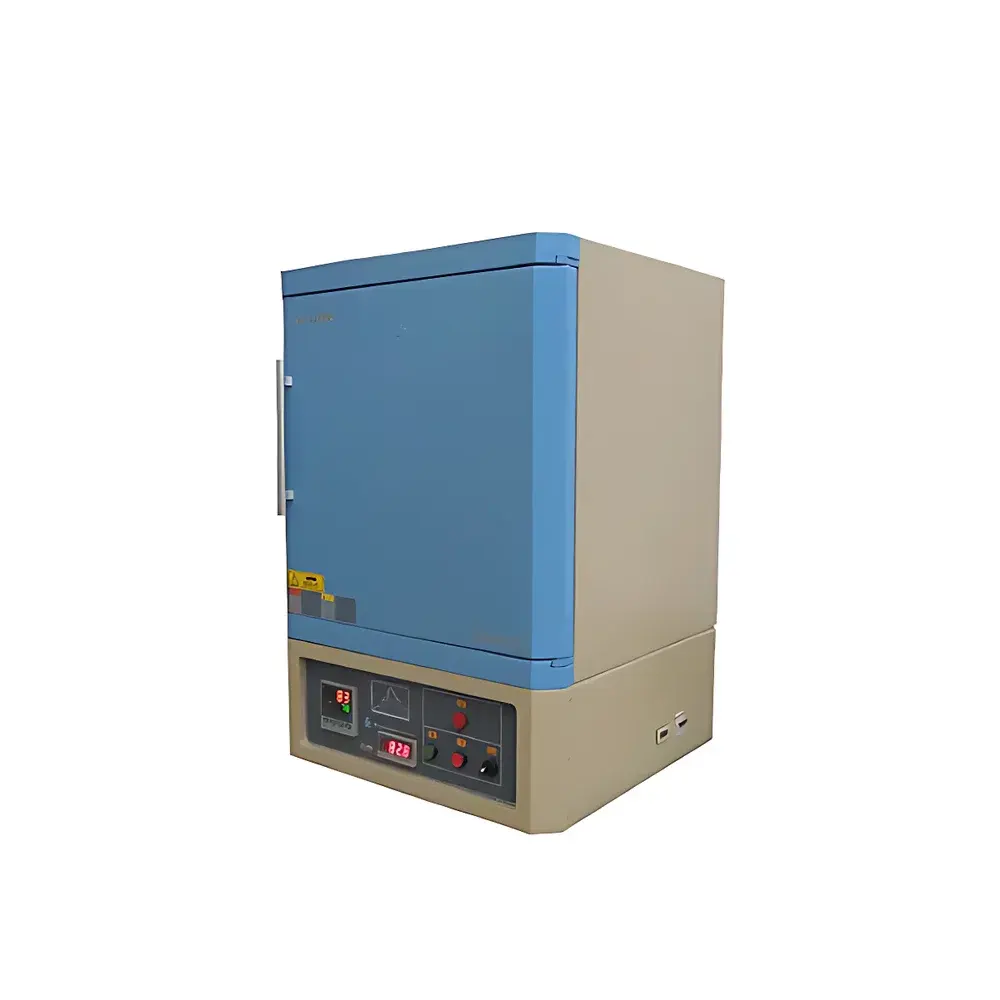
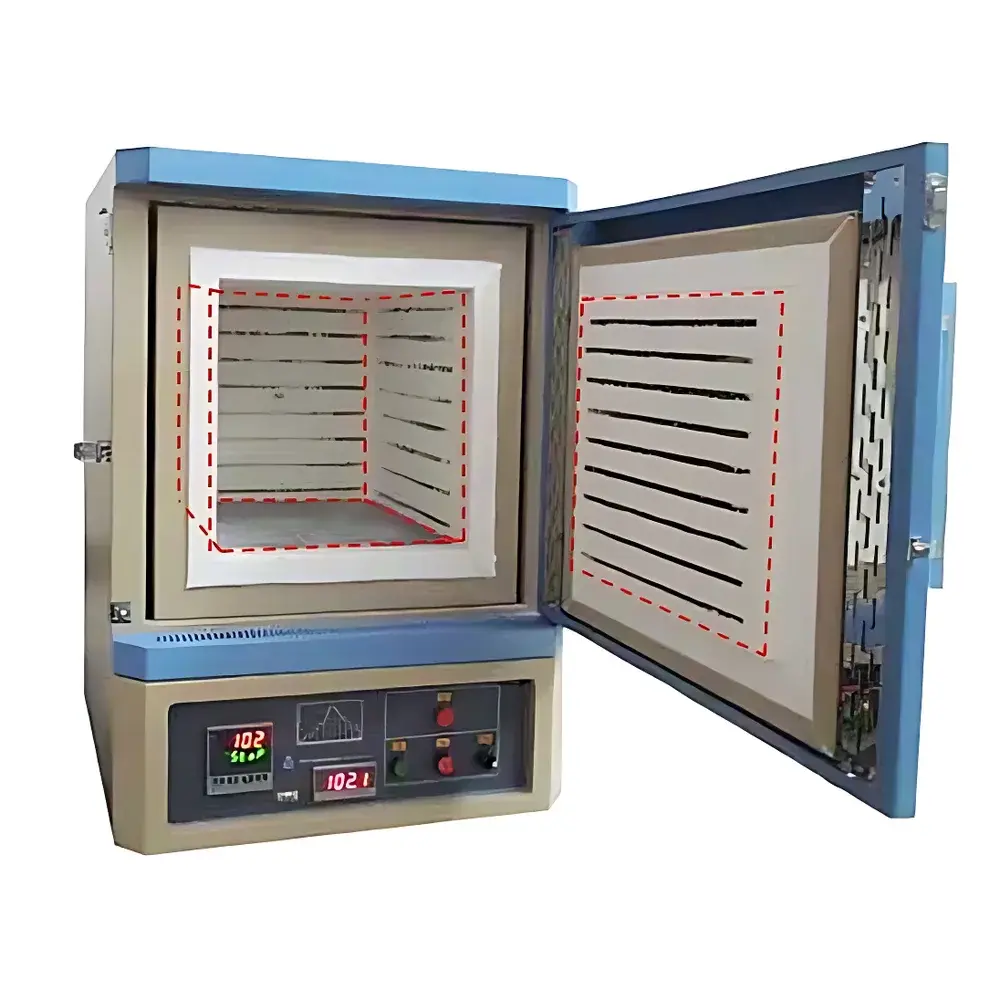
KJ GROUP KSL-1200X-5L-UL Five-Side Heated Box Furnace
| Brand | KJ GROUP |
|---|---|
| Origin | Anhui, China |
| Model | KSL-1200X-5L-UL |
| Max Operating Temperature | 1150°C (continuous), 1200°C (<1 h) |
| Temperature Uniformity | ±5°C (250 mm × 250 mm × 250 mm zone at 1000°C, 3 h soak) |
| Control Accuracy | ±1°C |
| Heating Rate | 20°C/min (to max temp) |
| Chamber Dimensions | 400 mm × 400 mm × 400 mm (64 L) |
| Power Supply | Single-phase AC 208–240 V, 50/60 Hz, 8.8 kW, 45 A |
| Heating Elements | Molybdenum-doped Fe-Cr-Al alloy |
| Thermocouples | Dual OMEGA Super-K-type armored thermocouples (control + independent alarm) |
| Controller | PID-based, 30-segment programmable ramp-soak profile |
| Certifications | CE compliant |
| Cooling | Integrated air-cooled double-wall housing (surface temp <60°C) |
| Optional | RS485 interface, inert gas inlet/outlet ports, PC-based temperature control software |
Overview
The KJ GROUP KSL-1200X-5L-UL is a precision-engineered five-side heated box furnace designed for high-reproducibility thermal processing of metallurgical alloys, ceramic precursors, and advanced functional materials where spatial temperature uniformity is critical. Unlike conventional single- or dual-wall furnaces, this model integrates heating elements on the left, right, front, rear, and floor surfaces—eliminating axial thermal gradients and enabling stable, repeatable heat treatment across large sample volumes. Its operational envelope spans 100–1150°C continuously (with short-term excursions to 1200°C), making it suitable for annealing, stress-relieving, sintering, and controlled oxidation/reduction protocols in R&D and QC laboratories. The furnace employs Couette-style symmetric heating architecture—where radiant energy is distributed from five orthogonal planes—to achieve ±5°C uniformity within a 250 mm cubic measurement zone at 1000°C after a 3-hour stabilization period, per ASTM E220-21 methodology for furnace qualification.
Key Features
- Five-face heating configuration (left, right, front, rear, and floor) ensures minimal radial and vertical thermal deviation—critical for homogenizing microstructure in large-section alloy billets and multi-layer ceramic stacks.
- Double-walled stainless steel housing with forced-air interstitial cooling maintains external surface temperature below 60°C under full-load operation, complying with IEC 61000-3-2 harmonic emission limits and enhancing lab safety.
- High-purity alumina fiber furnace chamber (99.7% Al₂O₃) coated with proprietary US-sourced reflective alumina enamel improves radiative efficiency by >18% and extends service life beyond 10,000 operational hours.
- Reinforced silicon carbide hearth plate rated for static loads up to 100 kg—capable of supporting dense metal ingots, crucibles, or multi-tier sample fixtures without deformation.
- Dual independent OMEGA Super-K-type armored thermocouples: one dedicated to closed-loop PID control, the other configured as a hardwired overtemperature safety cutoff (setpoint differential alarm) meeting UL 508A Class 1, Division 2 requirements.
- 30-segment programmable controller supports complex thermal profiles—including ramp-hold-cool cycles with variable rates—and stores up to 10 user-defined recipes with timestamped execution logs.
- Top-mounted vent port enables continuous purge of moisture and corrosive volatiles (e.g., Cl⁻, SOₓ), significantly reducing oxidation-induced degradation of heating elements and extending mean time between maintenance (MTBM).
Sample Compatibility & Compliance
The KSL-1200X-5L-UL accommodates standard ceramic crucibles (Al₂O₃, ZrO₂), graphite boats, and metallic retorts up to 380 mm × 380 mm × 380 mm. Its 64 L internal volume supports batch processing of multiple samples simultaneously while maintaining ISO/IEC 17025-compliant thermal stability. All electrical subsystems—including contactors, fuses, and terminal blocks—are UL-listed and integrated into a grounded, EMI-shielded enclosure. The unit carries full CE marking per Machinery Directive 2006/42/EC and Low Voltage Directive 2014/35/EU. It satisfies EN 60519-1:2016 safety requirements for industrial electroheating equipment and is compatible with GLP/GMP environments when paired with validated calibration procedures (e.g., using NIST-traceable reference thermocouples).
Software & Data Management
An optional RS485 interface (Modbus RTU protocol) enables bidirectional communication with laboratory information management systems (LIMS) or SCADA platforms. The companion PC software provides real-time temperature logging, profile editing, remote start/stop commands, and automated report generation compliant with FDA 21 CFR Part 11 Annex 11 requirements—including electronic signatures, audit trails, and data integrity safeguards. All temperature records are stored with ISO 8601 timestamps and include metadata such as operator ID, furnace ID, and ambient conditions—facilitating traceability during regulatory audits.
Applications
- Metallurgical annealing of Ni-based superalloys, Ti-6Al-4V, and Mg-Zn-Y bulk metallic glasses requiring precise thermal history control.
- Sintering of oxide ceramics (e.g., YSZ, AlN) and composite powders where density uniformity correlates directly with furnace temperature homogeneity.
- Thermal aging studies per ASTM G163-17 for evaluating long-term dimensional stability of aerospace-grade composites.
- Pre-oxidation treatments for thermal barrier coating (TBC) development, where oxide scale thickness reproducibility depends on ±2°C spatial consistency.
- Calibration of secondary temperature sensors (e.g., infrared pyrometers) against primary fixed-point cells within a defined uniformity zone.
FAQ
What is the maximum recommended continuous operating temperature?
The furnace is rated for continuous operation from 100°C to 1150°C. Short-term exposure to 1200°C is permissible for ≤60 minutes per cycle, provided soak time does not exceed manufacturer-specified thermal stress limits.
Can inert gas atmospheres be introduced during operation?
Yes—optional gas inlet and outlet ports can be installed on the rear panel to enable continuous N₂, Ar, or forming gas purging at flow rates up to 5 L/min, with pressure regulation compatible with DIN 4754 standards.
How is temperature uniformity verified and documented?
Uniformity mapping follows ASTM E220-21 using nine calibrated K-type thermocouples positioned in a 3×3×3 grid within the specified 250 mm cube. Validation reports include uncertainty budgets traceable to NIST SRM 1750a and are supplied with each unit.
Is remote monitoring supported out-of-the-box?
The standard RS485 interface requires external Modbus-to-Ethernet gateway hardware; however, the optional software package includes native TCP/IP drivers and supports integration with common OPC UA servers.
What maintenance intervals are recommended for heating elements and insulation?
Under typical usage (≤8 h/day, 1100°C average), heating elements require inspection every 1,500 operating hours; alumina fiber insulation should be assessed annually for compression or cracking per ISO 230-6 geometric accuracy guidelines.



