
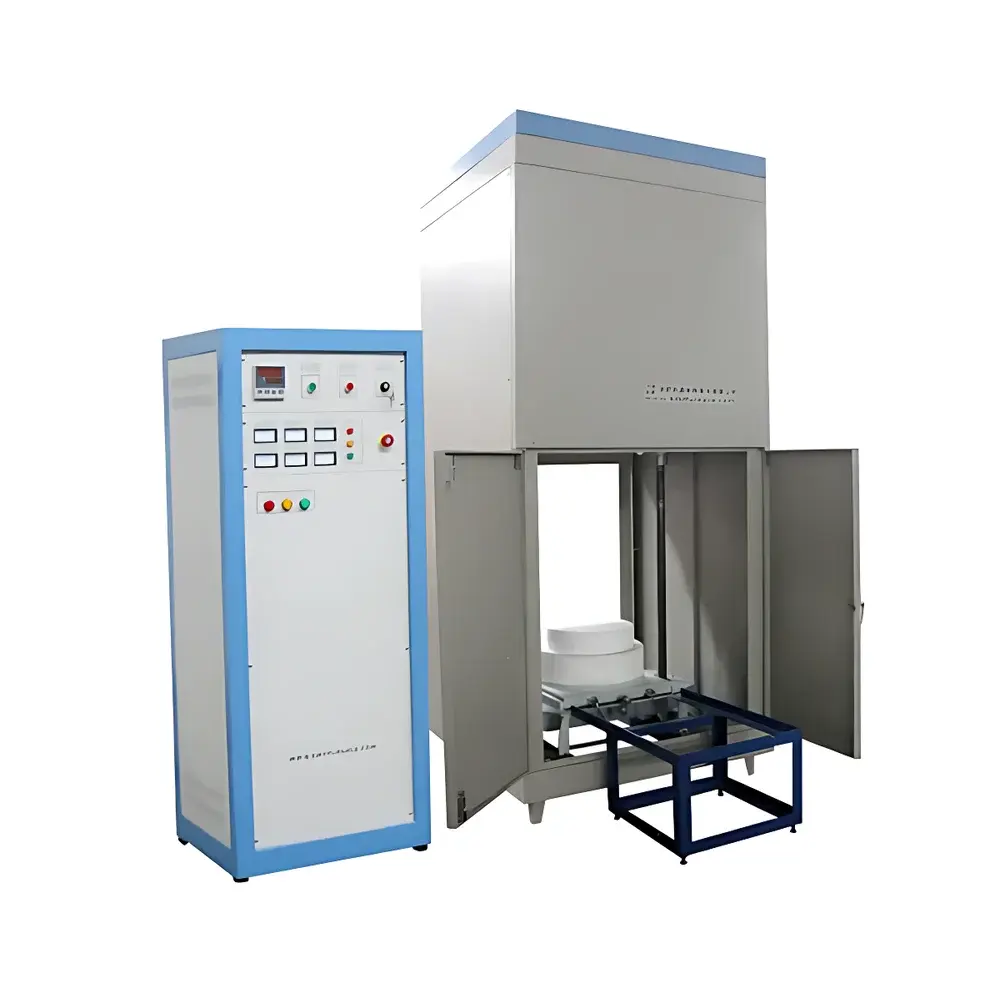
KJ GROUP KSL-1400X-BL High-Temperature Bell Jar Furnace
| Brand | KJ GROUP |
|---|---|
| Origin | Anhui, China |
| Manufacturer Type | Authorized Distributor |
| Country of Origin | China |
| Model | KSL-1400X-BL |
| Voltage | 3-Phase 208–460 V AC (configurable) |
| Power Rating | 50 kW |
| Max Temperature | 1400 °C (≤1 h) |
| Continuous Operating Range | 700–1300 °C |
| Temperature Uniformity | ±5 °C at 1200 °C |
| Control Accuracy | ±1 °C at 1200 °C |
| Chamber Dimensions | 800 × 800 × 800 mm (512 L) |
| Heating Element | SiC rods (Ø30 mm, L=1200+350 mm, delta-connected) |
| Thermocouple Type | S-type |
| Control System | PID with 30-segment programmable ramp-soak profile |
| Safety Features | Over-temperature & thermocouple break protection |
| Certification | CE-compliant |
| Communication Interface | RS485 |
| Cooling | Integrated recirculating chiller (deionized/purified water) |
| Atmosphere | Argon-purged (≥99.99% purity, 6 mm double-ferrule fitting supplied) |
| External Dimensions (Furnace) | 2100 × 2100 × 2300 mm |
| Electrical Panel Dimensions | 640 × 550 × 1600 mm |
| Net Weight | ~350 kg |
| Optional Accessory | PC-based temperature control software |
Overview
The KJ GROUP KSL-1400X-BL is a high-capacity, high-temperature bell jar furnace engineered for industrial-scale thermal processing under controlled inert atmospheres. Designed around the fundamental principles of radiant heat transfer and precise thermal zoning, this furnace employs a robust multi-zone resistive heating architecture—utilizing silicon carbide (SiC) rod elements arranged in a delta configuration—to achieve stable, repeatable operation up to 1400 °C for short-duration cycles and sustained processing between 700 °C and 1300 °C. Its 512-liter chamber (800 × 800 × 800 mm internal volume) accommodates large-format substrates, sintering boats, or stacked metal components, making it suitable for applications requiring uniform thermal exposure across volumetric loads. The furnace integrates a high-purity polycrystalline alumina fiber insulation system—rated for continuous service at 1500 °C—which minimizes radial and axial thermal gradients while reducing standby power consumption. Structural integrity is maintained via a rigid steel frame with reinforced lifting lugs and a manually actuated bell-lift mechanism compatible with standard overhead hoisting equipment.
Key Features
- Four independently monitored but synchronously controlled heating zones ensure axial and radial temperature uniformity of ±5 °C at 1200 °C across the full chamber volume.
- PID-based digital temperature controller with 30-segment programmable ramp/soak capability supports complex thermal profiles required for graded sintering, stress-relief annealing, and phase-transformation studies.
- Integrated over-temperature cutoff and thermocouple failure detection circuits comply with IEC 61508 functional safety principles for unattended operation.
- Front-access pull-handle ventilation ports allow rapid atmosphere exchange without full bell removal, facilitating process gas purging and cooling cycle acceleration.
- RS485 serial interface enables integration into centralized SCADA or MES environments; optional PC software provides real-time data logging, alarm history, and audit-trail generation per FDA 21 CFR Part 11 requirements.
- CE-marked design meets EN 61000-6-2 (immunity) and EN 61000-6-4 (emission) standards for industrial electromagnetic compatibility.
Sample Compatibility & Compliance
The KSL-1400X-BL supports a broad range of high-temperature sample forms—including bulk metallic ingots, ceramic green bodies, graphite crucibles, and coated wafers—provided they conform to maximum dimensional constraints and do not outgas volatile contaminants incompatible with argon blanketing. All internal surfaces are constructed from oxidation-resistant stainless steel (AISI 310S), and the furnace is validated for use under ASTM E220-20 (calibration of thermocouples) and ISO 9001:2015 quality management protocols. Argon atmosphere control requires external gas supply with pressure regulation (0.02–0.05 MPa); inlet fittings adhere to ISO 8434-1 specifications for 6 mm compression tube connections. No modifications are permitted to the furnace’s certified thermal barrier or electrical grounding scheme without revalidation by an authorized KJ GROUP service engineer.
Software & Data Management
The optional PC control software operates on Windows 10/11 platforms and communicates via Modbus RTU over RS485. It records timestamped temperature readings at user-defined intervals (1–60 s), stores up to 100 distinct recipes with version-controlled naming, and exports CSV-formatted logs compliant with GLP/GMP documentation standards. Audit trails include operator ID, parameter changes, alarm events, and firmware revision metadata. Data encryption and role-based access control (administrator/operator modes) satisfy baseline cybersecurity expectations for regulated laboratory environments. Raw data files may be imported into MATLAB, Python (NumPy/Pandas), or JMP for statistical process analysis.
Applications
- High-temperature sintering of tungsten, molybdenum, and refractory metal alloys in vacuum- or argon-processed powder metallurgy workflows.
- Stress-relief and homogenization annealing of large-diameter turbine discs, forging dies, and aerospace-grade superalloy billets.
- Thermal treatment of advanced ceramics—including silicon nitride, zirconia, and alumina composites—prior to HIP or final machining.
- Graphitization of carbon preforms used in nuclear moderator components or battery anode materials.
- Calibration and qualification of secondary reference standards for high-temperature metrology laboratories (per ISO/IEC 17025).
FAQ
What cooling medium is required for the integrated chiller unit?
Deionized or purified water must be used; tap water or glycol mixtures are prohibited due to mineral deposition and corrosion risks.
Can the furnace operate under vacuum conditions?
No—the KSL-1400X-BL is designed exclusively for inert-gas-purged operation; vacuum-rated variants (e.g., KSL-1400X-V) require separate specification and structural reinforcement.
Is the S-type thermocouple calibrated traceable to NIST standards?
Yes—each unit ships with a calibration certificate issued by an ILAC-accredited lab, including as-found/as-left data at three points (600 °C, 1000 °C, 1300 °C).
What is the recommended maintenance interval for SiC heating elements?
Inspection is advised every 200 operational hours; replacement frequency depends on thermal cycling depth and peak temperature exposure—typically 6–12 months under continuous 1200 °C operation.
Does the RS485 interface support Modbus TCP conversion?
Yes—when paired with an industrial protocol gateway (e.g., Moxa EDS-G205A), seamless translation to Ethernet/IP or OPC UA is achievable without firmware modification.



