
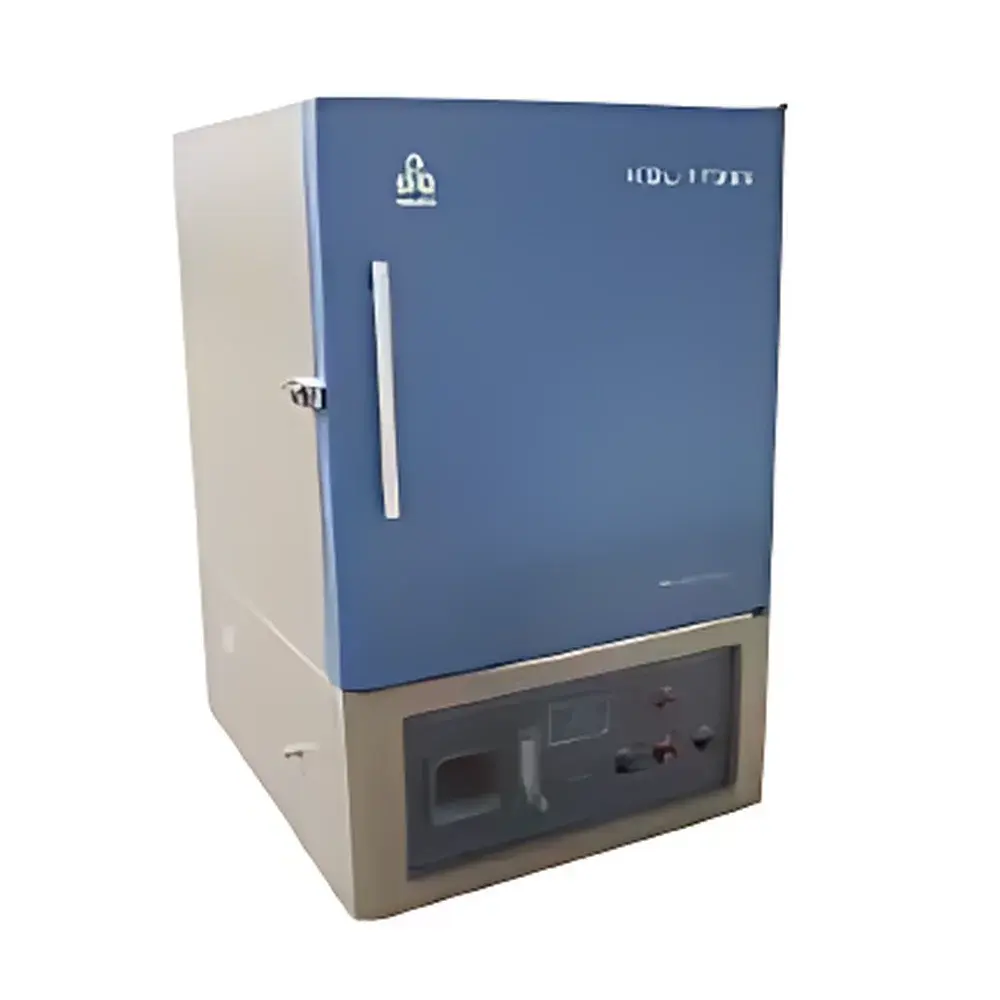
KJ GROUP KSL-1700X-A2 High-Temperature Box Furnace (8 L, 1700 °C)
| Brand | KJ GROUP |
|---|---|
| Origin | Anhui, China |
| Model | KSL-1700X-A2 |
| Maximum Operating Temperature | ≤1700 °C continuous, 1650 °C rated |
| Temperature Uniformity | ±1 °C |
| Power Supply | AC 220 V, 50 Hz, 5.2 kW |
| Heating Rate | 10 °C/min (to max temp) |
| Heating Element | Silicon Molybdenum (MoSi₂) Rods |
| Chamber Dimensions | 200 mm × 200 mm × 200 mm (8 L) |
| Door Type | Side-opening |
| Thermocouple | Type B Dual Platinum-Rhodium (PtRh30/PtRh6) |
| Controller | PID-based 30-segment programmable temperature controller |
| Certification | CE compliant |
| External Dimensions | 600 mm × 650 mm × 560 mm |
| Net Weight | 140 kg |
Overview
The KJ GROUP KSL-1700X-A2 is a high-temperature box furnace engineered for precision thermal processing in research laboratories and materials development facilities. Designed around a robust refractory architecture and MoSi₂ heating elements, it delivers stable, repeatable operation up to 1700 °C—suitable for sintering advanced ceramics, heat-treating refractory metals, ashing high-purity samples, and conducting solid-state synthesis under controlled atmospheric conditions. Its side-opening configuration enables convenient sample loading while maintaining structural integrity at extreme temperatures. The furnace employs a dual PtRh30/PtRh6 (Type B) thermocouple paired with a high-stability PID controller to achieve ±1 °C temperature uniformity across the 200 mm × 200 mm × 200 mm isothermal zone. Unlike vacuum or tube furnaces, the KSL-1700X-A2 operates in ambient or inert gas environments (e.g., N₂, Ar), and is explicitly not rated for reducing, flammable, or strongly corrosive atmospheres without prior customization.
Key Features
- High-temperature capability: Rated for continuous operation at ≤1700 °C, with nominal service life optimized at ≤1650 °C per ASTM E220 and ISO 17025 thermal calibration guidelines.
- Advanced thermal management: Internal chamber coated with US-sourced alumina (Al₂O₃) reflective ceramic layer—enhancing radiant efficiency, reducing energy consumption, and extending liner service life.
- Precise thermal programming: 30-segment programmable PID controller supports complex ramp-hold-cool profiles, enabling reproducible thermal cycles for phase transformation studies and annealing protocols.
- Structural reliability: Reinforced fiberboard insulation and MoSi₂ rod array ensure thermal stability, low thermal mass, and minimal thermal drift during extended dwell periods.
- Safety-compliant design: CE-marked per EN 61000-6-3 (EMC) and EN 61000-6-4 (immunity); includes over-temperature cut-off, door interlock, and grounded chassis.
Sample Compatibility & Compliance
The KSL-1700X-A2 accommodates standard crucibles (alumina, zirconia, graphite) and custom fixtures up to 180 mm in height or diameter. It is compatible with ASTM C20, ISO 506, and GB/T 2997 test methods for bulk density and porosity determination of refractories. While the unit itself does not provide vacuum or pressure-rated seals, optional quartz or alumina gas inlet/outlet ports can be integrated for inert purge applications. Users must avoid introducing H₂, CO, NH₃, or halogenated gases unless pre-approved by KJ GROUP engineering—corrosion-sensitive components (e.g., thermocouple sheaths, heating element terminals) require specialized passivation or coating. For GLP/GMP-regulated workflows, the furnace supports external data logging via analog 4–20 mA output and RS485 Modbus RTU interface (optional).
Software & Data Management
The embedded controller records real-time temperature, setpoint, and segment status to internal non-volatile memory (retains ≥100 cycles). Optional PC connectivity via USB-to-RS485 adapter enables integration with KJ LabControl™ software (v3.2+), supporting CSV export, time-stamped audit trails, and user-level access control—aligning with FDA 21 CFR Part 11 requirements when configured with electronic signatures and system validation documentation. Raw thermocouple voltage data is accessible for secondary calibration verification against NIST-traceable references.
Applications
- Sintering of silicon carbide (SiC), yttria-stabilized zirconia (YSZ), and rare-earth doped phosphors
- Thermal gravimetric analysis (TGA) pre-conditioning and residue quantification
- Calcination of metal oxides and catalyst precursors (e.g., NiO, Co₃O₄, MnO₂)
- Heat treatment of tungsten, molybdenum, and niobium alloys
- Pre-firing of ceramic green bodies prior to hot isostatic pressing (HIP)
- Ash content determination per AOAC 942.05 and ISO 2171 in food, feed, and pharmaceutical raw materials
FAQ
What is the recommended maximum heating/cooling rate for long-term reliability?
The manufacturer specifies 10 °C/min as the optimal ramp rate to minimize thermal stress on the MoSi₂ elements and refractory lining. Exceeding this may accelerate aging and reduce mean time between maintenance (MTBM).
Can this furnace operate under vacuum or reduced pressure?
No. The KSL-1700X-A2 is not sealed for vacuum use and lacks pressure-rated gaskets or flanges. Vacuum-compatible variants (e.g., KSL-1700X-V) are available upon request.
Is the Type B thermocouple calibrated and certified?
Each unit ships with a factory-calibrated Type B thermocouple traceable to national standards; full calibration certificate (per ISO/IEC 17025) is available as an add-on option.
How often should the alumina coating be reapplied?
Under normal usage (≤1650 °C, air atmosphere), reapplication is typically required only after 500–800 operating hours or upon visible spalling—verified visually or via emissivity measurement.
Does the furnace support third-party SCADA integration?
Yes. Analog outputs (0–10 V / 4–20 mA) and Modbus RTU over RS485 enable direct integration with Siemens S7, Rockwell Logix, or Ignition SCADA platforms using standard function codes.



