
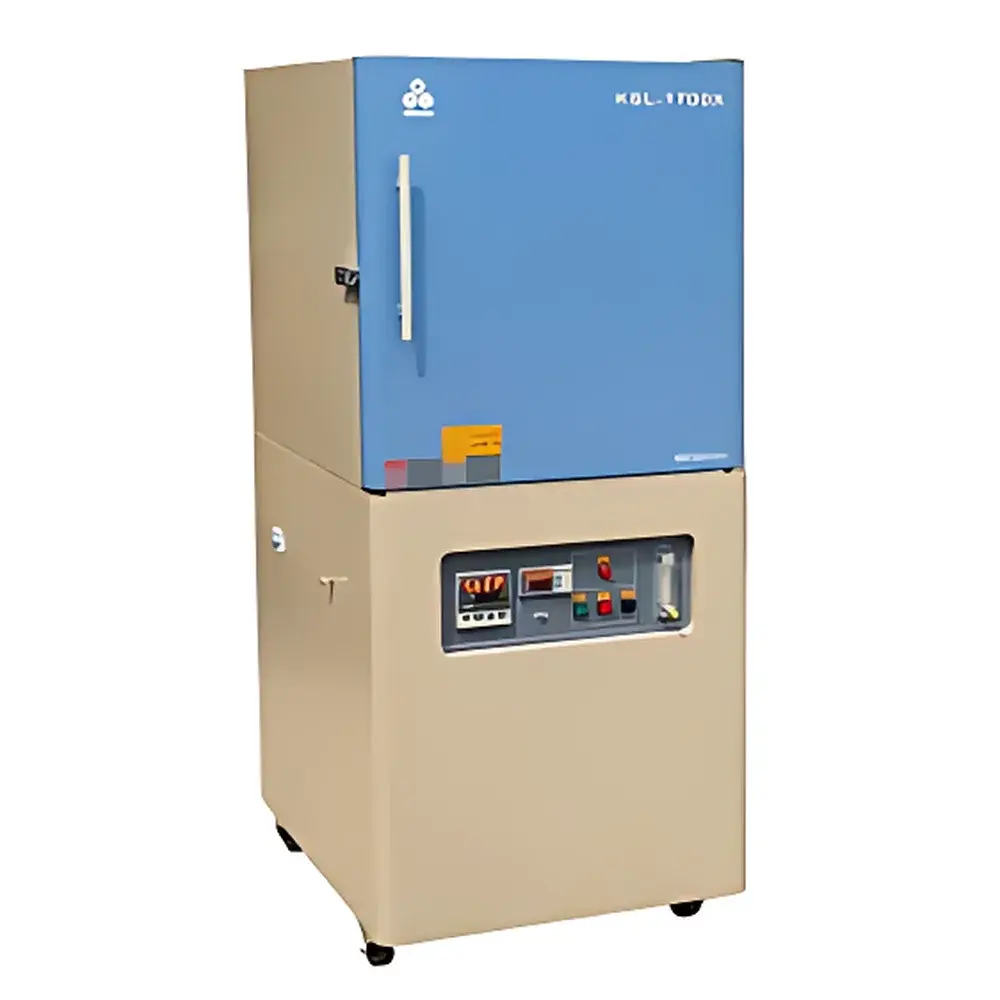
KJ GROUP KSL-1700X-A4 High-Temperature Box Furnace (36 L, 1700 °C)
| Brand | KJ GROUP |
|---|---|
| Origin | Anhui, China |
| Manufacturer Type | Authorized Distributor |
| Equipment Type | Box-Type Muffle Furnace |
| Model | KSL-1700X-A4 |
| Max Operating Temperature | ≤1700 °C continuous, 1650 °C rated |
| Temperature Uniformity | ±1 °C |
| Power Supply | AC 380 V, 2-phase, 50 Hz, 13 kW |
| Heating Rate | ≤10 °C/min up to 1400 °C |
| Heating Element | Silicon Molybdenum (MoSi₂) Rods |
| Chamber Dimensions | 300 mm × 400 mm × 300 mm (36 L volume) |
| Thermocouple | Type B Dual Platinum-Rhodium (Pt–Rh/Pt–Rh) |
| Control System | PID-Based 30-Stage Programmable Controller |
| Certification | CE Compliant |
| External Dimensions | 760 mm × 700 mm × 1020 mm |
| Net Weight | 300 kg |
Overview
The KJ GROUP KSL-1700X-A4 is a high-temperature box-type muffle furnace engineered for precision thermal processing in materials science laboratories, ceramic R&D facilities, and advanced metallurgical testing environments. Designed with a maximum continuous operating temperature of 1700 °C and a rated service temperature of 1650 °C, it employs silicon molybdenum (MoSi₂) heating elements—known for exceptional oxidation resistance and long-term stability at ultra-high temperatures. The furnace utilizes a Type B dual platinum-rhodium thermocouple for accurate, drift-resistant temperature measurement across its full range, coupled with a microprocessor-based PID controller enabling precise closed-loop regulation. Its side-opening door configuration minimizes heat loss during sample loading and improves ergonomic access, while the internally insulated chamber—lined with U.S.-sourced alumina reflective coating—enhances thermal efficiency and reduces energy consumption without compromising temperature uniformity.
Key Features
- High-stability MoSi₂ heating elements with extended lifetime under repeated thermal cycling up to 1700 °C
- Alumina-coated inner chamber surface for improved infrared reflectivity, faster heat-up response, and reduced thermal gradient across the working zone
- 30-segment programmable PID temperature controller supporting complex ramp-hold-cool profiles with user-defined dwell times and rate limits
- CE-certified design compliant with EN 61000-6-3 (EMC emission) and EN 61000-6-2 (immunity), ensuring safe integration into regulated laboratory infrastructure
- Robust mechanical construction featuring double-layer insulation (ceramic fiber + refractory brick), minimizing external surface temperature rise and improving operator safety
- Side-hinged furnace door with high-temperature gasket seal, facilitating reproducible sample placement and minimizing convection-driven temperature perturbation during operation
Sample Compatibility & Compliance
The KSL-1700X-A4 accommodates standard crucibles (alumina, zirconia, graphite, or silicon carbide), sintering boats, and custom fixtures within its 36 L usable chamber (300 × 400 × 300 mm). It supports atmospheric and inert gas purging (N₂, Ar) but is explicitly not designed for vacuum or explosive atmospheres per IEC 60079-0 requirements. Corrosive gas introduction (e.g., SO₂, H₂S, Na vapor) requires prior consultation for optional alumina-silica composite lining upgrades. While not inherently GLP/GMP validated, the furnace’s repeatable thermal profiles, audit-ready controller logs (via optional RS485/Modbus interface), and traceable calibration support compliance with ASTM C114, ISO 562, and USP sintering validation protocols when integrated into documented SOPs.
Software & Data Management
The embedded PID controller provides local parameter setting, real-time temperature display, and event-triggered alarms (over-temperature, thermocouple break, power failure). Optional communication modules enable data logging via Modbus RTU over RS485, allowing integration with LabVIEW, MATLAB, or SCADA systems for automated batch reporting. All temperature programs are stored non-volatilely and support password-protected editing to prevent unauthorized changes—critical for audit trails under FDA 21 CFR Part 11 when paired with compliant electronic record systems. Firmware updates maintain compatibility with evolving lab informatics platforms without hardware modification.
Applications
- Sintering of advanced ceramics (Al₂O₃, ZrO₂, Si₃N₄), refractory metals (Mo, W, Ta), and ultra-high-temperature composites
- Heat treatment of battery cathode precursors (e.g., LiCoO₂, NMC, LFP) under controlled oxidizing or inert conditions
- Ash content determination per ASTM D3174 and ISO 1171 in coal, biomass, and polymer composites
- Thermal gravimetric analysis (TGA) pre-conditioning and residue stabilization for subsequent XRD or SEM characterization
- Crystal growth annealing, diffusion bonding trials, and solid-state reaction kinetics studies requiring precise multi-step thermal profiles
FAQ
What is the recommended maximum ramp rate for long-term reliability?
For optimal element longevity and thermal shock mitigation, KJ GROUP recommends limiting ramp rates to ≤10 °C/min across the entire cycle—even though the furnace supports higher initial rates up to 1400 °C.
Can this furnace be used under vacuum or hydrogen atmosphere?
No. The KSL-1700X-A4 lacks vacuum sealing and is not rated for reducing or flammable gases. Hydrogen or vacuum applications require specialized furnace variants with welded seals and explosion-proof controllers.
Is the alumina coating repairable if cracked during extended use?
Yes. Minor microcracking in the alumina lining is normal after thermal cycling; it does not impair performance and can be refurbished using KJ GROUP’s certified alumina slurry (part #AL-REF-2024), applied per included technical bulletin.
Does the furnace include calibration documentation traceable to NIST standards?
Factory calibration certificates are provided with each unit, referencing Type B thermocouple calibration against reference standards traceable to national metrology institutes. Full ISO/IEC 17025 calibration services are available upon request.
What safety interlocks are integrated?
The system includes door-open thermal cut-off, over-temperature limit switch (independent of main controller), and phase-loss detection—all hardwired to disable power to heating elements immediately upon fault detection.



