
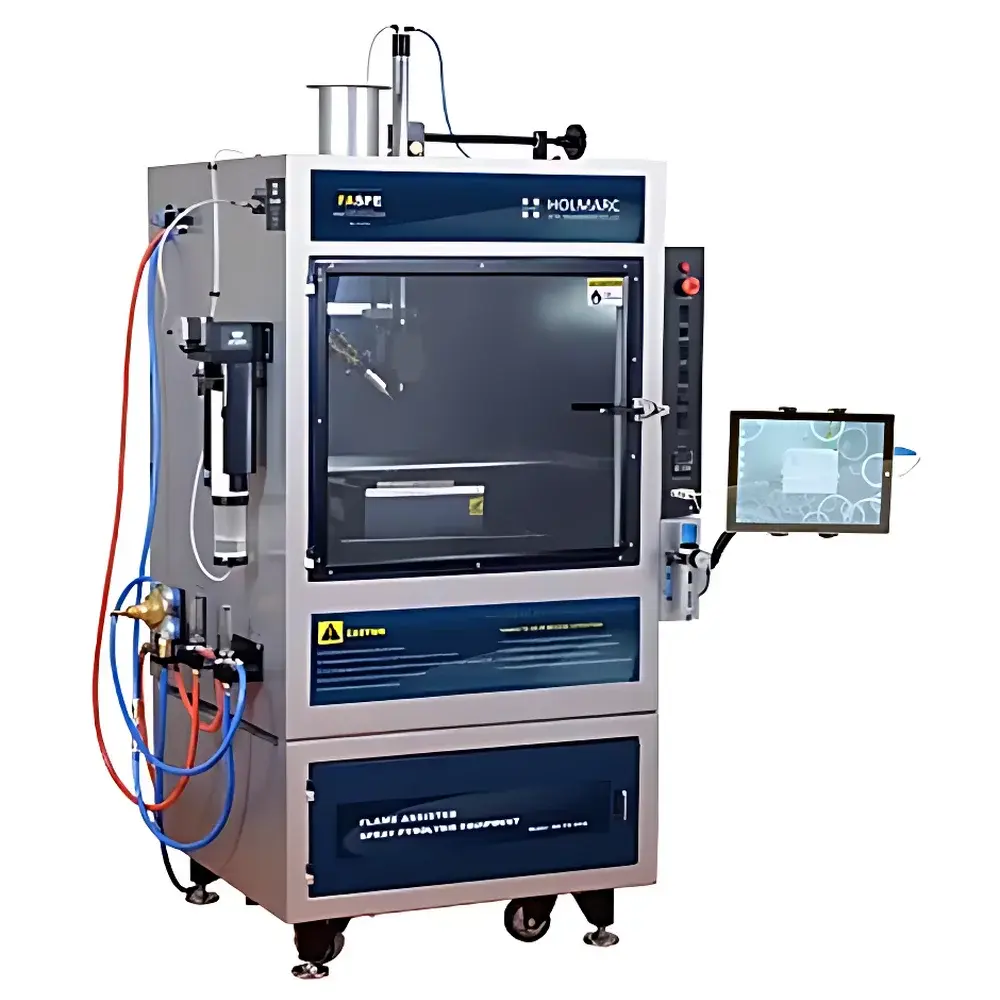
KJ GROUP MSK-TH-04FA Flame-Assisted Spray Pyrolysis Coating System
| Brand | KJ GROUP |
|---|---|
| Origin | Liaoning, China |
| Manufacturer Type | Authorized Distributor |
| Country of Origin | China |
| Model | MSK-TH-04FA |
| Price | Upon Request |
| Input Power | AC 208–240 V, Single Phase |
| Syringe Pump Flow Rate | 1–10 mL/min |
| Syringe Capacity | 50 mL or 250 mL |
| Substrate Heater Plate | 150 mm × 150 mm, Max 500 °C |
| XY Stage Travel | X: 100 mm, Y: 100 mm |
| XY Speed | X: 5–20 mm/s, Y: 2–12 mm/s |
| Nozzle | Compressed Air Atomizer |
| Integrated Air Compressor | Yes |
| Control Interface | RS232 (Heater), USB/Serial (Pump & Stage) |
| CE Certified | Yes |
| Software | Pre-installed on Included Laptop |
Overview
The KJ GROUP MSK-TH-04FA Flame-Assisted Spray Pyrolysis Coating System is a precision-engineered laboratory-scale deposition platform designed for the controlled synthesis of functional oxide thin films via thermally driven chemical decomposition of precursor solutions. Operating on the principle of spray pyrolysis—where atomized precursor solution droplets undergo rapid thermal decomposition upon impingement onto a heated substrate—the MSK-TH-04FA integrates an auxiliary liquefied petroleum gas (LPG) flame to preheat and partially oxidize the aerosol stream prior to substrate contact. This dual-thermal-zone architecture (flame-assisted pre-pyrolysis + substrate-controlled post-deposition annealing) enables precise control over reaction kinetics, stoichiometry, and phase evolution—particularly critical for metastable solid solutions such as ZnO–MgO or Y₂O₃-stabilized ZrO₂ (YSZ), which cannot be reliably synthesized via conventional furnace-based methods. The system supports both flame-assisted and flame-free operational modes, allowing sequential or comparative deposition protocols on identical substrates under reproducible thermal and fluidic conditions.
Key Features
- CE-certified integrated platform with safety interlocks, flame monitoring sensors, and emergency shutdown circuitry compliant with EN 61000-6-3 and EN 61000-6-4 electromagnetic compatibility standards.
- Dual-mode operation: switch seamlessly between flame-assisted (LPG/air premixed burner) and non-flame (compressed-air-only) spray pyrolysis—enabling direct comparison of thermal activation pathways on the same sample.
- Computer-synchronized control of all critical parameters: syringe pump flow rate (1–10 mL/min), XY-stage trajectory (programmable raster or custom path), heater temperature (ambient to 500 °C, ±1 °C stability), and flame intensity (adjustable via mass-flow-controlled LPG and air valves).
- Integrated industrial-grade air compressor (oil-free, 8 bar max, 120 L/min free air delivery) eliminates dependency on external compressed air sources.
- Pre-loaded Windows-based control software with real-time parameter logging, multi-channel data acquisition (temperature, position, flow), and GLP-compliant audit trail generation—including user login timestamps, parameter change history, and session export in CSV/Excel format.
- Modular mechanical design: separation into two transport modules (450 kg main unit + 135 kg auxiliary console) facilitates installation in Class 1000 cleanrooms or standard lab environments with floor-loading capacity ≥500 kg/m².
Sample Compatibility & Compliance
The MSK-TH-04FA accommodates rigid planar substrates up to 150 mm × 150 mm, including silicon wafers, alumina ceramics, stainless steel foils, nickel-based superalloys (e.g., Inconel 718), and amorphous silicon-coated glass. Its open-chamber configuration permits in situ visual alignment and post-deposition inspection without disassembly. All wetted components (syringe barrels, PTFE tubing, stainless-steel nozzles) are chemically inert to common metal-organic precursors (e.g., zinc acetate in ethanol, aluminum tri-sec-butoxide in toluene, yttrium nitrate hexahydrate aqueous solutions). The system conforms to ISO 14001 environmental management requirements for solvent handling and complies with OSHA 1910.106 flammable liquid storage guidelines for onboard LPG cylinder integration. Optional exhaust ducting (not included) enables connection to facility fume hoods meeting ANSI/AIHA Z9.5 laboratory ventilation standards.
Software & Data Management
Control is executed via proprietary KJ-CoatSuite™ v3.2 software, pre-installed on the supplied ruggedized laptop. The interface provides synchronized timeline-based programming: users define deposition sequences by assigning time-stamped events to pump speed, stage coordinates, heater setpoint, and flame state. All parameters are stored in encrypted SQLite databases with SHA-256 hash verification. Data exports include calibrated thermal profiles (via K-type thermocouple input), positional accuracy logs (verified against laser interferometer calibration reports), and flow-rate validation traces (cross-referenced with gravimetric mass-loss measurements). Audit trails meet FDA 21 CFR Part 11 requirements for electronic records and signatures, supporting GMP/GLP-regulated R&D environments where traceability and re-run fidelity are mandatory.
Applications
- Synthesis of transparent conducting oxides (TCOs) such as Al-doped ZnO (AZO) and Sn-doped In₂O₃ (ITO) for photovoltaic and display applications.
- Deposition of thermally stable dielectric layers (Al₂O₃, Y₂O₃) on high-temperature alloys for oxidation barrier coatings.
- Preparation of metastable ceramic solid solutions—including cubic-phase YSZ and Mg-doped ZnO—for solid electrolyte and piezoelectric research.
- Rapid prototyping of graded-composition films via dynamic modulation of precursor concentration and stage velocity during single-pass deposition.
- Correlative studies of nucleation kinetics by coupling in situ optical pyrometry (optional add-on) with ex situ XRD, SEM-EDS, and XPS characterization.
FAQ
What substrate heating uniformity can be expected across the 150 mm × 150 mm plate?
The heater employs embedded NiCr resistance wires with PID-controlled feedback from three independent K-type thermocouples; measured radial temperature deviation is ≤±3 °C at 450 °C.
Can the system accommodate rotating cylindrical substrates?
Yes—optional motorized rotary stage (KJ-RS-200) replaces the XY platform, enabling uniform coating on tubes or rods up to Ø100 mm × 200 mm length.
Is flame quenching capability available for rapid cooling studies?
Not natively; however, the heater plate’s thermal mass allows programmed ramp-down rates of 0.5–5 °C/s, and external N₂ purge nozzles (customizable) may be integrated for convective quenching.
What precursor solvents are compatible with the fluidic system?
All low-viscosity (<5 cP), non-halogenated solvents: ethanol, isopropanol, toluene, xylene, and aqueous nitrate/acetate solutions. Chlorinated solvents (e.g., chloroform) and HF-containing formulations are prohibited.
Does the system support remote monitoring via Ethernet or Wi-Fi?
The base configuration uses USB/RS232 connections; optional Ethernet-to-serial gateway (KJ-ETH-GW1) enables TCP/IP communication for LabVIEW or Python-based automation frameworks.



