
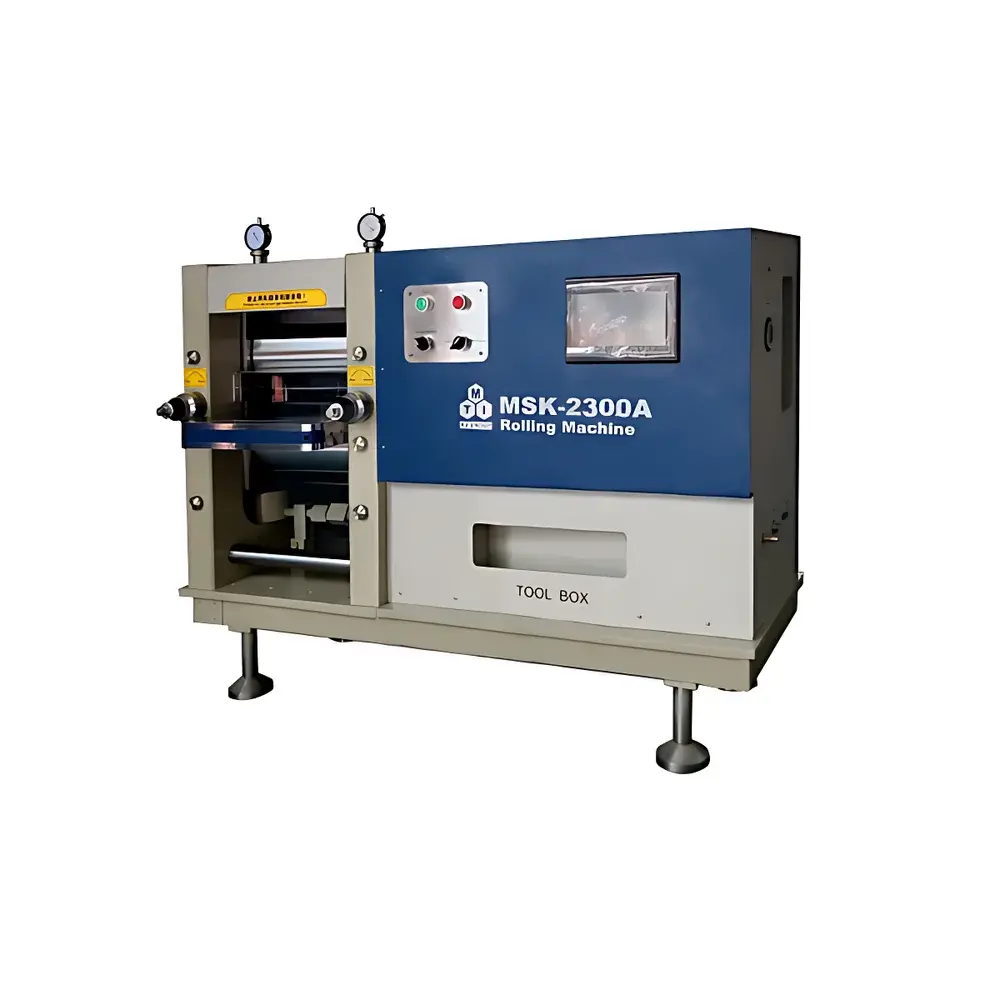
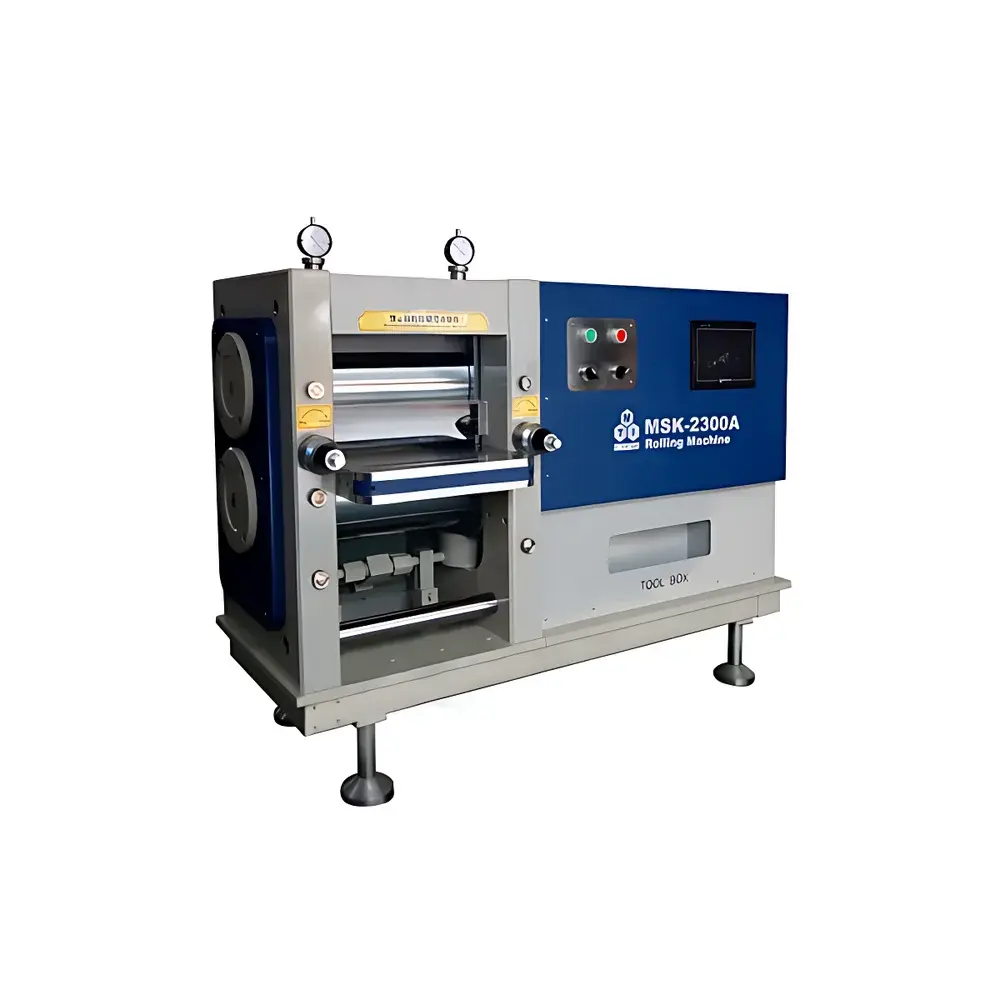
KJ GROUP MSK-2300A Hydraulic-Balanced Electric Calendering Roll Press
| Brand | KJ GROUP |
|---|---|
| Origin | Liaoning, China |
| Manufacturer Type | Authorized Distributor |
| Country of Origin | China |
| Model | MSK-2300A Hydraulic-Balanced Electric Calendering Roll Press |
| Quotation | Upon Request |
| Power Supply | AC 110 V / 60 Hz or AC 220 V / 50 Hz |
| Compressed Air Requirement | ≥ 0.3 MPa |
| Maximum Rolling Force | 55 T (Hydraulically Balanced) |
| Roll Dimensions | Ø210 mm × 330 mm |
| Roll Hardness | Surface HRC62–HRC68, Core HRC60–HRC62 |
| Thickness Uniformity | ±2.5 µm |
| Flatness Tolerance | ±0.0025 mm |
| Speed Range | 1–6 m/min |
| Machine Dimensions (L×W×H) | 1200 mm × 420 mm × 800 mm |
| Net Weight | ~800 kg |
Overview
The KJ GROUP MSK-2300A Hydraulic-Balanced Electric Calendering Roll Press is an industrial-grade precision calender engineered for high-reproducibility thickness reduction and surface consolidation of electrode foils in lithium-ion battery manufacturing. It operates on the principle of controlled compressive deformation between two counter-rotating hardened rolls under hydraulically balanced axial force—ensuring uniform pressure distribution across the entire roll bite zone. Unlike mechanically biased systems, its NPAK-sourced hydraulic balance mechanism eliminates edge thinning and center bulging, directly addressing critical quality requirements for anode and cathode calendering per ISO 12944-5 and IEC 62660-1. The press is designed for integration into pilot-line and small-batch production environments where repeatable density control, minimal thickness variation, and long-term dimensional stability are non-negotiable.
Key Features
- Hydraulically balanced roll loading system delivering up to 55 metric tons of controllable, uniform compressive force—eliminating lateral force gradients and ensuring consistent line pressure across the full 330 mm working width.
- PLC-based closed-loop pressure regulation with real-time force feedback; enables precise correlation of applied load (1–25 T standard range, scalable to 55 T) with instantaneous foil thickness and calculated density.
- High-strength Cr-Mo cold-work tool steel rolls (Ø210 mm × 330 mm), fully hardened through heat treatment to HRC60–HRC62 core and HRC62–HRC68 surface—optimized for wear resistance, thermal stability, and micro-deflection control during extended operation.
- Variable-speed DC drive system with bidirectional rotation and linear speed adjustment from 1 to 6 m/min—supporting both single-pass and multi-pass calendering strategies per USP compaction guidelines.
- Integrated touchscreen HMI displaying real-time rolling force vs. thickness trend plots; supports data logging with timestamped storage, CSV export, and optional thermal-printer output for QA documentation.
- Modular design accommodating optional motorized unwind/tension-controlled rewind units—enabling continuous web processing without manual intervention.
Sample Compatibility & Compliance
The MSK-2300A is validated for calendering metallic current collectors (Cu/Al foil), coated electrode sheets (NMC, LFP, graphite, silicon composites), and non-ferrous metal foils (Ni, Cu, Al ≤ 4.0 mm initial thickness). It meets mechanical safety requirements per EN 692 and incorporates emergency stop circuits compliant with IEC 60204-1. All PLC logic operations support audit-trail-enabled data retention for GLP/GMP-aligned process validation. While not certified to FDA 21 CFR Part 11 out-of-the-box, the system’s data architecture permits third-party validation for regulated battery R&D labs requiring electronic record integrity.
Software & Data Management
The embedded Siemens S7-1200 PLC executes deterministic control cycles at 10 ms intervals, synchronizing roll speed, hydraulic pressure ramp rates, and tension feedback (when paired with optional dancer-roll sensors). The HMI firmware stores ≥10,000 measurement records—including force, speed, thickness deviation, and timestamp—with configurable retention policies. Export functions generate ISO/IEC 17025-compatible calibration-ready reports. No cloud connectivity is included by default; all data remains local unless interfaced via RS485/Modbus TCP to external MES or LIMS platforms.
Applications
- Lithium-ion electrode densification: Achieves 20–35% first-pass thickness reduction on double-sided coated foils (≤0.3 mm initial), maintaining coating adhesion and minimizing particle fracture per ASTM D790 flexural testing criteria.
- Porosity optimization: Enables empirical derivation of density–pressure curves essential for optimizing ionic conductivity and cycle-life prediction models.
- Research-scale foil development: Supports parametric studies on binder migration, calender-induced cracking, and interfacial delamination under controlled strain rates.
- Non-battery applications: Validated for copper foil tempering, aluminum foil leveling, and thin-gauge nickel strip consolidation where surface finish ≤ Ra 0.4 µm and flatness ≤ ±2.5 µm are required.
FAQ
What is the maximum recommended initial thickness for single-pass calendering?
For battery electrodes, initial thickness should not exceed 0.3 mm for double-sided coatings and 0.15 mm for single-sided coatings to ensure uniform deformation without edge cracking.
Can the MSK-2300A be integrated into an automated electrode line?
Yes—via Modbus TCP or discrete I/O signals, the PLC supports handshaking with upstream slitting or downstream drying modules; full integration requires custom interface engineering.
Is roll surface grinding or re-polishing supported in-field?
Rolls are supplied pre-ground to Ra ≤ 0.2 µm; field reconditioning requires OEM-certified tooling and hardness verification post-grinding to maintain HRC62+ integrity.
Does the system include automatic thickness feedback control?
No—closed-loop thickness control requires optional laser micrometer integration (e.g., Keyence IL-1000); the base system provides open-loop force–thickness correlation only.
What maintenance intervals are specified for the hydraulic system?
NPAK hydraulic components require oil analysis every 500 operating hours and filter replacement every 1,000 hours; full system recalibration is recommended annually or after 2,000 cumulative ton-hours of operation.



