
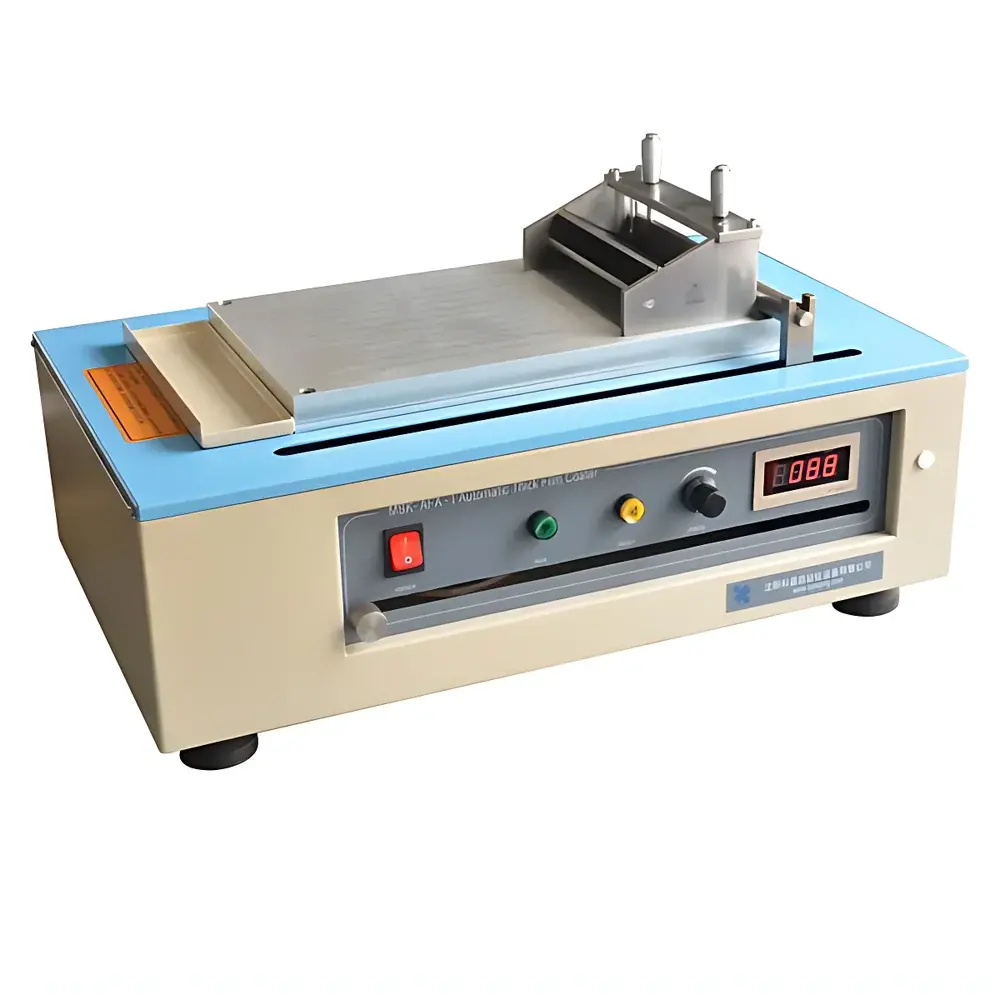
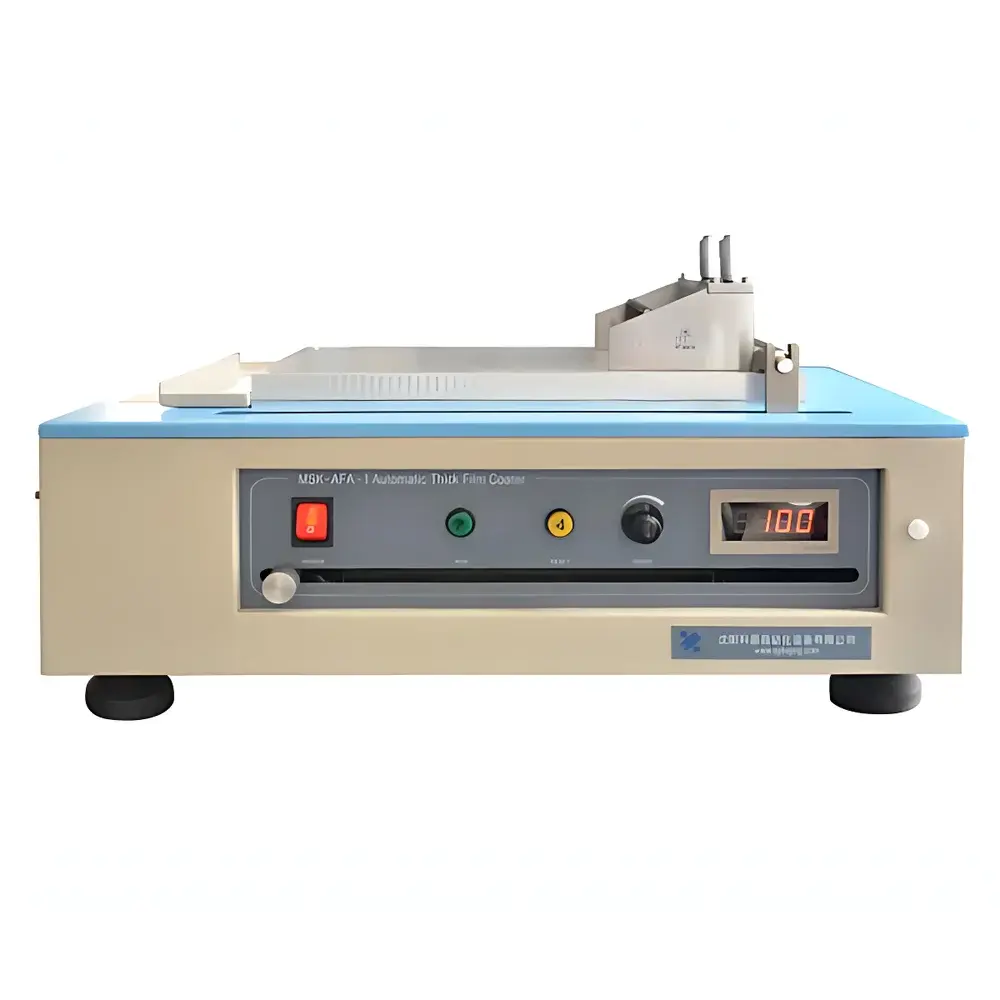
KJ GROUP MSK-AFA-I Automatic Film Coater
| Brand | KJ GROUP |
|---|---|
| Origin | Liaoning, China |
| Model | MSK-AFA-I |
| Coating Width | 150 mm (adjustable via KTQ150 doctor blade) |
| Coating Thickness Range | 0–3500 µm (micrometer-adjustable gap) |
| Coating Length | 10–290 mm (programmable stroke) |
| Coating Speed | 10–100 mm/s (infinitely variable, digital display) |
| Vacuum Adsorption Area | 300 mm × 150 mm |
| Base Plate Dimensions | 360 mm × 200 mm |
| Overall Dimensions | 610 mm × 390 mm × 240 mm |
| Weight | 25 kg |
| Power Supply | DC 24 V / 3.75 A (via included AC/DC adapter: IN AC 100–240 V, 50/60 Hz |
| Max. Power Consumption | ≤50 W |
| Environmental Operating Range | 0–45 °C, 10–85 % RH (non-condensing) |
| Vacuum Requirement | External oil-free vacuum pump (e.g., AP-1400V, optional) |
Overview
The KJ GROUP MSK-AFA-I Automatic Film Coater is a precision-engineered laboratory-scale coating system designed for controlled, repeatable fabrication of uniform thin films on rigid or semi-rigid substrates. It operates on the principle of doctor-blade (knife-over-edge) coating—a gravure-adjacent technique where a precisely gapped blade shears excess slurry or paste from the substrate surface under vacuum-assisted immobilization. This method ensures high thickness reproducibility and minimal edge effects, making it particularly suitable for functional film development in solid-state energy materials (e.g., cathode/anode slurries for Li-ion batteries), ceramic electrolytes, piezoelectric oxides, perovskite precursors, and nanostructured optical coatings. Unlike spin coating, the MSK-AFA-I imposes no rotational constraints, accommodates larger-area substrates (up to 300 mm × 150 mm active adsorption zone), and enables direct correlation between mechanical gap setting and final dry-film thickness—critical for process transfer to roll-to-roll pilot lines.
Key Features
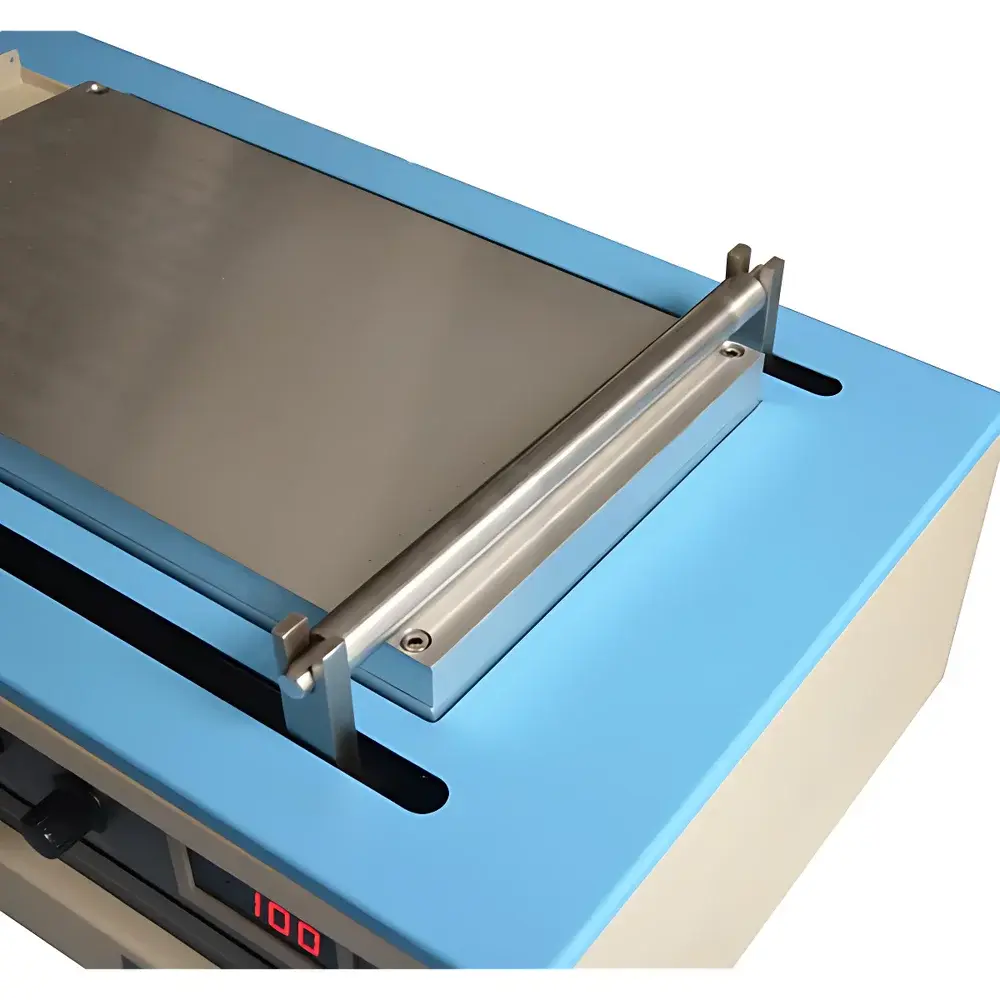
- Vacuum-based substrate fixation: Integrated vacuum manifold with 300 mm × 150 mm adsorption area ensures flat, wrinkle-free immobilization of glass, silicon wafers, metal foils, and polymer films—eliminating lateral drift during coating.
- Micrometer-actuated KTQ150 adjustable doctor blade: 150 mm wide stainless-steel blade with calibrated vernier scale allows sub-micron gap resolution; thickness tuning range spans 0–3500 µm wet film, enabling both ultrathin (100 µm) deposition protocols.
- Programmable linear motion system: Stepper-driven carriage provides smooth, backlash-free traversal over 10–290 mm stroke length; speed continuously adjustable from 10–100 mm/s with real-time digital readout for kinetic control of solvent evaporation and shear rate.
- Modular electrical architecture: Powered by an external, CE-compliant AC/DC adapter (24 V / 3.75 A); total power draw ≤50 W ensures compatibility with standard lab circuits and minimizes thermal load in confined benchtop environments.
- Compact footprint and ergonomic design: Overall dimensions of 610 × 390 × 240 mm and mass of 25 kg facilitate integration into fume hoods, gloveboxes (with feedthrough adaptation), or shared instrumentation suites without structural reinforcement.
Sample Compatibility & Compliance
The MSK-AFA-I supports substrates up to 300 mm in length and 150 mm in width, including float glass, ITO/PET, stainless steel foil, aluminum current collectors, and silicon wafers. Its non-contact vacuum chuck eliminates adhesive residue or mechanical deformation risks associated with clamping systems. All electrical components comply with EU Low Voltage Directive 2014/35/EU and Electromagnetic Compatibility Directive 2014/30/EU, evidenced by CE marking. The system is compatible with ISO/IEC 17025-accredited laboratories performing method validation per ASTM D823 (Standard Practice for Producing Films of Uniform Thickness of Paint, Varnish, and Related Products on Test Panels) and ASTM D1186 (Standard Test Methods for Nondestructive Measurement of Dry Film Thickness of Nonmagnetic Coatings Applied to a Ferrous Base). No hazardous gases, solvents, or high-pressure utilities are required—only a certified oil-free vacuum pump (e.g., AP-1400V, sold separately) meeting ISO 8573-1 Class 0 purity standards for cleanroom-compatible operation.
Software & Data Management
The MSK-AFA-I operates via hardware-integrated manual controls—no proprietary software or PC interface is required, reducing cybersecurity exposure and ensuring deterministic behavior under GLP/GMP-aligned workflows. All operational parameters (speed, stroke, dwell time) are set using front-panel dials and digital displays with ±0.5% full-scale accuracy. Critical settings—including blade gap position, carriage start/end limits, and vacuum activation timing—are mechanically locked and documented in the user logbook, supporting audit readiness per FDA 21 CFR Part 11 Annex 11 requirements for electronic records in regulated R&D environments. Optional accessories such as vacuum stirring modules or inline viscometers (e.g., Brookfield DV2T) may be integrated upstream to ensure slurry homogeneity prior to coating—a prerequisite for ASTM D1898-compliant battery electrode manufacturing studies.
Applications
- Electrode fabrication for lithium-ion, sodium-ion, and solid-state batteries: Slurry coating of NMC, LFP, SiOx, and sulfide-based composites onto Cu/Al foils.
- Ceramic membrane development: Deposition of YSZ, GDC, or BaZrO3-based electrolyte layers for SOFC/SOEC research.
- Optoelectronic thin films: Controlled casting of perovskite precursor solutions, quantum dot inks, or conductive polymer dispersions (e.g., PEDOT:PSS).
- Functional barrier coatings: Fabrication of SiOx/AlOx hybrid layers on flexible packaging substrates for moisture/oxygen阻隔 testing.
- Academic thin-film metrology: Correlation studies between wet-film rheology (measured via optional viscometer), drying kinetics (monitored via in-situ IR), and final film morphology (characterized by SEM/XRD).
FAQ
What vacuum specifications are required for optimal substrate adhesion?
A minimum vacuum level of −80 kPa (absolute) is recommended; the AP-1400V oil-free vacuum pump (optional) achieves −90 kPa at 40 L/min flow, ensuring reliable hold-down force across low-porosity substrates.
Can the MSK-AFA-I be operated inside a nitrogen-filled glovebox?
Yes—external vacuum tubing can be routed through standard glovebox feedthroughs; the unit’s DC-powered architecture eliminates internal AC components that could pose ignition risks.
Is blade replacement standardized across KJ GROUP coaters?
The KTQ150 blade uses M4 threaded mounting and conforms to ISO 20483-1 dimensional tolerances; blades from third-party suppliers meeting these specs are mechanically interchangeable.
How is film thickness validated post-coating?
Users typically employ contact profilometry (e.g., Bruker Dektak) or non-contact white-light interferometry (e.g., Zygo NewView) on dried films; wet-film thickness correlates linearly with micrometer gap setting for Newtonian slurries within ±5% uncertainty.
Does the system support automated recipe storage?
No—parameter retention relies on procedural documentation per SOP; this design aligns with ALCOA+ principles for data integrity in preclinical materials development labs.



