
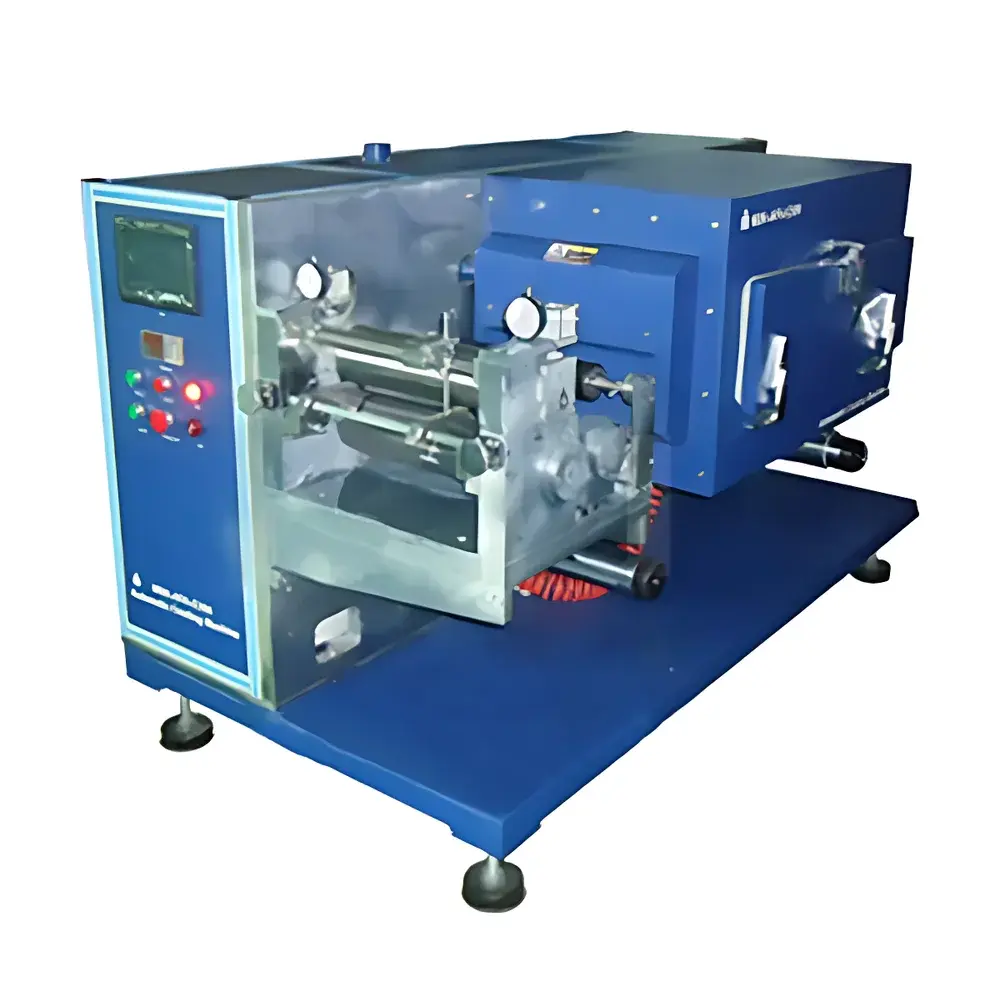
KJ GROUP MSK-AFA-EC300 Continuous Experimental Automatic Coating Machine
| Brand | KJ GROUP |
|---|---|
| Origin | Liaoning, China |
| Manufacturer Type | Authorized Distributor |
| Country of Origin | China |
| Model | MSK-AFA-EC300 |
| Price | Upon Request |
| Input Voltage | AC 220 V, 50 Hz |
| Max Power Consumption | ~5 kW |
| Compressed Air Supply | 0.5–0.8 MPa |
| Substrate Width | up to 280 mm |
| Coating Width | up to 260 mm |
| Coating Speed | 100–600 mm/min |
| Coating Thickness Accuracy | ±3 µm (edge deviation ±5 µm) |
| Coating Roll Diameter | Ø100 mm |
| Roll Runout | ≤2 µm |
| Unwind/Reel Max Diameter | 250 mm |
| Web Tension Range | 5–40 N (adjustable) |
| Doctor Blade Positioning Resolution | ±1 µm (micrometer indicator) |
| Edge Guiding Accuracy | ±0.5 mm |
| Drying Temperature Range | up to 150 °C ±5 °C |
| Oven Length | 800 mm |
| Heating Method | Resistive heating with dual-zone forced-air convection |
| Overall Dimensions | 1530 × 950 × 1080 mm (L×W×H) |
| Net Weight | 1000 kg |
| Operating Altitude | ≤1000 m |
| Ambient Temp | 25 °C ±15 °C |
| Relative Humidity | 55 %RH ±10 %RH |
| Required Utilities | Grounded AC power only |
Overview
The KJ GROUP MSK-AFA-EC300 Continuous Experimental Automatic Coating Machine is an industrial-grade laboratory coating system engineered for high-precision, repeatable thin-film deposition on flexible substrates. It implements the three-roll transfer coating principle—where metering, application, and transfer rolls work in synchronized kinematic harmony—to achieve uniform wet-film thickness control across wide-area webs. Unlike slot-die or gravure systems, this architecture offers inherent mechanical stability and minimal shear-induced degradation of shear-thinning slurries (e.g., Li-ion battery cathode/anode slurries, conductive polymer dispersions, or photosensitive emulsions). Designed explicitly for R&D-scale prototyping and pre-pilot batch validation, the MSK-AFA-EC300 bridges the gap between manual lab coaters and full-scale production lines—enabling direct process translation under GLP-aligned operating conditions.
Key Features
- PLC-based motion and thermal control architecture with dual-language (English/Chinese) HMI interface supporting real-time parameter logging and recipe management.
- Three-roll transfer coating station featuring Ø100 mm precision-ground chrome-plated steel rolls with radial runout ≤2 µm—ensuring consistent gap geometry and minimizing edge bead formation.
- Integrated automatic slurry agitator with variable-speed motor (0–200 rpm), preventing sedimentation and maintaining rheological homogeneity during extended runs.
- Motorized unwind/reel system with closed-loop tension control (5–40 N range) and optical edge-guiding mechanism (±0.5 mm repeatability) for defect-free winding of narrow or low-tensile-strength foils.
- Forced-convection drying oven (800 mm length) with independent top/bottom airflow distribution and PID-controlled resistive heating—capable of ramping to 150 °C ±5 °C with thermal uniformity <±3 °C across the web path.
- Modular add-on compatibility including optional NMP solvent recovery unit (condensation + activated carbon adsorption) for compliant handling of volatile organic carriers in battery electrode manufacturing.
Sample Compatibility & Compliance
The MSK-AFA-EC300 accommodates a broad spectrum of substrate types—including Al/Cu foil (6–20 µm), PET/PI films (12–125 µm), paper, nonwovens, and composite laminates—within a maximum width of 280 mm. Its mechanical design conforms to CE Machinery Directive 2006/42/EC and Electromagnetic Compatibility Directive 2014/30/EU. While not certified to ISO 13485 or FDA 21 CFR Part 11 out-of-the-box, its audit-ready data logging architecture (timestamped parameter records, user login tracking, and recipe versioning) supports GMP/GLP documentation workflows when deployed in regulated development labs. The system operates safely within standard laboratory ventilation guidelines; integration with dedicated fume extraction is recommended when processing solvents with TLV <100 ppm (e.g., NMP, DMAC).
Software & Data Management
The embedded PLC controller logs all operational parameters—including web speed, tension setpoints, oven zone temperatures, blade position readings, and agitator RPM—at 1 Hz resolution. Exportable CSV files contain synchronized timestamps aligned to system clock (NTP-capable via optional Ethernet module). No proprietary software installation is required: configuration and monitoring occur directly through the touchscreen HMI. For advanced analytics, raw logs are compatible with MATLAB, Python (pandas), or LabVIEW for statistical process control (SPC) charting, coating uniformity mapping (via post-run caliper scans), and DOE correlation studies. Audit trails include operator ID, timestamp, and parameter change history—fully traceable per ALCOA+ principles.
Applications
This coater serves as a critical platform in multiple advanced materials development domains: lithium-ion and solid-state battery electrode R&D (cathode: NMC/LFP, anode: Si-C composites); functional barrier coatings for flexible electronics; anti-reflective or hydrophobic layers on optical films; pharmaceutical film-coating process scouting; and nanocomposite dispersion validation for aerospace prepregs. Its ability to maintain ±3 µm thickness tolerance across 260 mm widths at speeds up to 600 mm/min enables statistically meaningful sample generation for electrochemical cycling, peel adhesion, and SEM cross-section analysis—reducing time-to-data versus manual doctor-blade methods by >70%.
FAQ
What substrate thicknesses can the MSK-AFA-EC300 handle?
It supports foils and films ranging from 6 µm (ultra-thin Cu current collector) to 250 µm (heavy-duty composite backing), provided tensile strength exceeds 15 MPa and surface energy permits wetting.
Is the oven temperature profile programmable in segments?
Yes—the drying zone is divided into two independently controlled sections (inlet and outlet), each with configurable ramp/soak profiles via HMI.
Can the system be integrated with in-line metrology tools?
The machine includes analog voltage outputs (0–10 V) and Modbus RTU ports for synchronization with external laser micrometers, IR thickness gauges, or vision inspection systems.
What maintenance intervals are recommended for the coating rolls?
Roll surface inspection and cleaning are advised after every 50 hours of operation; re-polishing is recommended every 500 hours or upon detection of >3 µm surface wear via profilometry.
Does the CE marking cover electrical safety and EMC compliance?
Yes—certification documentation (DoC, test reports) covers EN 60204-1 (electrical safety) and EN 61000-6-2/-4 (immunity/emissions) and is available upon request with proof of purchase.



