
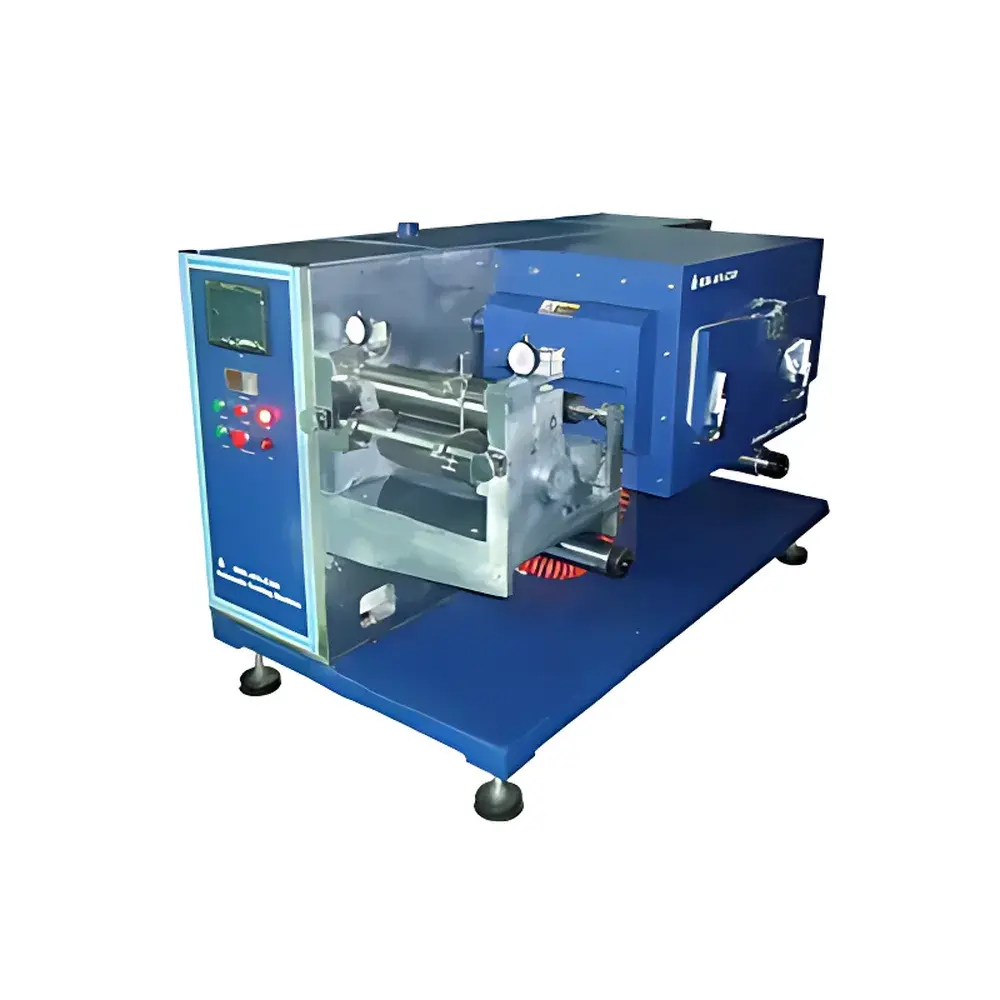
KJ GROUP MSK-AFA-EI300 Continuous & Intermittent Laboratory-Scale Automatic Coating Machine
| Brand | KJ GROUP |
|---|---|
| Origin | Liaoning, China |
| Manufacturer Type | Authorized Distributor |
| Country of Origin | China |
| Model | MSK-AFA-EI300 |
| Power Supply | AC 220 V, 50 Hz |
| Max. Power Consumption | ~5 kW |
| Air Supply | 0.5–0.8 MPa compressed air |
| Substrate Width | ≤280 mm |
| Coating Width | ≤260 mm |
| Coating Speed | 100–600 mm/min |
| Coating Accuracy | ±3 µm (edge error ±5 µm) |
| Coating Roll Diameter | Ø100 mm |
| Roll Runout | ≤2 µm |
| Unwind/rewind Max. Roll Diameter | 250 mm |
| Tension Range | 5–40 N (adjustable) |
| Doctor Blade Positioning Resolution | ±1 µm (dial indicator) |
| Edge Guiding Accuracy | ±0.5 mm |
| Drying Temperature Range | up to 150 °C ±5 °C |
| Oven Length | 800 mm |
| Heating Method | Resistive heating with dual-side forced-air convection |
| Overall Dimensions | 1530 × 950 × 1080 mm |
| Net Weight | 1000 kg |
| Operating Altitude | ≤1000 m |
| Ambient Temp. | 25 °C ±15 °C |
| Relative Humidity | 55 %RH ±10 %RH |
| Required Utilities | Grounded AC power only |
Overview
The KJ GROUP MSK-AFA-EI300 is a precision-engineered laboratory-scale coating system designed for R&D environments requiring high-fidelity, repeatable thin-film deposition on flexible substrates. It operates on the three-roll transfer coating principle—where metering, transfer, and application rolls work in synchronized kinematic coupling—to deliver uniform wet-film thicknesses across foil, polymer film, and paper-based substrates. Unlike slot-die or gravure systems, this architecture enables deterministic control over shear history, residence time, and meniscus stability during coating, making it especially suitable for non-Newtonian slurries used in lithium-ion battery electrode fabrication (e.g., NCM, LFP, or silicon anode slurries), as well as functional coatings in photographic film, packaging laminates, and advanced composites. The system supports both continuous and intermittent (stop-start) coating modes, allowing users to decouple process development from full-scale production constraints while maintaining metrological traceability to industrial specifications.
Key Features
- PLC-based motion and process control architecture with dual-language (English/Chinese) HMI interface, supporting recipe storage, real-time parameter monitoring, and alarm logging.
- Three-roll transfer station with Ø100 mm precision-ground chrome-plated steel rolls; radial runout ≤2 µm ensures minimal thickness modulation across the web width.
- Motorized doctor blade assembly with micrometer-adjustable positioning (±1 µm resolution via dial indicator), enabling fine-tuning of gap-based wet-film thickness without mechanical reassembly.
- Automated web handling subsystem including servo-driven unwind/rewind stations, closed-loop tension control (5–40 N range), and optical edge-guiding system (±0.5 mm repeatability) for consistent winding geometry.
- Integrated convection oven (800 mm length) with independent upper/lower airflow channels and PID-controlled resistive heating (max. 150 °C ±5 °C), optimized for solvent evaporation kinetics and thermal profile uniformity.
- Optional NMP solvent recovery module compatible with ISO 14001-compliant lab ventilation infrastructure—designed to reduce VOC emissions and support GLP-aligned environmental stewardship protocols.
Sample Compatibility & Compliance
The MSK-AFA-EI300 accommodates substrates up to 280 mm wide—including aluminum/copper foils (6–20 µm), PET/PEN films (12–100 µm), release liners, and cellulose-based papers—without requiring tooling changes. Its modular frame design allows rapid adaptation to varying substrate stiffness and surface energy characteristics. All electrical components conform to CE marking requirements under Directive 2014/30/EU (EMC) and 2014/35/EU (LVD). Mechanical safety interlocks, emergency stop circuitry, and grounded chassis construction meet IEC 61000-6-2/6-4 immunity and emission standards. While not certified to UL 508A or CSA C22.2 No. 14, the system is routinely deployed in ISO/IEC 17025-accredited laboratories where equipment qualification follows internal SOPs aligned with ASTM D6735 (coating thickness measurement) and ISO 2137 (viscosity determination of paints and varnishes).
Software & Data Management
The embedded PLC controller records timestamped operational data—including speed, tension, temperature setpoints, and actuator positions—at 10 Hz sampling rate. Raw logs are exportable via USB to CSV format for post-processing in MATLAB, Python (Pandas), or statistical analysis platforms such as JMP or Minitab. Optional Ethernet/IP or Modbus TCP connectivity enables integration into centralized MES or LIMS environments, supporting audit trails compliant with FDA 21 CFR Part 11 when paired with validated user authentication and electronic signature modules. No proprietary cloud service is required; all firmware updates are delivered via offline SD card to maintain air-gapped network integrity in regulated QC labs.
Applications
- Lithium-ion battery R&D: Electrode slurry coating (cathode/anode), dry-film thickness validation prior to calendering, and slurry rheology–coating correlation studies.
- Functional film development: Conductive polymer coatings (PEDOT:PSS), anti-reflective layers, barrier films (SiOx, AlOx), and photovoltaic absorber layers (perovskite precursors).
- Industrial R&D: Pressure-sensitive adhesive transfer, thermal-transfer ribbon formulation, and specialty paper coating (e.g., inkjet receptor layers).
- Academic research: Shear-thinning behavior quantification, defect formation analysis (ribbing, streaking, drying cracks), and multi-layer sequential coating feasibility testing.
FAQ
What substrate materials are compatible with the MSK-AFA-EI300?
Aluminum and copper foils, PET, PI, PP, and cellulose-based papers—any flexible material up to 280 mm wide and capable of sustaining 5–40 N web tension.
Is the system suitable for aqueous and solvent-based slurries?
Yes—provided the solvent compatibility of roll elastomers (standard nitrile rubber) and oven internal surfaces is verified; NMP-compatible configurations include stainless-steel oven liners and fluoropolymer-coated rolls.
Can coating thickness be correlated to rheological properties?
Within defined shear-rate windows (governed by roll speed and gap), wet-film thickness shows predictable dependence on zero-shear viscosity and yield stress—enabling empirical calibration against Brookfield or rotational rheometer data.
Does the system support GLP-compliant documentation?
When configured with optional electronic signature and audit trail firmware, raw process logs meet ALCOA+ principles for data integrity and are admissible in regulatory submissions referencing ICH GCP or ISO 13485.
What maintenance intervals are recommended?
Roll cleaning after each batch; tension sensor calibration every 6 months; oven airflow verification annually; PLC firmware update checks per KJ GROUP security bulletins (typically biannually).



