
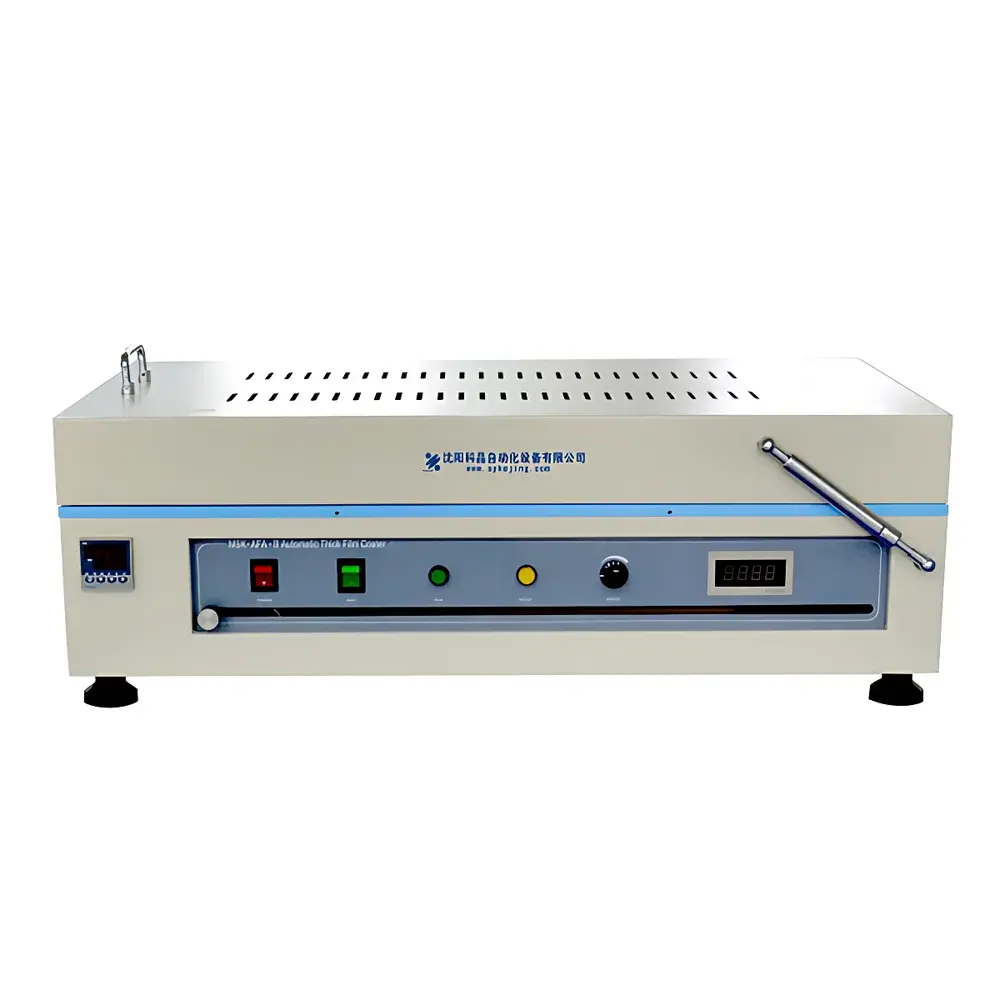
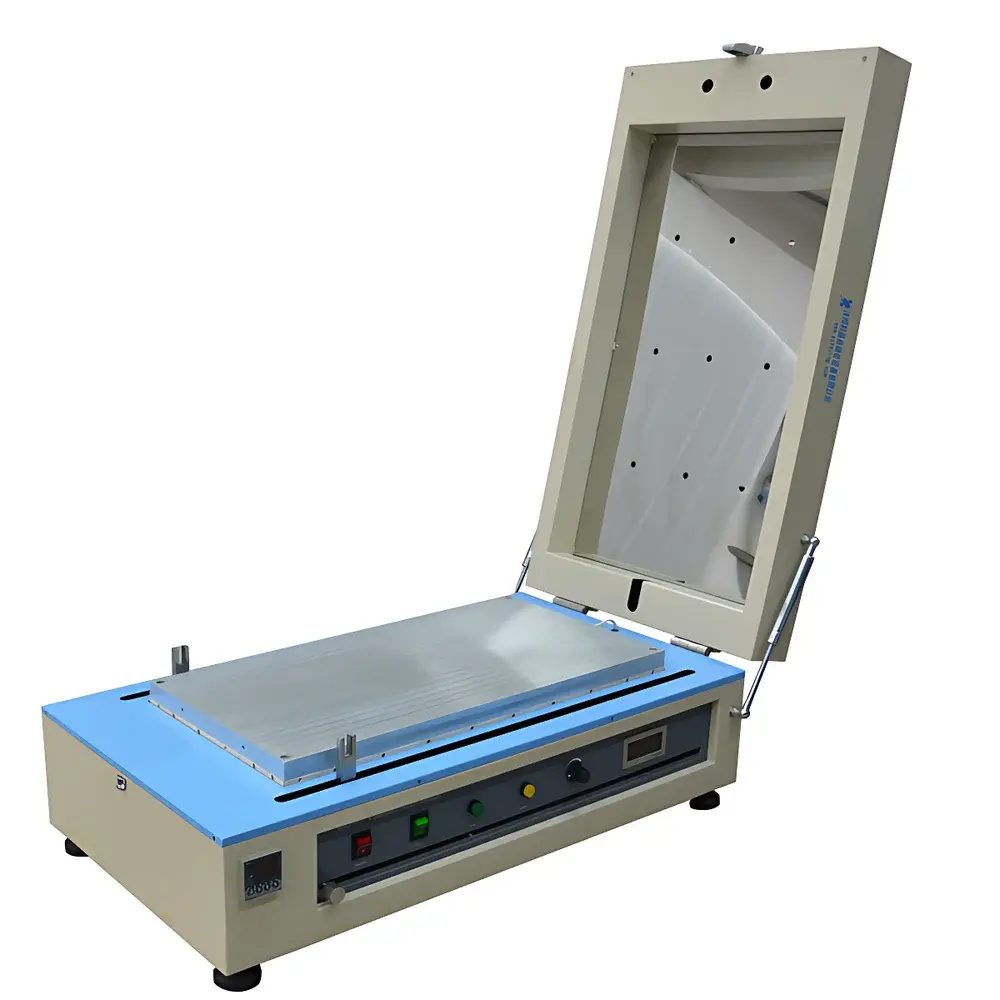
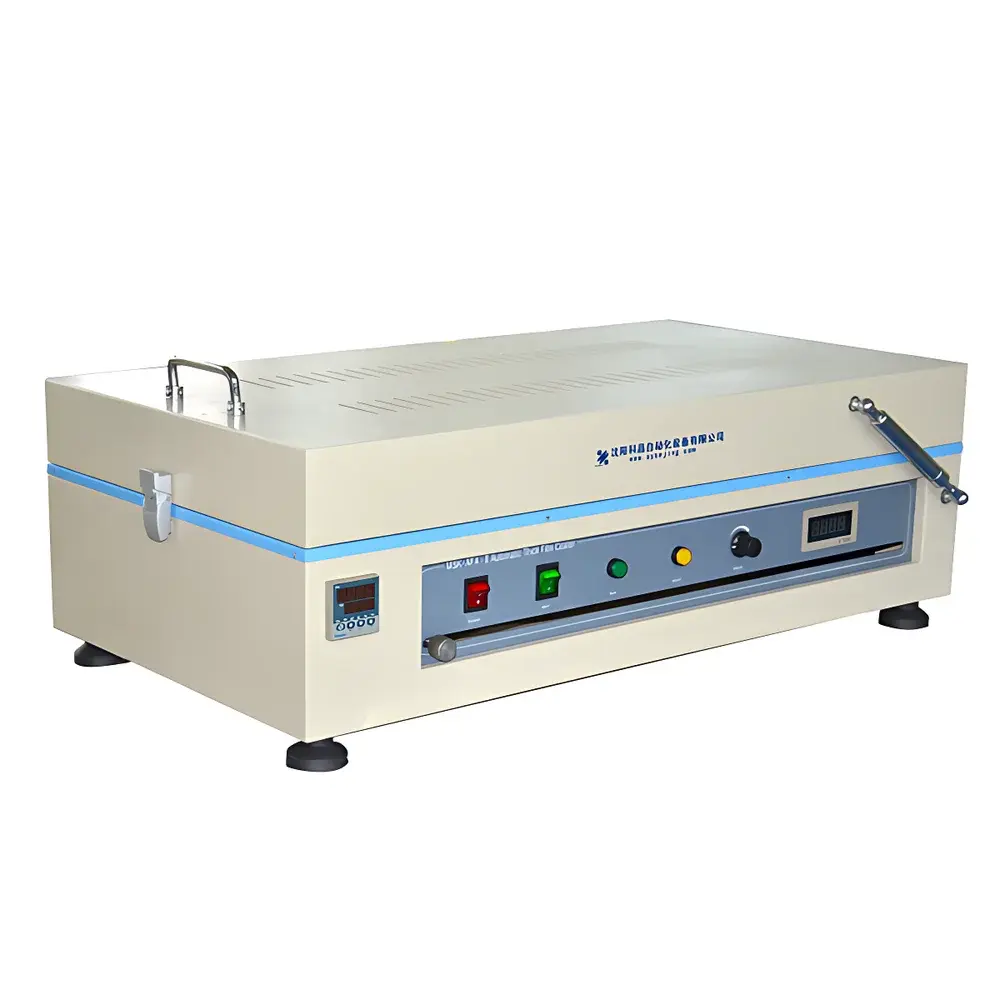
KJ GROUP MSK-AFA-IID Benchtop Automatic Doctor-Blade Coater with Integrated Vacuum-Assisted Hotplate Drying
| Brand | KJ GROUP (Shenyang Kejing) |
|---|---|
| Origin | Liaoning, China |
| Manufacturer Type | Authorized Distributor |
| Product Category | Domestic Lab-Scale Coating Equipment |
| Model | MSK-AFA-IID |
| Power Supply | AC 220 V, 50 Hz / Optional AC 110 V, 50/60 Hz |
| Total Power Consumption | 2050 W |
| Coating Base Dimensions (L×W) | 600 mm × 300 mm |
| Vacuum Adsorption Area (L×W) | 540 mm × 240 mm |
| Coating Speed | 10–100 mm/s (infinitely variable) |
| Adjustable Coating Length | 0–530 mm |
| Adjustable Doctor Blade | KTQ250 (250 mm wide, thickness adjustment range: 0–3500 µm) |
| Heating Method | Bottom-mounted vacuum-heated platen |
| Max. Heating Temperature | 120 °C |
| Temperature Control Accuracy | ±2 °C |
| Operating Environment | 0–45 °C, 10–85% RH (non-condensing) |
| Unit Dimensions (lid closed) | 850 mm × 490 mm × 320 mm |
| Unit Weight | 60 kg |
| Vacuum Requirement | External oil-free vacuum pump (e.g., AP-1400V, optional) |
Overview
The KJ GROUP MSK-AFA-IID is a precision-engineered benchtop doctor-blade coater designed for reproducible thin-film deposition of liquid or colloidal suspensions in R&D and quality control laboratories. It integrates three critical unit operations—controlled wet-film application, vacuum-assisted substrate immobilization, and in-line thermal drying—into a single compact platform. The system operates on the principle of shear-controlled film formation: a motor-driven, infinitely variable-speed carriage advances a rigid stainless-steel doctor blade across a vacuum-held substrate at precisely defined linear velocities (10–100 mm/s), enabling deterministic control over wet-film thickness and uniformity. Simultaneous bottom-heating via a digitally regulated heated platen (up to 120 °C, ±2 °C accuracy) accelerates solvent evaporation and promotes rapid, defect-minimized film consolidation—particularly advantageous for polymer solutions, battery slurries, ceramic precursors, and functional nanocomposites. Its modular architecture supports method transfer from lab-scale formulation development to pilot-line process validation.
Key Features
- Infinitely variable-speed DC motor drive ensures repeatable coating velocity control across the full 10–100 mm/s range, minimizing shear-rate-induced variability in film morphology.
- Stainless-steel adjustable doctor blade (KTQ250, 250 mm width) with micrometer-based gap adjustment (0–3500 µm), delivering high geometric consistency and long-term dimensional stability under thermal cycling.
- Vacuum-heated adsorption platen (540 mm × 240 mm active area) provides uniform substrate fixation and direct conductive heating—eliminating edge lift, bubble entrapment, and thermal gradient artifacts common in convection-dried systems.
- Integrated mechanical end-stop and automatic blade retraction mechanism enables precise, operator-independent control of coating length (0–530 mm), supporting standardized test strips and multi-zone patterning protocols.
- Sealed insulated lid functions as both dust barrier and thermal reflector, improving energy efficiency and maintaining stable ambient conditions above the coating zone during extended drying cycles.
- Modular accessory ecosystem—including optional micro-adjustable blades (50 mm to 180 mm), vacuum stirrers, viscometers, and glass substrates—facilitates cross-platform method harmonization and material compatibility testing.
Sample Compatibility & Compliance
The MSK-AFA-IID accommodates rigid and semi-rigid substrates up to 540 mm × 240 mm, including silicon wafers, metal foils, PET films, alumina plates, and conductive glass. Its vacuum adsorption system ensures flatness-critical alignment for optical, electrochemical, and structural characterization workflows. The device complies with EU Machinery Directive 2006/42/EC and carries CE marking, confirming conformity with essential health and safety requirements. While not inherently GLP/GMP-certified, its digital temperature controller with ±2 °C stability, traceable calibration interface, and programmable operation sequence support audit-ready documentation when integrated into validated laboratory workflows per ISO/IEC 17025 or ASTM D1239 (film thickness measurement) standards.
Software & Data Management
The MSK-AFA-IID operates via an embedded digital controller with LED display for real-time monitoring of platen temperature, coating speed, and operational status. Though standalone (no PC interface), all parameters are manually set and retained per session—enabling strict procedural adherence in regulated environments. For enhanced traceability, users may pair the instrument with external data loggers (e.g., USB thermocouple recorders) or integrate it into LIMS via analog output modules (optional). Temperature profiles and coating parameters are documented in standard lab notebooks or electronic batch records compliant with FDA 21 CFR Part 11 when supported by institutional SOPs.
Applications
- Battery electrode R&D: Uniform slurry coating of LiCoO₂, NMC, or Si-anode formulations onto Cu/Al foil for electrochemical performance benchmarking.
- Functional thin-film development: Deposition of perovskite precursors, conductive polymers (PEDOT:PSS), or sol-gel metal oxides for optoelectronic device prototyping.
- Quality assurance of coating formulations: Rapid assessment of viscosity-thickness correlation, leveling behavior, and drying-induced cracking thresholds.
- Membrane science: Fabrication of asymmetric polymeric membranes (e.g., PVDF, PES) with controlled skin-layer thickness and pore structure.
- Academic materials research: Teaching and validating fundamental relationships between shear rate, capillary number, and meniscus dynamics in wet-film formation.
FAQ
Does the MSK-AFA-IID include a vacuum pump?
No—the system requires an external oil-free vacuum pump (e.g., AP-1400V, sold separately) to generate the negative pressure needed for substrate immobilization.
Can the coating speed be programmed in steps or only set manually?
Coating speed is manually adjusted via potentiometer; the device does not support multi-step velocity profiles or timed ramping.
Is the heated platen temperature uniform across its entire surface?
Yes—thermal mapping confirms ≤±1.5 °C deviation across the 540 mm × 240 mm active zone at 120 °C, verified per ASTM E220 standard practices for temperature uniformity testing.
What substrate thicknesses are compatible with the vacuum adsorption system?
Substrates from 0.1 mm (flexible films) to 10 mm (rigid ceramics) are reliably held, provided surface flatness meets ISO 10791-7 tolerances for vacuum contact.
Are calibration certificates available for the temperature controller?
Factory calibration is performed against NIST-traceable references; users may request third-party calibration documentation at time of order or during annual maintenance.



