
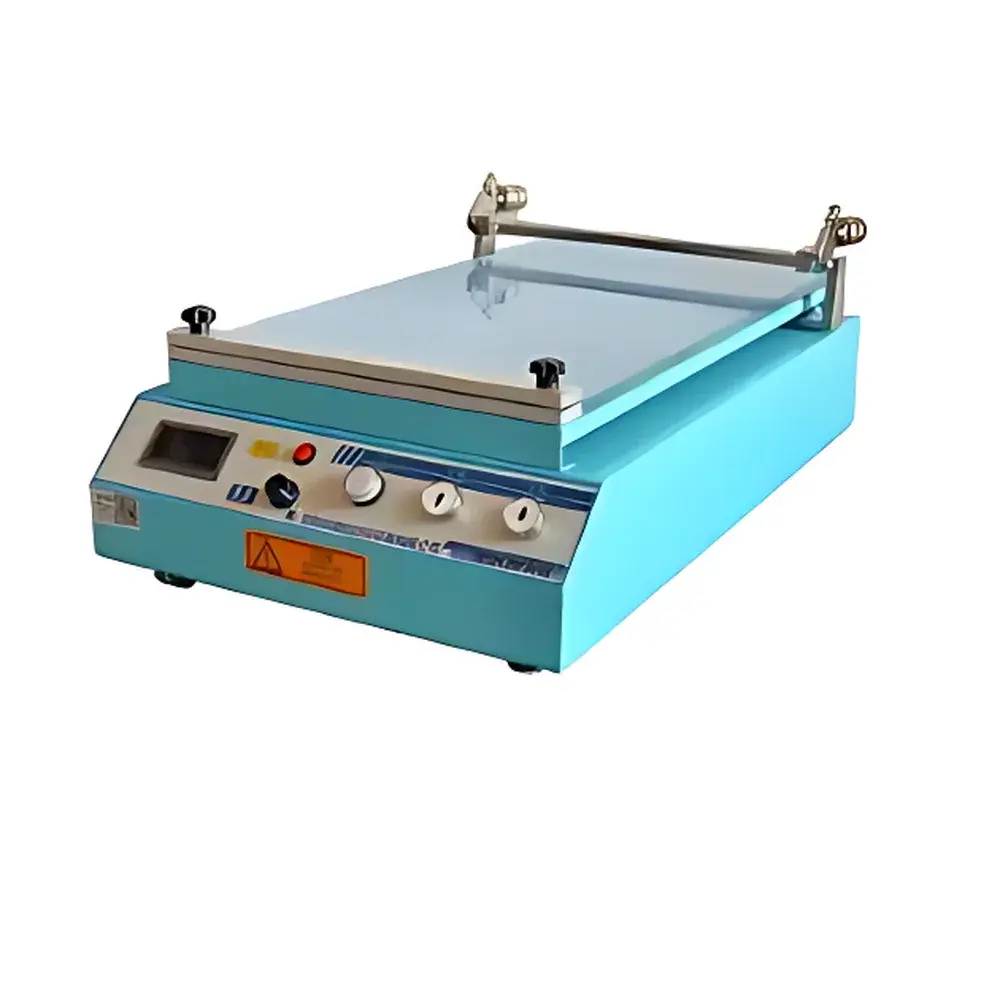
KJ GROUP MSK-AFA-IV Benchtop Precision Coating Machine
| Brand | KJ GROUP |
|---|---|
| Origin | Liaoning, China |
| Model | MSK-AFA-IV |
| Power Supply | AC 220 V, 50 Hz |
| Total Power Consumption | 48 W |
| Coating Speed Range | 0–1200 mm/min (adjustable via rotary knob with digital display) |
| Coating Accuracy | ±1 µm |
| Maximum Coating Area | 300 mm × 420 mm |
| Roller Dimensions | Ø12 mm × 400 mm |
| Adjustable Film Thickness Range | 12–200 µm (dependent on selected precision coating rod) |
| Optional Adjustable Thickness Doctor Blade | 5–200 µm (1 µm resolution) |
| Operating Environment | Altitude <1000 m |
| Footprint | 710 mm (L) × 420 mm (W) × 300 mm (H) |
| Net Weight | 20 kg |
| Electrical Requirement | Grounded AC 220 V, 50 Hz only |
| Mechanical Safety | Dual-end limit switches for automatic stop |
Overview
The KJ GROUP MSK-AFA-IV Benchtop Precision Coating Machine is an electromechanically integrated laboratory-scale film deposition system engineered for reproducible, uniform thin-film fabrication on rigid and flexible substrates. It operates on the principle of doctor-blade (or metering-rod) coating—where a precisely machined cylindrical roller or adjustable blade controls the wet-film thickness by shearing excess material from the substrate surface during linear translation. This method ensures high volumetric transfer efficiency and eliminates variability introduced by manual techniques such as spin-coating or bar-coating without mechanical constraint. Designed specifically for R&D environments, the MSK-AFA-IV delivers sub-micrometer repeatability in film thickness control across small-area substrates (up to 300 × 420 mm), making it suitable for prototyping functional layers in battery electrode development, optical coatings, printed electronics, polymer film characterization, and pharmaceutical film dosage studies.
Key Features
- Precision-adjustable coating speed (0–1200 mm/min) via calibrated rotary encoder, with real-time digital readout for traceable process documentation.
- Interchangeable precision-coated rollers (standard Ø12 × 400 mm) enabling discrete film thickness selection from 12 µm to 200 µm—each roller manufactured to ISO 2768-mK dimensional tolerances and surface roughness Ra ≤ 0.4 µm.
- Optional continuously adjustable doctor blade unit (5–200 µm range, 1 µm resolution) for fine-tuning without hardware swap—ideal for iterative formulation screening.
- Integrated end-limit switches at both travel extremes ensure repeatable stroke length and prevent over-travel damage to rollers or substrates.
- Industrial-grade imported control components—including sealed potentiometers, brushless DC drive motor, and reinforced aluminum alloy frame—guarantee long-term operational stability under daily lab use.
- Compact footprint (710 × 420 × 300 mm) and low power draw (48 W) allow integration into standard fume hoods or gloveboxes without HVAC load concerns.
Sample Compatibility & Compliance
The MSK-AFA-IV accommodates a broad range of substrate types including silicon wafers, glass slides, PET/PI films, aluminum foil, copper foil, paperboard, and ceramic substrates up to 3 mm thickness. Its open-frame architecture permits easy loading/unloading of irregular or oversized samples within the defined work envelope. All electrical components comply with IEC 61000-6-3 (EMI emission) and IEC 61000-6-2 (immunity) standards. While not certified for Class I Div 1 hazardous locations, the device meets general-purpose laboratory safety requirements per UL 61010-1 and GB 4793.1. When used in regulated environments (e.g., GLP-compliant battery materials testing), the digital speed display and mechanical repeatability support audit-ready process records aligned with ISO/IEC 17025 clause 7.7 (result reporting) and ASTM D823 (practice for producing films of uniform thickness).
Software & Data Management
The MSK-AFA-IV operates as a standalone analog-digital hybrid system with no embedded firmware or proprietary software dependency. Speed calibration is performed mechanically and verified using NIST-traceable linear displacement sensors during factory acceptance testing. For laboratories requiring electronic data capture, the analog speed signal output (0–10 V DC) can be interfaced with third-party DAQ systems (e.g., National Instruments USB-6009) to log velocity profiles synchronized with environmental monitoring or in-line metrology tools. No FDA 21 CFR Part 11 compliance features are included—users implementing electronic records must apply institutional validation protocols per their SOPs.
Applications
- Electrode slurry coating for lithium-ion battery R&D (anode/cathode layer optimization, binder distribution analysis).
- Functional polymer film deposition for flexible electronics (PEDOT:PSS, PVDF-HFP, conductive nanocomposites).
- Optical interference layer preparation on glass or quartz substrates (anti-reflective, AR, or high-refractive-index stacks).
- Pharmaceutical film-coating trials for immediate-release or controlled-release tablet formulations (per USP <1217>).
- Calibration verification of profilometers and ellipsometers using reference-thickness polymer films.
- Academic thin-film physics experiments involving solvent evaporation kinetics, Marangoni flow visualization, and meniscus dynamics.
FAQ
What substrates can be coated with the MSK-AFA-IV?
Rigid (glass, silicon, metal foils) and flexible (PET, PI, paper) substrates up to 3 mm thick and within 300 × 420 mm dimensions are compatible.
Is vacuum or inert atmosphere operation supported?
No built-in vacuum or gas-purged chamber is provided; however, the unit may be installed inside externally maintained gloveboxes or vacuum chambers if structural mounting provisions are adapted.
How is film thickness accuracy validated?
Thickness repeatability (±1 µm) is verified using calibrated stylus profilometry (e.g., Bruker Dektak XT) on three replicate coatings per roller, per ASTM E1077.
Can custom roller geometries be supplied?
Yes—KJ GROUP offers OEM machining of specialty rollers (e.g., grooved, knurled, or tapered) upon provision of dimensional drawings and material specifications.
Does the device meet CE or UL certification requirements?
It complies with applicable IEC safety standards; formal CE marking is not applied due to regional regulatory classification as non-medical, non-explosive lab equipment.



