
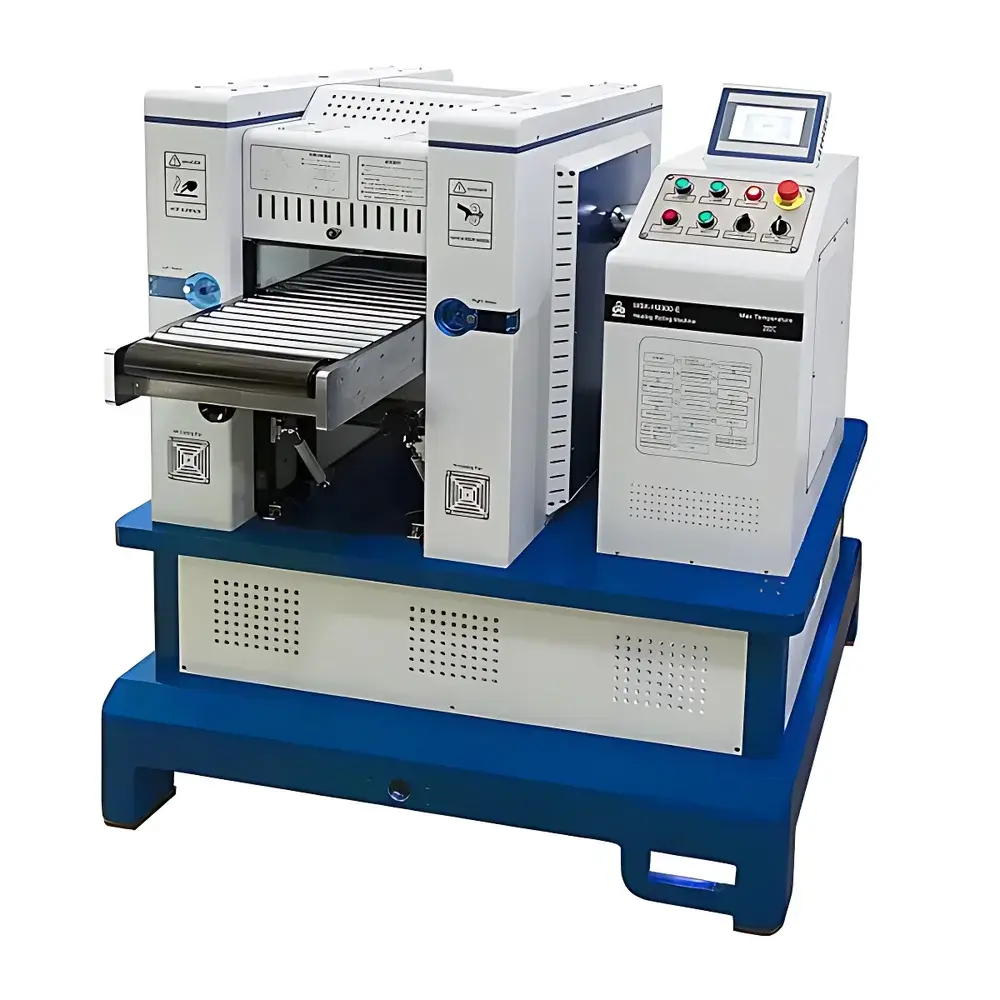
KJ GROUP MSK-H2300-E Electrically Heated Two-Roll Mill
| Brand | KJ GROUP |
|---|---|
| Origin | Liaoning, China |
| Manufacturer Type | Authorized Distributor |
| Country of Origin | China |
| Model | MSK-H2300-E |
| Pricing | Upon Request |
| Power Supply | 3×380 VAC ±10%, 50 Hz, 8.5 kW |
| Drive Motor | 1 kW Variable-Frequency Motor |
| Roll Diameter | Ø200 mm |
| Roll Surface Hardness | HRC 60–62 (case depth >10 mm |
| Roll Gap Range | 0–1.5 mm (stepper motor–driven |
| Maximum Rolling Speed | 4 m/min |
| Maximum Roll Temperature | 200 °C (control accuracy ≤±2 °C) |
| Maximum Roll Width | 300 mm |
| Thickness Control Accuracy | Better than ±1.5 µm (subject to incoming material uniformity ≤±1.5 µm) |
| Preheating | Infrared preheater, max 120 °C (adjustable) |
| Hydraulic System | Rated pressure 15 tons (software-locked extension to 20 tons available upon authorization) |
| Cold Rolling Module Option | Up to 50 tons (separate cold-roll assembly) |
| Dimensions (L×W×H) | 1290 × 1020 × 1400 mm |
| Net Weight | ~1300 kg |
Overview
The KJ GROUP MSK-H2300-E Electrically Heated Two-Roll Mill is an industrial-grade calendering system engineered for precision thermal rolling of flexible sheet and coil materials. It operates on the principle of controlled compressive deformation between two parallel, counter-rotating rolls—where one or both rolls are electrically heated and actively temperature-regulated via segmented PID-controlled zones. Unlike oil-heated systems, its direct resistive heating architecture eliminates hydraulic fluid contamination risks, ensuring process purity critical for battery electrode manufacturing, thin-film composites, and high-purity metal foils. The mill integrates a hydraulically actuated, self-balancing pressure system with real-time load monitoring, enabling stable force application across the full 300 mm working width. Its modular roll design supports rapid reconfiguration between hot-rolling (max 20 tons) and cold-rolling (max 50 tons) configurations, making it suitable for R&D scale-up, pilot-line production, and quality assurance testing in regulated environments.
Key Features
- Patented electrically heated rolls with multi-zone intelligent temperature control—achieving ±2 °C uniformity across the 200 mm diameter surface at up to 200 °C.
- Mechanical gap compensation structure eliminating thermal drift-induced thickness variation; enables repeatable sub-micron gap resolution (≤±1.5 µm).
- Rolls fabricated from imported high-carbon, low-alloy tool steel (HRC 60–62, case depth >10 mm), validated for <5% hardness degradation after prolonged 200 °C operation.
- Integrated infrared preheating stage (0–120 °C, adjustable) upstream of the nip zone—reducing thermal shock and improving interfacial adhesion in coated foils.
- PLC-based control architecture with HMI touchscreen interface supporting recipe management, parameter logging, and alarm history.
- Hydraulic pressure system with closed-loop feedback and auto-compensation—maintains constant force during thermal expansion cycles; rated at 15 tons (extendable to 20 tons via authorized firmware unlock).
- Stepper-motor-driven gap adjustment with absolute position encoding—enabling programmable thickness reduction profiles and automated pass scheduling.
- Modular roll assembly design allows field replacement of heating elements, bearings, or entire roll sets without disassembling the frame.
- Full-surface guarding, thermal insulation shrouds, and surface temperature sensors comply with IEC 60204-1 safety requirements for industrial machinery.
- Optional integrated feed platform with tension-controlled unwinding and winding modules—enabling continuous roll-to-roll processing of Li-ion anode/cathode foils, conductive polymer films, and laminated metal composites.
Sample Compatibility & Compliance
The MSK-H2300-E accommodates a broad spectrum of flexible substrates including copper/aluminum foil (coated or uncoated), Ag/Au thin foils (≥0.1 mm thick), thermoplastic resin films (e.g., PVDF, PI), carbon-coated electrodes, and multilayer laminates. Its 300 mm maximum width and 0–1.5 mm adjustable gap support common electrode calendering workflows per ISO 18567 (electrode coating characterization) and ASTM F3020 (battery material compaction testing). All electrical components meet CE marking requirements under the Low Voltage Directive (2014/35/EU) and EMC Directive (2014/30/EU). Data acquisition functions—including real-time pressure, temperature, speed, and gap position—support GLP-compliant documentation when paired with external audit-trail-capable SCADA systems. While not intrinsically certified for Class I Div 1 hazardous locations, it may be deployed in non-classified lab or cleanroom environments compliant with ISO 14644-1 Class 7 or better.
Software & Data Management
The embedded Siemens S7-1200 PLC executes deterministic motion and thermal control loops with cycle times <10 ms. Operational parameters—including setpoints, actual values, timestamps, and fault codes—are logged internally at user-defined intervals (100 ms to 10 s) and exportable via USB or Ethernet to CSV or SQLite formats. Optional OPC UA server integration enables bidirectional communication with MES platforms (e.g., Siemens Opcenter, Rockwell FactoryTalk) for traceability in GMP-aligned battery manufacturing facilities. All calibration constants (e.g., load cell gain, thermocouple offset) are stored in protected memory with password-protected write access—fulfilling basic data integrity expectations aligned with FDA 21 CFR Part 11 Annex 11 principles when used in conjunction with validated IT infrastructure.
Applications
- Lithium-ion battery electrode densification: Calendering of NMC, LFP, graphite, and silicon-carbon composite coatings on Cu/Al current collectors to achieve target porosity (30–40%), density (>2.2 g/cm³), and adhesion strength (≥0.5 N/mm per ASTM D3359).
- Functional thin-film fabrication: Thermal consolidation of conductive ink layers (Ag nanowire, CNT dispersion) on PET or PI substrates for flexible electronics.
- Metallurgical foil processing: Thickness homogenization and surface planarization of precious metal foils (Au, Ag) prior to sputtering or electroplating.
- Composite laminate development: Interlayer bonding enhancement in polymer/metal hybrid tapes used in aerospace thermal management sheets.
- R&D process mapping: Empirical correlation of rolling force, temperature, and dwell time with post-calendering properties (tensile modulus, electrical conductivity, peel strength).
FAQ
What is the maximum continuous operating temperature of the heated rolls?
The rolls are rated for continuous operation at 200 °C, with thermal stability maintained within ±2 °C across the full surface area.
Can the machine be integrated into an existing roll-to-roll line?
Yes—the MSK-H2300-E supports standard 0–10 V analog I/O and Modbus TCP protocols; mechanical interfaces (web guiding, dancer rollers, tension sensors) require custom mounting brackets.
Is the 50-ton cold-rolling capability available as a factory-installed option?
The 50-ton cold-rolling module is a mechanically distinct assembly requiring separate foundation reinforcement and hydraulic power unit upgrade; quotation and lead time must be confirmed prior to order.
Does the system support automated thickness feedback control?
Not natively—the current configuration provides open-loop gap positioning; closed-loop thickness control requires integration with an external laser micrometer (e.g., Keyence IL-1000) and custom PLC logic.
Are calibration certificates provided for load cells and temperature sensors?
Factory calibration reports (traceable to NIST-equivalent national standards) are included; ISO/IEC 17025-accredited third-party calibration is available as an add-on service.



