
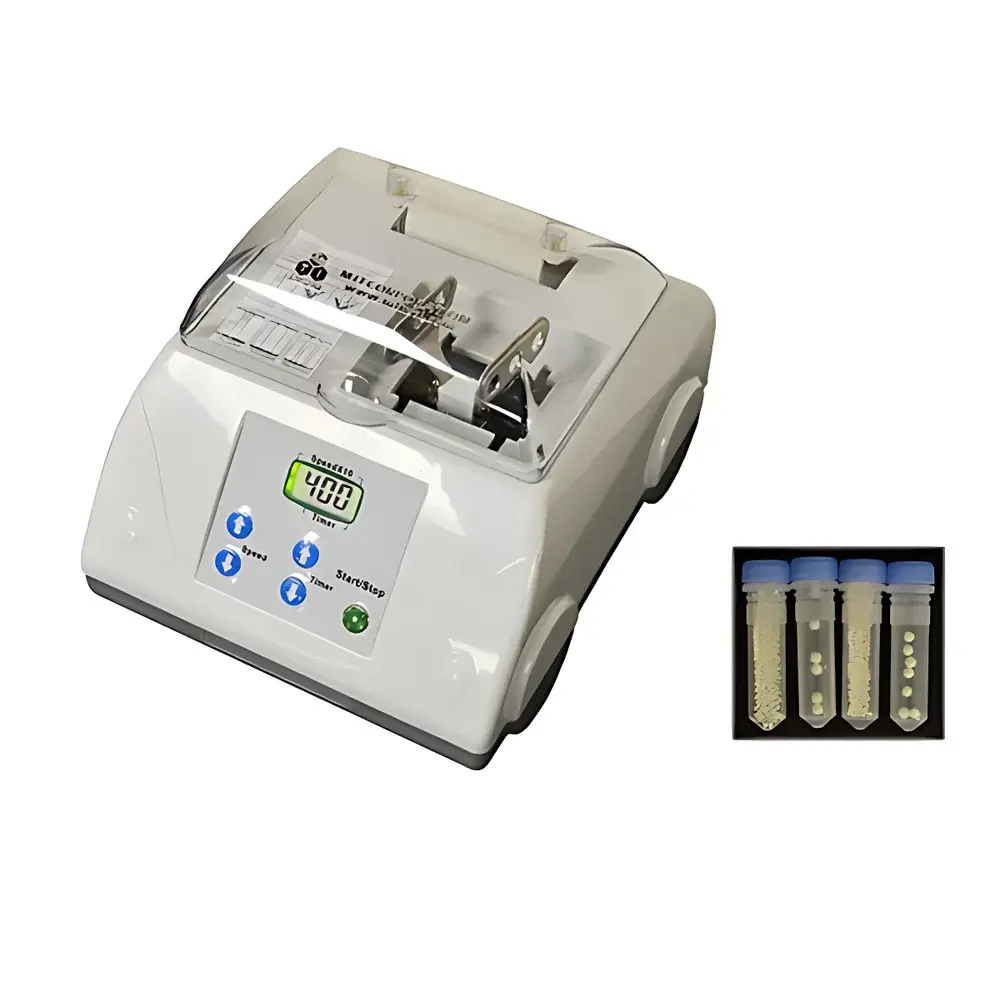
KJ GROUP MSK-SFM-12M Micro Vibratory Ball Mill
| Brand | KJ GROUP |
|---|---|
| Origin | Liaoning, China |
| Manufacturer Type | Authorized Distributor |
| Country of Origin | China |
| Model | MSK-SFM-12M |
| Power Supply | 208–240 V AC, 50 Hz |
| Speed Range | 2700–4000 rpm |
| Timer Range | 3–180 s |
| Sample Vial Capacity | 2 mL (screw-cap microtube) |
| Dimensions (W×D×H) | 170 × 210 × 135 mm |
| Weight | 2.2 kg |
| Standard Zirconia Beads | Ø0.1, Ø0.5, Ø1.0, Ø1.5, Ø3.0 mm (10 pcs each) |
| Sample Throughput | Up to 3 vials simultaneously |
Overview
The KJ GROUP MSK-SFM-12M Micro Vibratory Ball Mill is a compact, high-energy laboratory-scale milling system engineered for rapid, reproducible homogenization and mechanical alloying of small-volume solid samples. Unlike conventional planetary or mortar-based mills, the MSK-SFM-12M operates on the principle of high-frequency vibrational impact—where kinetic energy is transferred from oscillating zirconia beads to sample material within sealed, disposable 2 mL screw-cap microtubes. This mechanism enables efficient particle size reduction, dispersion, and solid-state reaction initiation in timeframes as short as 45 seconds per batch. Designed specifically for laboratories handling limited sample quantities—such as R&D labs developing battery cathode precursors, pharmaceutical co-crystals, nanocomposites, or forensic trace evidence—the instrument delivers consistent mechanical energy input with minimal cross-contamination risk and no requirement for clamping fixtures or solvent media.
Key Features
- High-speed vibratory drive system delivering adjustable rotational speeds from 2700 to 4000 rpm, enabling precise control over impact energy density.
- Simultaneous processing of up to three independent 2 mL screw-cap microtubes, ensuring parallel sample treatment without thermal or mechanical crosstalk.
- Integrated digital timer with programmable range from 3 to 180 seconds, supporting repeatable process validation and method transfer across users and shifts.
- Standard inclusion of five grades of high-purity yttria-stabilized zirconia (YSZ) beads (Ø0.1, Ø0.5, Ø1.0, Ø1.5, and Ø3.0 mm), selected for exceptional hardness (>1200 HV), fracture toughness, and chemical inertness against acidic, basic, or reducing environments.
- Compact footprint (170 × 210 × 135 mm) and lightweight design (2.2 kg) facilitate integration into fume hoods, gloveboxes, or shared instrumentation benches without structural reinforcement.
- Robust aluminum alloy housing with vibration-damping base minimizes operational noise and prevents resonance-induced drift during extended runs.
Sample Compatibility & Compliance
The MSK-SFM-12M accommodates a broad spectrum of dry or low-moisture solid materials—including metal oxides, intermetallics, polymers, ceramics, pharmaceutical actives, and geological powders—provided they are compatible with zirconia’s surface chemistry and thermal stability limits (<600 °C). The use of disposable polypropylene or PTFE-lined microtubes eliminates cleaning validation requirements and supports GLP-compliant workflows where sample integrity and chain-of-custody are critical. While not certified to ISO/IEC 17025 or ASTM E2921 as a standalone analytical instrument, the mill’s mechanical repeatability and timer accuracy align with internal method qualification protocols required under USP , ISO 13320 (for subsequent particle size analysis), and FDA 21 CFR Part 11 when paired with compliant data acquisition software.
Software & Data Management
The MSK-SFM-12M operates via an embedded microcontroller interface with no external PC dependency; however, it supports manual documentation of run parameters (speed, duration, bead size, tube lot number) in laboratory notebooks or LIMS-integrated electronic records. For audit-trail compliance, users may integrate the device into validated SOPs requiring timestamped operator entries, equipment ID logging, and raw parameter archiving. Optional firmware upgrades (available through KJ GROUP technical support) may introduce USB data export functionality for future compatibility with centralized QC databases.
Applications
- Mechanical activation of LiCoO₂, NMC, or sulfur composites prior to electrochemical testing.
- Preparation of amorphous drug formulations via solvent-free mechanochemistry.
- Rapid homogenization of heterogeneous catalyst supports (e.g., Pt/CeO₂ mixtures) for TEM-EDS mapping consistency.
- Trace-level mixing of forensic standards with matrix-matched reference materials.
- Small-batch synthesis of metal–organic frameworks (MOFs) under ambient conditions.
- Particle size narrowing of quantum dot precursors prior to colloidal stabilization.
FAQ
What is the maximum recommended operating temperature for the microtubes during milling?
The standard polypropylene microtubes are rated for continuous use up to 100 °C; exothermic reactions exceeding this threshold require PTFE- or quartz-lined alternatives.
Can the MSK-SFM-12M be used for cryogenic milling?
No—this model lacks integrated cooling capability or cryo-adapted drive components; low-temperature operation requires external cold-stage integration and validated tube material selection.
Is calibration required before first use or at scheduled intervals?
The device does not require user-performed calibration; speed and timer accuracy are factory-verified per IEC 61000-4-30 and documented in the Certificate of Conformance supplied with each unit.
How is cross-contamination prevented between sequential runs?
Through exclusive use of single-use microtubes and zirconia beads—no wet cleaning or ultrasonic decontamination is necessary, eliminating carryover risk inherent in reusable grinding chambers.
Does KJ GROUP provide application-specific method development support?
Yes—qualified applications engineers offer remote protocol optimization guidance, including bead-to-sample mass ratio recommendations, energy dose estimation (kWh/kg), and empirical correlation to downstream XRD or BET results.



